
 KOR
KOR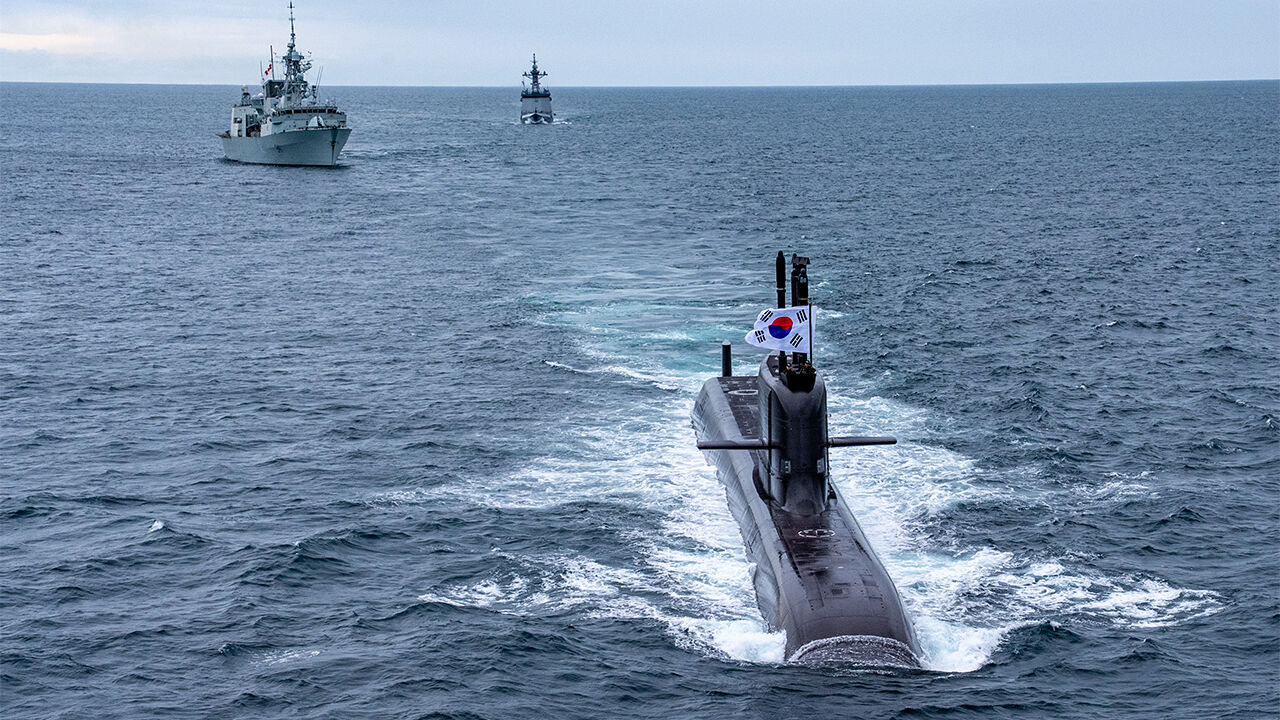
▲ South Korea-Canada Joint Naval Cooperation Exercise
Analysts suggest that South Korea's failure to secure Canada's Patrol Submarine Project (CPSP), valued at up to 60 trillion won, was ultimately due to the NATO alliance between Canada and Germany.
According to industry sources on July 7, Hanwha Ocean had been evaluated as being on par with Germany's ThyssenKrupp Marine Systems (TKMS)—the company selected as the preferred bidder—in terms of technical capabilities.
The 3,600-ton Jangbogo-III Batch-II submarine proposed by Hanwha Ocean is a platform that has already been built and is currently in operation.
Its predecessor, the Dosan Ahn Changho submarine (Jangbogo-III Batch-I), demonstrated long-range operational capability and interoperability with the Canadian Navy by sailing 14,000 km from Jinhae through Guam and Hawaii to a naval base in western Canada.
In contrast, the Type 212CD submarine proposed by TKMS, while incorporating next-generation combat systems, was still in the design phase with no physical prototype.
Delivery competitiveness was also a strength for Hanwha Ocean.
Hanwha Ocean proposed a plan to deliver one vessel annually starting in 2035, while TKMS was reportedly only able to begin deliveries from 2036.
With Canada needing to replace four Victoria-class submarines scheduled for retirement in 2035, the ability to achieve early operational capability was considered a key competitive advantage for the South Korean side.
Nevertheless, Canada's choice of Germany is interpreted as a result of strategic considerations outweighing submarine performance or delivery schedules.
Both Germany and Canada are key NATO members that have maintained military, security, and economic cooperation across the Atlantic.
Norway, which partnered with Germany for the submarine bid, is also a NATO member.
In its announcement, the Canadian government stated that the goal of the project, alongside protecting Canadian sovereignty, is "collective security with allies, including NATO," and emphasized that the project would make a significant contribution to meeting NATO's goal of increasing defense spending to 5% of GDP by 2035.
Throughout the bidding process, Germany leveraged its long-standing cooperation through NATO, as well as TKMS's track record in submarine construction.
The fact that many NATO member countries operate German-made submarines also appears to have worked in Germany's favor regarding joint operations, maintenance, and training.
TKMS emphasized its experience in European defense cooperation and NATO operations, based on the Type 212CD submarine family used by Germany and Norway.
An official from the defense industry said, "From Canada's perspective, if there is no significant difference in performance, they may prioritize interoperability within NATO and relations with allies."
This project is the largest defense procurement in Canadian history, involving the acquisition of up to 12 new multi-purpose diesel submarines.
The submarine contract alone is worth approximately 20 trillion won, and the total project scale is estimated to reach up to 60 trillion won when including maintenance, repair, and overhaul (MRO) over the next 30 years.
South Korea launched an all-out public-private effort to win this bid.
Hanwha Ocean promised over 70 billion Canadian dollars (75 trillion won) in trade and investment between 2026 and 2044, along with more than 25,000 jobs annually.
Hanwha has signed MOUs with 67 local companies and government agencies, including PCL Construction, BlackBerry, and Ontario shipyards.
The South Korean government also provided support by proposing billions of dollars in incentives for what is known as "Project Beaver," which includes the production of hydrogen fuel cell trucks and the construction of related infrastructure in Canada.
Chief of Staff to the President Kang Hoon-sik visited Canada earlier this year with a special delegation including Minister of Trade, Industry and Energy Kim Jeong-gwan and Hyundai Motor Group Executive Chair Euisun Chung to support the submarine bid.
Both Chief of Staff Kang and Minister Kim recently visited Canada again to request support for the bid.
They also presented a cooperation plan that included the construction of a hydrogen vehicle manufacturing plant and charging station infrastructure by Hyundai Motor Group.
Germany also countered by proposing plans to build local supply chains, transfer technology, and foster an industrial ecosystem.
TKMS signed a contract with Canadian specialty steel company Valbruna ASW to order special steel for the next-generation submarines.
The German Defense Minister previously stated that the TKMS proposal would generate a GDP increase of 86 billion Canadian dollars (92 trillion won) over the project period.
Germany and Norway even offered to adjust the volume of submarines destined for their own navies to deliver them to Canada first.
Throughout the selection process, Canada presented not only performance but also maintenance, logistics support, price, and economic and strategic cooperation as key evaluation factors.
Some in the industry suggest that Canada utilized the competition between South Korea and Germany to extract the maximum possible economic benefits and industrial cooperation conditions.
However, it is noted that Hanwha Ocean's achievements despite this loss are not insignificant.
Last August, Hanwha Ocean was selected for the final shortlist alongside TKMS, beating out major European defense firms such as France's Naval Group, Spain's Navantia, and Sweden's Saab.
Analysts say this achievement demonstrates that the South Korean submarine industry possesses world-class competitiveness.
(Photo: Provided by ROK Navy, Yonhap News)
※ Please note: This article was translated by AI and may contain errors.



 Video News
 Video News

 Video News