
 KOR
KOR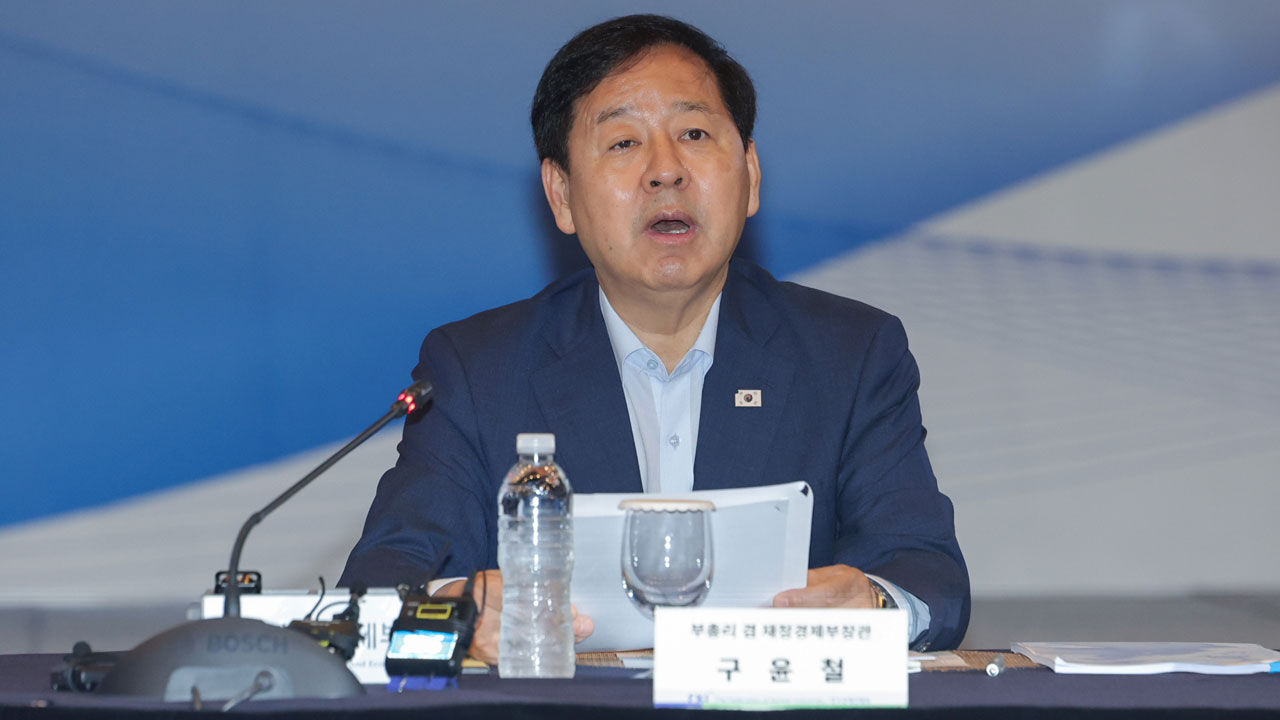
▲ Deputy Prime Minister and Minister of Economy and Finance Koo Yun-cheol delivers opening remarks at the 2nd meeting of the Task Force for Strengthening Service Industry Competitiveness, held at the Westin Josun Seoul in Jung-gu, Seoul, on July 6.
Deputy Prime Minister and Minister of Economy and Finance Koo Yun-cheol emphasized today (July 6) that "the enactment of the Service Industry Development Act is urgent to boldly open up barriers between industries and provide intensive support for research and development (R&D), taxation, and finance."
During his opening remarks at the 2nd meeting of the Task Force for Strengthening Service Industry Competitiveness held at the Westin Josun Hotel in Jung-gu, Seoul, today, Deputy Prime Minister Koo stated, "It is time to redraw the blueprint for the development of the service industry."
He noted, "The Lee Jae-myung administration is pursuing three major mega-projects centered on semiconductors, AI data centers, and physical AI," and stressed that "to achieve a great economic leap forward, it is crucial to enhance the competitiveness of the service industry, which accounts for 60% of the gross domestic product (GDP)."
Deputy Prime Minister Koo assessed that "the service industry is currently facing a great transformation period where it meets AI, leading to 'convergence with manufacturing,' 'innovation in public services,' and a 'major transformation of daily life'."
He stated that the government would promptly prepare measures to secure a leading position in fields such as the AI agentic commerce market related to shopping, mobility services related to AI autonomous driving, and public services.
"We need the Service Industry Development Act, which provides the legal basis to foster the entire industry through systematic development planning and integrated governance that breaks down silos," Koo said, adding, "We must also pursue bold regulatory rationalization."
Ryu Jin, Chairman of the Federation of Korean Industries (FKI), said in his welcoming remarks, "We must cultivate the service industry as a central pillar of our national growth strategy alongside manufacturing," and diagnosed that "the advancement of the service industry is a key task for opening the era of New K-Industry."
He continued, "Just as the Heavy and Chemical Industry Promotion Committee in the 1970s laid the foundation for the growth of the manufacturing industry, the Service Industry Development Act must now become the institutional foundation for the leap of the service industry."
Ryu, who leads the FKI as the chairman of the defense manufacturing company Poongsan, also made remarks suggesting plans to contribute to the service industry by building a world-class golf course in his hometown of Andong, North Gyeongsang Province.
"Although Poongsan is a manufacturing company, we are very interested in strengthening the competitiveness of the service industry," he said.
The meeting included discussions on agendas such as ▲ The K-Service Industry Development Strategy in the Era of AI and Convergence (Kwon Nam-hoon, President of the Korea Institute for Industrial Economics & Trade), ▲ Industrial Growth and Global Expansion Strategy for K-Culture (Professor Shim Sang-min of Sungshin Women's University), and ▲ Policy Proposals for Revitalizing the Service Industry (Heo Min-heoi, CEO of CJ).
President Kwon stated that the service industry accounts for 70% of domestic employment and 60% of value-added, and proposed three major development strategies: vitalizing exports, rationalizing the value of domestic demand, and global leadership in new services.
Professor Shim Sang-min emphasized that for the sustainable growth of K-Culture, it is necessary to innovate production, investment, and distribution, along with promoting integrated policies and shifting cultural perceptions.
Heo Min-heoi, CEO of CJ and Chairman of the FKI's Service Industry Competitiveness Strengthening Committee, represented the corporate sector and proposed 20 tasks, including ▲ the enactment of the Service Industry Development Act, ▲ vitalizing financial support for K-content, ▲ expanding tax credits for post-production of videos, and ▲ improving standard terms and conditions for non-face-to-face delivery services.
The Ministry of Economy and Finance stated, "We plan to actively utilize the content discussed today in identifying and establishing policy tasks related to the service industry."
(Photo: Yonhap News)
※ Please note: This article was translated by AI and may contain errors.


 Video News


 Video News
 Video News