
 KOR
KOR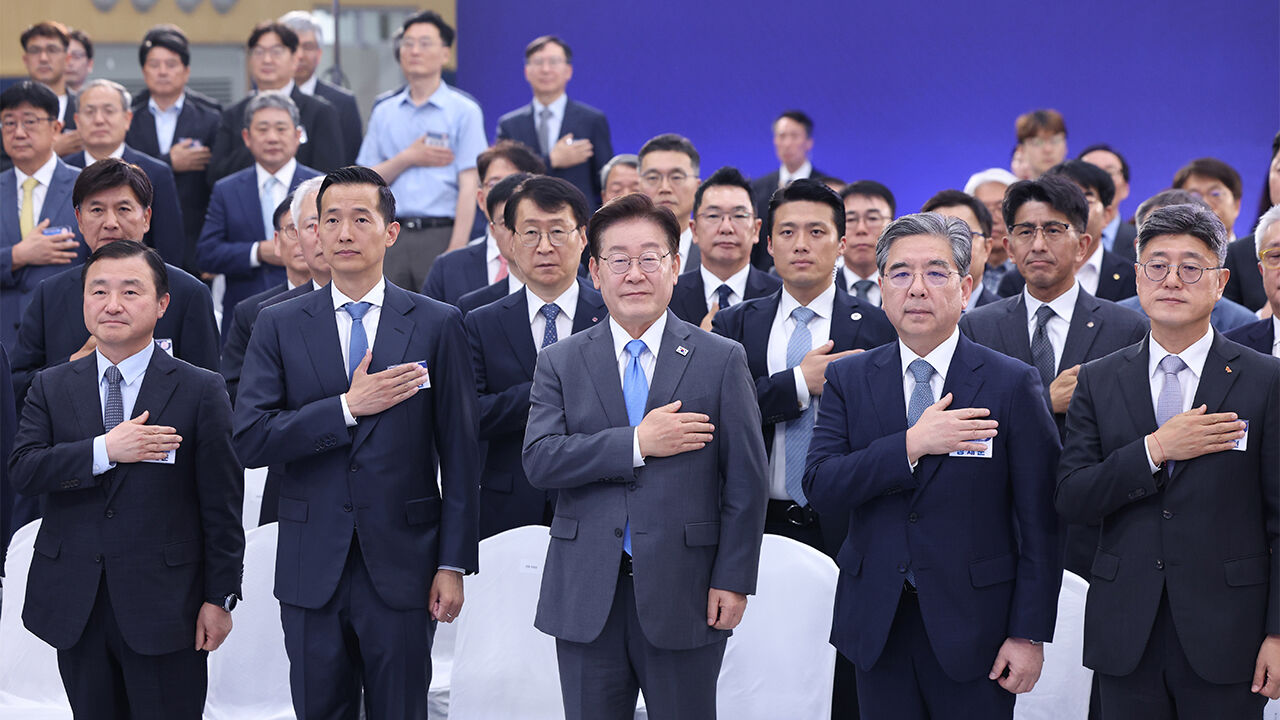
▲ From left: Roh Tae-moon, President and Head of Mobile eXperience Business at Samsung Electronics; Kim Dong-kwan, Vice Chairman of Hanwha Group; President Lee Jae-myung; Chang Jae-hoon, Vice Chairman of Hyundai Motor Group; and Jung Jae-heon, CEO of SK Telecom.
Hyundai Motor Group has announced plans to invest a total of 42 trillion won over the next 10 years, starting this year, to transform the Yeongnam region into the group's global hub for advanced industries.
The group plans to focus its capabilities on establishing an AI-based Dedicated Vehicle (AI DV) hub, a core components cluster, and energy infrastructure, while also driving innovation in AI-based manufacturing and the aerospace sector.
Chang Jae-hoon, Vice Chairman of Hyundai Motor Group, unveiled these investment plans today (July 3) at the National Report Meeting on the Development Vision for Advanced Industries in the Yeongnam Region, held in Jinju, South Gyeongsang Province.
First, the group will transform the Hyundai Motor Ulsan plant, the world's largest single automobile manufacturing facility, into a key base for the future mobility industry.
The vision includes building an AI DV manufacturing hub equipped with state-of-the-art automation and integrated production systems, including the Ulsan electric vehicle (EV) plant scheduled to begin operations in the fourth quarter of this year.
AI DV refers to vehicles where AI learns and makes decisions on its own based on vehicle data.
Hyundai Motor Group is currently advancing its technology to Level 4 autonomous driving, which is equivalent to the level of robotaxis.
The Ulsan hydrogen fuel cell plant will serve as a strategic production base to support the expansion of hydrogen mobility and clean energy industries.
The group plans to foster the next-generation hydrogen fuel cells and polymer electrolyte membrane (PEM) water electrolyzers produced at this facility as key export products.
The supply chain for components will also be strengthened.
By 2030, the group plans to establish new production lines, including a Hyundai Mobis battery system assembly line in Ulsan, a Hyundai Mobis motor and controller production line in Daegu, and a Hyundai Wia thermal management system production line for EVs in Changwon, South Gyeongsang Province.
Hyundai Motor Group has decided to use the Yeongnam region, where its manufacturing bases are concentrated, as a hub for demonstrating and expanding intelligent factories based on manufacturing-specialized AI.
These are factories where AI independently judges and optimizes the entire production process, including production equipment, logistics, and quality control.
By utilizing high-quality data accumulated from global manufacturing sites, the group plans to develop manufacturing-specialized AI models and create a virtuous data cycle where physical AI leads innovation in industrial settings.
Furthermore, the group will expand its business scope into future aerospace fields, ranging from urban air mobility to space launch vehicles and lunar exploration.
Supernal, Hyundai Motor Group's U.S.-based advanced air mobility company, has decided to conduct parallel development of next-generation airframes based on electrified powertrains in the Yeongnam region.
The group will also push for the localization of core space industry technologies by mobilizing its capabilities, such as space launch vehicle engines and rovers (mobile robots) dedicated to lunar exploration.
In the energy infrastructure sector, the group plans to build small modular reactors (SMRs), offshore wind power facilities, and water electrolysis plants, with the goal of linking these to future exports.
"By making additional investments in new business areas in the Yeongnam region, which is the cradle of Hyundai Motor Group, we will foster it into a core hub for future advanced industries and contribute to strengthening South Korea's industrial competitiveness," said Vice Chairman Chang Jae-hoon.
(Photo: Provided by the Blue House Press Corps, Yonhap News)
※ Please note: This article was translated by AI and may contain errors.





 Video News
 Video News