
 KOR
KOR
▲ 'Care Savings'
How many people live their daily lives thinking, "I need care too"? Most people probably live with the vague assumption that they will remain healthy, independent, and free from needing anyone's help throughout their lives. Some point out that relying on such an "illusion" is what creates a care crisis. In reality, we all eventually enter a stage of life where we require care, but by ignoring this, we tend to view the role of caregiving as something less than its inherent value.
Here, there are people who are accumulating caregiving hours today for their future care. To be precise, they volunteer to help those in need of care, accumulate those hours as points, and then, when they turn 65 and need care themselves, they can deduct those points to receive caregiving services. This service, which could be described as a caregiving bank, is called 'CareBank.' Having launched its pilot program in Daegu and Cheongju in 2015, CareBank marks its 11th year of operation this year. Until now, volunteers could only accumulate points, and using them was deferred. However, starting yesterday (July 1), point deduction has finally become possible. This means that among volunteers who have been steadily accumulating points like a savings account while providing care, those aged 65 or older with more than 100 points can now 'withdraw' their points to receive caregiving services.
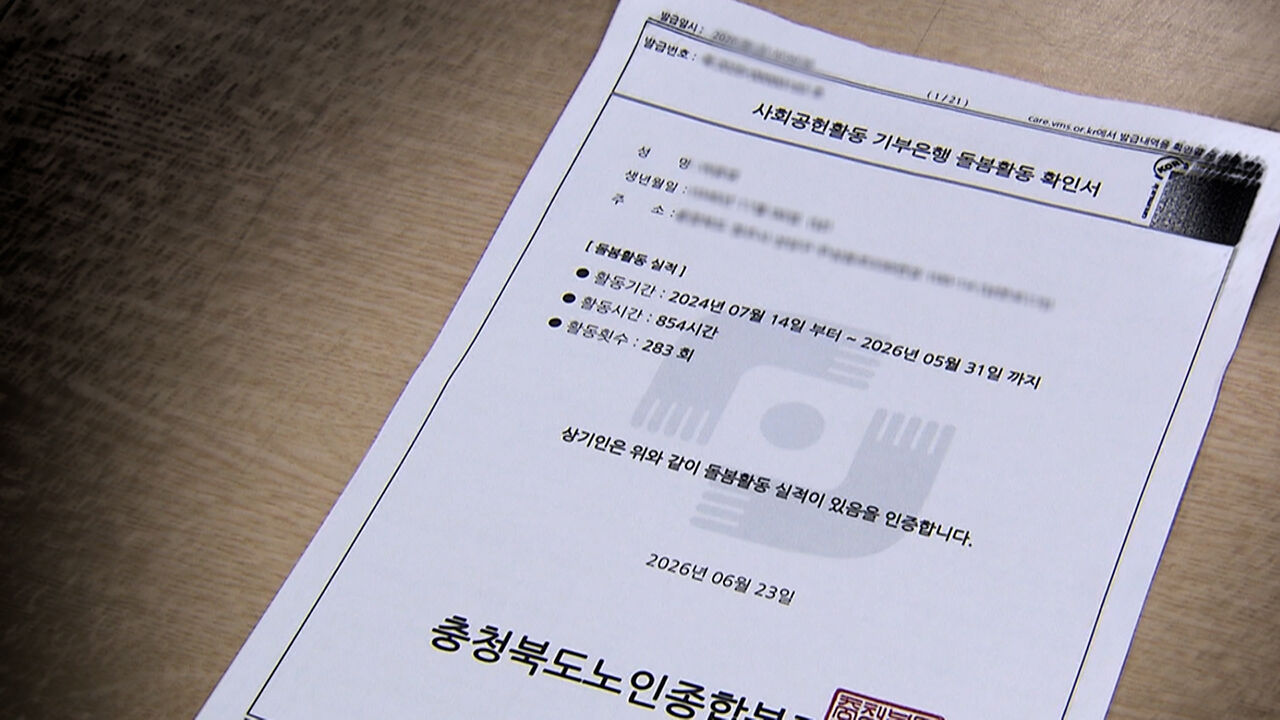
Lee Jong-eop, an 80-year-old senior, is now able to deduct the points he has accumulated so far. Since 2024, he has earned 854 points by providing care, such as keeping company with a 98-year-old neighbor or pushing their wheelchair for walks in the park. "I had no idea about this number," said Lee, who had been volunteering without paying attention to how many points he was accumulating. Based on his points so far, he is now eligible to receive caregiving services for over a year, calculated at three hours a day, five times a week. "Just like getting a blood transfusion with a donor card after donating blood, it would be great to receive care later. I haven't really thought about what kind of care I would want yet." Smiling broadly, Lee mentioned that he might start receiving care services when he gets a bit older, perhaps around 90. "Being able to do this caregiving volunteer work is good for my mental health. It makes me feel like I'm doing something meaningful and gives me a sense of reward that I am participating in social work as a member of society."
The "reward" Lee speaks of aligns perfectly with the origins of the "TimeBank" concept, which is the foundation of CareBank. Created in 1980 by an American civil rights lawyer, TimeBank is known to encourage marginalized groups to participate in their communities as proud, active members of society. The lawyer, Edgar Cahn, was hospitalized with heart disease when he was 44. Having gone from being a civil rights lawyer to suddenly being solely on the receiving end of care, he felt a sense of helplessness, feeling as though he was becoming useless. This led him to think about creating a way for recipients of social welfare services like himself to actively participate as providers of services, rather than being marginalized. The basic principle of the TimeBank established this way is as follows: anyone participating in the system receives equal value—1 care point for every 1 hour of caregiving activity they provide. Whether an elderly care volunteer keeps another senior company or a young volunteer repairs a senior's home, both activities earn 1 care point per hour. Ultimately, this process fosters a horizontal relationship between care providers and recipients, and the supply and demand of care are characterized by spontaneity and openness.
Kim Soon-ok, a volunteer who has accumulated 455 points so far, also said she has not given much thought to how she will use her points when she gets older and becomes eligible to deduct them. However, one thing was clear. "Rather than using them for myself, I want to give them back so they can be used for those who are truly in need. I volunteer because it makes me happy. When I was young, I received a lot of help from others because I was sick." Under the CareBank system, when a volunteer earns 1 care point for 1 hour of caregiving, they can deduct it to receive care for themselves after turning 65, or they can donate the points to a designated person, much like donating a blood donor card. Donations can be made to family members or third parties, allowing the recipient to use the care services. "If this program becomes more widely known and the number of volunteers increases, there will be so much more we can give back to society. I hope it becomes much more active."
The CareBank system, which is managed and supervised by the Ministry of Health and Welfare, with the Korea National Council on Social Welfare establishing business plans, selecting operating agencies, and building a care coordinator system, defines the eligibility criteria for care recipients as follows: individuals who have accumulated or received more than 100 care points, those deemed in need of care by care coordinators or social workers, and those who have not received a grade under the National Long-Term Care Insurance. The National Long-Term Care Insurance grades are given to those aged 65 or older, or under 65 with geriatric diseases, who are judged by the government to have difficulty performing daily activities on their own. They receive support in the form of home care benefits or institutional benefits, but the CareBank program targets those who have not received such a determination. This means it has the effect of filling the gaps where public care does not reach. Seok Jae-eun, a professor of social welfare at Hallym University, emphasized this characteristic of CareBank as "relational welfare," explaining, "It can fully play a role in filling the gaps in public care services using informal resources."
Seniors who do not qualify for a National Long-Term Care Insurance grade are not necessarily free from the need for care. Since they are outside the public care system, if they feel the need for care, they must seek care services in the private market. Those who refer to this TimeBank system as a form of "co-production"—where citizens jointly participate in producing and delivering services—emphasize that it also plays a role in restoring non-market economic functions and supplementing the market economy. In particular, it is pointed out that such TimeBanks are emerging in the field of elderly care in countries where the social infrastructure for care is lacking compared to the rapid pace of aging. It is known that TimeBank systems similar to Korea's CareBank have been introduced in countries like Singapore, Taiwan, and Thailand.
However, the CareBank system will not fill all the gaps in elderly care. Looking at the numbers alone makes this clear. As of the end of 2025, there were 50,923 care recipients nationwide, while there were 55,389 care volunteers. Since the number of volunteers is higher than the number of recipients, it might seem that everyone who wants care can receive services. However, looking closer at the regional data, in South Jeolla Province, there are 1,896 care volunteers and 5,448 care recipients. The number of recipients is nearly three times higher. When asked if this numerical imbalance could make it difficult to connect volunteers with recipients, an official from the Korea National Council on Social Welfare said, "That could be the case," adding, "Volunteers are more likely to be in urban areas, while those in need of help may live in rural areas." They also noted, "There are cases where one volunteer is responsible for multiple recipients," which could ultimately affect the quality of care services.
In addition to regional imbalances, imbalances in the types of services offered can also arise. Currently, when registering with CareBank, volunteers specify what care services they can provide, and recipients state what services they wish to receive. Local operating agencies, such as local senior welfare centers, review these registrations and match volunteers with recipients whose needs and offerings align. For example, suppose 100 volunteers and 100 recipients in the same region wish to participate in the CareBank program. If 90 volunteers offer companionship but 90 recipients want household support like cooking, they cannot exchange care activities as desired. In particular, because all activities are valued at 1 care point per hour under CareBank, there may be fewer volunteers willing to take on relatively demanding care tasks. This is why some point out that the characteristic of "one hour for one hour" being exchanged indiscriminately limits the scope of TimeBank's application. This core feature can act as a limitation in expanding the scope of reciprocal exchange.
First, there are voices calling for a more active role for the government, which currently seems to be keeping its distance from the system. Seok Jae-eun, a professor of social welfare at Hallym University, noted, "The gap in care service infrastructure between regions is serious, not just the gap in volunteer infrastructure," adding, "The role of care coordinators who organize activities is crucial." She explained that coordinators need to motivate people by helping them realize, "There is something I can do too," while breaking down care activities into smaller, manageable tasks so that volunteers do not feel burdened by participating. Professor Seok's view aligns with suggestions that the government should act as a mediator for relationship-based care, helping to supplement care recipient policies that currently seem to flow in only one direction.
Several ideas have also been proposed to overcome the limitations of the "one care point per hour" rule. First, in Japan, there is a TimeBank project called "Fureai Kippu" (Caring Relationship Tickets). The concept dates back to the 1950s but became widely known in the 1990s with the expansion of volunteerism in Japan. These tickets can sometimes be used in combination with cash, and contrary to the general principle of TimeBanks, care that assists with physical activities is valued higher than other forms of care. Since volunteers can receive more than one point per hour for specific (and likely more demanding) care activities, this encourages participation in those tasks. Meanwhile, Professor Seok Jae-eun suggested categorizing volunteer activities as an alternative. "We could group care activities together, and group legal advice or education together, allowing people to volunteer, accumulate, and deduct points within those specific categories," she said, adding that this methodological approach could respect market value to some extent while still sharing the spirit of TimeBank. As an attempt to blend the non-market and market economies, there is also a proposal to allow care points earned through volunteering to be used in the external market rather than just within the TimeBank. For example, a young volunteer who provides one hour of care could exchange their one care point for a one-hour voucher at a private academy. This idea is gaining traction as it could incentivize younger generations to participate in TimeBank activities.
In South Korea, which has entered a super-aged society, elderly care has become an unavoidable social challenge. CareBank is meaningful because it attempts to fill the gaps that the public care system cannot handle by relying on private relationships. The CareBank website and promotional pamphlets use the phrase "care that returns" to describe the program. However, as many have already pointed out, if the project is run in a way that shifts the burden to the private sector to "figure it out" in areas the public system cannot cover, care may never truly return. To ensure that volunteers' caregiving efforts are properly returned to them in the distant future, we must not rely solely on the goodwill of volunteers and recipients to sustain the system. There are still many issues we need to address together, starting with improving the working conditions and supporting the capabilities of care coordinators—who currently juggle multiple roles while receiving only minor allowances—as well as resolving regional and service imbalances, and finding incentives to increase volunteer participation.
References used for this article
- Kim Jung-hoon and Lee Da-gyeom. 2018. A Study on Strategies for Activating Local Community Economy: Focusing on TimeBank. Gyeonggi Research Institute.
- Kim Ja-ok and Yang Hye-ran. 2019. A Study on the Practical Application of TimeBank and the Development of an Efficient Operation Management System. Seoul Volunteer Center.
- Cho Gi-hyeon and Hong Jong-hyeon. 2024. When We Call Our Relationship Care. Hankyoreh Publishing.
- David Boyle. 2011. More than money: Platforms for exchange and reciprocity in public services. NESTA.
Here, there are people who are accumulating caregiving hours today for their future care. To be precise, they volunteer to help those in need of care, accumulate those hours as points, and then, when they turn 65 and need care themselves, they can deduct those points to receive caregiving services. This service, which could be described as a caregiving bank, is called 'CareBank.' Having launched its pilot program in Daegu and Cheongju in 2015, CareBank marks its 11th year of operation this year. Until now, volunteers could only accumulate points, and using them was deferred. However, starting yesterday (July 1), point deduction has finally become possible. This means that among volunteers who have been steadily accumulating points like a savings account while providing care, those aged 65 or older with more than 100 points can now 'withdraw' their points to receive caregiving services.
"I Am Also Doing Something Meaningful," Says One Senior Citizen
The "reward" Lee speaks of aligns perfectly with the origins of the "TimeBank" concept, which is the foundation of CareBank. Created in 1980 by an American civil rights lawyer, TimeBank is known to encourage marginalized groups to participate in their communities as proud, active members of society. The lawyer, Edgar Cahn, was hospitalized with heart disease when he was 44. Having gone from being a civil rights lawyer to suddenly being solely on the receiving end of care, he felt a sense of helplessness, feeling as though he was becoming useless. This led him to think about creating a way for recipients of social welfare services like himself to actively participate as providers of services, rather than being marginalized. The basic principle of the TimeBank established this way is as follows: anyone participating in the system receives equal value—1 care point for every 1 hour of caregiving activity they provide. Whether an elderly care volunteer keeps another senior company or a young volunteer repairs a senior's home, both activities earn 1 care point per hour. Ultimately, this process fosters a horizontal relationship between care providers and recipients, and the supply and demand of care are characterized by spontaneity and openness.
"I Want to Give Back the Care," Says a Volunteer
The CareBank system, which is managed and supervised by the Ministry of Health and Welfare, with the Korea National Council on Social Welfare establishing business plans, selecting operating agencies, and building a care coordinator system, defines the eligibility criteria for care recipients as follows: individuals who have accumulated or received more than 100 care points, those deemed in need of care by care coordinators or social workers, and those who have not received a grade under the National Long-Term Care Insurance. The National Long-Term Care Insurance grades are given to those aged 65 or older, or under 65 with geriatric diseases, who are judged by the government to have difficulty performing daily activities on their own. They receive support in the form of home care benefits or institutional benefits, but the CareBank program targets those who have not received such a determination. This means it has the effect of filling the gaps where public care does not reach. Seok Jae-eun, a professor of social welfare at Hallym University, emphasized this characteristic of CareBank as "relational welfare," explaining, "It can fully play a role in filling the gaps in public care services using informal resources."
Seniors who do not qualify for a National Long-Term Care Insurance grade are not necessarily free from the need for care. Since they are outside the public care system, if they feel the need for care, they must seek care services in the private market. Those who refer to this TimeBank system as a form of "co-production"—where citizens jointly participate in producing and delivering services—emphasize that it also plays a role in restoring non-market economic functions and supplementing the market economy. In particular, it is pointed out that such TimeBanks are emerging in the field of elderly care in countries where the social infrastructure for care is lacking compared to the rapid pace of aging. It is known that TimeBank systems similar to Korea's CareBank have been introduced in countries like Singapore, Taiwan, and Thailand.
What if There Are Many Care Recipients but No Volunteers?
However, the CareBank system will not fill all the gaps in elderly care. Looking at the numbers alone makes this clear. As of the end of 2025, there were 50,923 care recipients nationwide, while there were 55,389 care volunteers. Since the number of volunteers is higher than the number of recipients, it might seem that everyone who wants care can receive services. However, looking closer at the regional data, in South Jeolla Province, there are 1,896 care volunteers and 5,448 care recipients. The number of recipients is nearly three times higher. When asked if this numerical imbalance could make it difficult to connect volunteers with recipients, an official from the Korea National Council on Social Welfare said, "That could be the case," adding, "Volunteers are more likely to be in urban areas, while those in need of help may live in rural areas." They also noted, "There are cases where one volunteer is responsible for multiple recipients," which could ultimately affect the quality of care services.
In addition to regional imbalances, imbalances in the types of services offered can also arise. Currently, when registering with CareBank, volunteers specify what care services they can provide, and recipients state what services they wish to receive. Local operating agencies, such as local senior welfare centers, review these registrations and match volunteers with recipients whose needs and offerings align. For example, suppose 100 volunteers and 100 recipients in the same region wish to participate in the CareBank program. If 90 volunteers offer companionship but 90 recipients want household support like cooking, they cannot exchange care activities as desired. In particular, because all activities are valued at 1 care point per hour under CareBank, there may be fewer volunteers willing to take on relatively demanding care tasks. This is why some point out that the characteristic of "one hour for one hour" being exchanged indiscriminately limits the scope of TimeBank's application. This core feature can act as a limitation in expanding the scope of reciprocal exchange.
First, there are voices calling for a more active role for the government, which currently seems to be keeping its distance from the system. Seok Jae-eun, a professor of social welfare at Hallym University, noted, "The gap in care service infrastructure between regions is serious, not just the gap in volunteer infrastructure," adding, "The role of care coordinators who organize activities is crucial." She explained that coordinators need to motivate people by helping them realize, "There is something I can do too," while breaking down care activities into smaller, manageable tasks so that volunteers do not feel burdened by participating. Professor Seok's view aligns with suggestions that the government should act as a mediator for relationship-based care, helping to supplement care recipient policies that currently seem to flow in only one direction.
Several ideas have also been proposed to overcome the limitations of the "one care point per hour" rule. First, in Japan, there is a TimeBank project called "Fureai Kippu" (Caring Relationship Tickets). The concept dates back to the 1950s but became widely known in the 1990s with the expansion of volunteerism in Japan. These tickets can sometimes be used in combination with cash, and contrary to the general principle of TimeBanks, care that assists with physical activities is valued higher than other forms of care. Since volunteers can receive more than one point per hour for specific (and likely more demanding) care activities, this encourages participation in those tasks. Meanwhile, Professor Seok Jae-eun suggested categorizing volunteer activities as an alternative. "We could group care activities together, and group legal advice or education together, allowing people to volunteer, accumulate, and deduct points within those specific categories," she said, adding that this methodological approach could respect market value to some extent while still sharing the spirit of TimeBank. As an attempt to blend the non-market and market economies, there is also a proposal to allow care points earned through volunteering to be used in the external market rather than just within the TimeBank. For example, a young volunteer who provides one hour of care could exchange their one care point for a one-hour voucher at a private academy. This idea is gaining traction as it could incentivize younger generations to participate in TimeBank activities.
'Return of Care?' What It Takes to Truly Return
References used for this article
- Kim Jung-hoon and Lee Da-gyeom. 2018. A Study on Strategies for Activating Local Community Economy: Focusing on TimeBank. Gyeonggi Research Institute.
- Kim Ja-ok and Yang Hye-ran. 2019. A Study on the Practical Application of TimeBank and the Development of an Efficient Operation Management System. Seoul Volunteer Center.
- Cho Gi-hyeon and Hong Jong-hyeon. 2024. When We Call Our Relationship Care. Hankyoreh Publishing.
- David Boyle. 2011. More than money: Platforms for exchange and reciprocity in public services. NESTA.
※ Please note: This article was translated by AI and may contain errors.


 Video News
 Video News
 Video News
 Video News