
 KOR
KOR
▲ A Homeplus store in Seoul
A recent study has found that an increase in consumer spending on online retail platforms leads to a decline in sales for large hypermarkets.
While online retail channels have grown rapidly, regulations such as mandatory operating hour restrictions and compulsory closures remain applied only to offline hypermarkets, leading to criticism that retail industry regulations are skewed toward specific business types.
Lee Gong, a research fellow at the Korea Development Institute (KDI), announced on June 30 that according to the KDI Focus report titled "Growth of Online Retail and Directions for Improving Retail Market Policy," an analysis of monthly Shinhan Card transaction data at the administrative neighborhood level from January 2020 to December 2024 showed that for every 1% increase in online spending per capita, sales at hypermarkets decreased by 0.264%.
This suggests that the expansion of online transactions could lead to a significant blow to the operations of hypermarkets.
However, the expansion of online retail channels did not always lead to a decline in sales across the entire offline retail market.
The study found that for every 1% increase in online spending per capita in a region, sales at corporate-run supermarkets (SSM) increased by 0.221%, convenience stores by 0.324%, and other specialized retail stores by 0.356%.
When analyzing the market regardless of business type, a 1% increase in online spending per capita in a region resulted in a 0.186% increase in total offline sales in that area.
It was also found to have an effect of increasing the number of consumers per offline store by 0.045% and the number of offline stores by 0.152%.
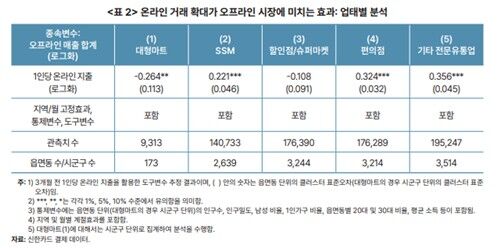
▲ Effects of Expanding Online Transactions on the Offline Market: Analysis by Business Type
Lee explained, "These results do not align with the existing hypothesis that online and offline are in a competitive, substitutional relationship."
Given that the business types experiencing sales growth are primarily located in neighborhood commercial areas, it appears that consumers are continuing to use nearby offline stores while simultaneously purchasing a variety of goods online.
In contrast, hypermarkets, which were frequently used in the past, appear to be being replaced by the online retail market due to factors such as travel costs.
The fact that Homeplus, one of the three major hypermarket chains in Korea, has entered corporate rehabilitation procedures is difficult to explain solely as a management failure of a single company; it suggests that even if the immediate crisis is overcome, the operational crisis for the hypermarket sector as a whole is likely to persist structurally.
The introduction of same-day delivery systems, such as Coupang's Rocket Delivery, has not yet been shown to affect the overall sales of offline retailers.
However, the study found that in situations where Rocket Delivery is introduced, a 1% increase in online spending leads to an additional 0.010% decrease in the number of offline transactions per capita.
The number of consumers per offline retailer was also found to decrease by an additional 0.023%.
As delivery systems continue to expand in the future, the structure is such that it could impact sales in the offline retail market.
Lee pointed out, "With the online market growing rapidly, the current regulatory framework is designed around offline businesses, causing the regulatory burden to be skewed toward specific sectors," adding, "There is significant doubt regarding how effective hypermarket regulations are in protecting traditional markets."
He further emphasized, "If Chinese e-commerce platforms like Temu and AliExpress fully establish dawn delivery and same-day delivery services in Korea, there is a possibility that sales at offline retailers will decline," and added, "We must monitor the impact of logistics advancement on offline retail and flexibly reflect those results in policy."
(Photo courtesy of KDI, Yonhap News)
※ Please note: This article was translated by AI and may contain errors.



 Video News

 Video News