
 KOR
KOR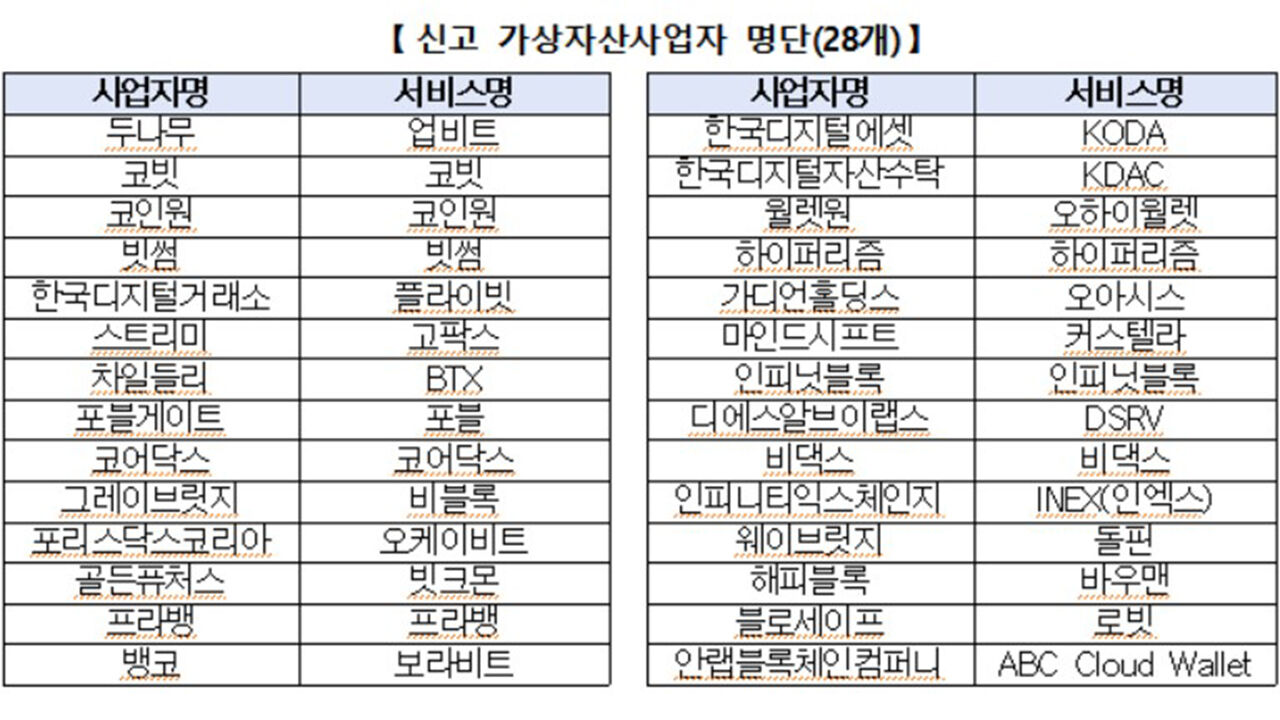
▲ List of Registered Virtual Asset Service Providers
The Financial Intelligence Unit (FIU) has issued a warning to investors, stating that while the number of illegal virtual asset operators on social media is rapidly increasing, all entities except for the 28 officially registered businesses are operating illegally.
The FIU announced today (June 24) that illegal virtual asset operators—those not registered under the Act on Reporting and Using Specified Financial Transaction Information—are spreading through platforms such as YouTube, Telegram, and open chat rooms.
These operators often lure users with false or exaggerated claims, such as guarantees of high returns, leading to financial losses.
Under the Act on Reporting and Using Specified Financial Transaction Information, any entity wishing to legally operate as a virtual asset service provider in Korea must meet specific requirements, including obtaining Information Security Management System (ISMS) certification, and register with the FIU.
These regulations apply equally to overseas businesses if they are conducting business activities targeting Korean residents.
The FIU highlighted common types of illegal operations, including cases where entities provide virtual asset trading or brokerage services to Koreans while attempting to conceal their domestic operations by using English during customer consultations to evade regulations.
In other instances, private currency exchanges directly trade virtual assets, such as stablecoins, for fiat currencies like the Korean won, targeting international students, tourists, and foreign workers.
Promoting overseas virtual asset businesses via YouTube or Telegram in exchange for commissions is also a typical form of illegal activity.
Illegal virtual asset operators often lack proper anti-money laundering measures or safeguards for user assets, posing high risks of personal information leaks and hacking.
There is also a possibility that these platforms could be exploited for concealing criminal proceeds or money laundering.
In such cases, investors may face unexpected disadvantages, such as their funds being mixed with illicit money or becoming the subject of investigations during the process of verifying the source of funds.
Some operators may also take transaction payments without delivering the virtual assets or charge exorbitant fees compared to registered service providers.
A recent joint investigation by the FIU, the National Police Agency, the Korea Customs Service, and the Digital Asset eXchange Alliance (DAXA) found that the average transaction commission for illegal over-the-counter (OTC) exchanges ranged from 1.5% to 10%. This is up to 62 times higher than the 0.16% average commission charged by the five major domestic virtual asset exchanges, such as Upbit and Bithumb.
The FIU emphasized that investors should exercise extreme caution, as it is difficult to recover funds if they suffer financial losses from illegal virtual asset operators.
(Photo: Provided by FIU, Yonhap News)
※ Please note: This article was translated by AI and may contain errors.

 Video News
 Video News
 Video News
 Video News
 Video News