
 KOR
KOR
▲ Hajodae Rocks in Yangyang
"Hey, please step back. It's dangerous."
On the afternoon of June 23, as tourists gathered around the rocks at Hajodae Beach in Yangyang County, Gangwon Province, the urgent voice of an on-site safety guard rang out.
Vacationers walking along the sandy beach dipped their feet into the crevices of the rocks where the seawater rushed in, or climbed onto the rocks to take photos.
Some threw off their slippers and walked toward the rocks through seawater that appeared shallow.
On the surface, it did not look like a dangerous scene.
The sea right next to the beach looked calm, and from a distance, the water around the rocks did not seem deep.
This is why it is easy for vacationers to step in without much thought.
However, the on-site safety guard stopped people every time they headed toward the rocks.
Although it was a weekday, quite a few people were staying around the beach and the rocks.
Some enjoyed playing in the water just enough to dip their feet, while many others approached the rocks to look at the sea or take photos.
The area around the rocks was often regarded as a sort of photo zone because of how it meets the sea, but on-site, this section was the most sensitive area.
The safety guard watched the surroundings and immediately moved to stop and explain whenever someone approached.
Although the area around the Hajodae Beach rocks looks calm and close from the outside, it is known to have complex underwater currents.
Because it borders the beach, it may look gentle from afar, but in reality, the water flow can shift to one side, or the spot where one steps can suddenly become deep, posing a risk of losing balance and leading to an accident.
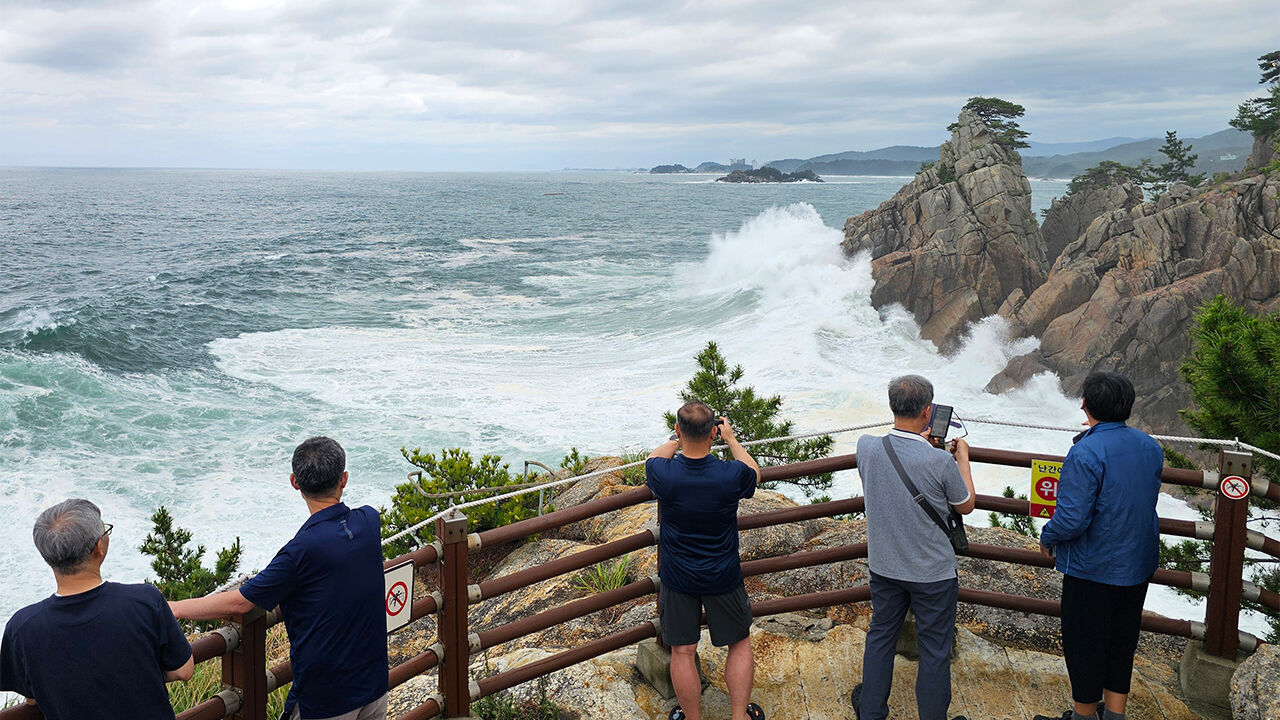
Indeed, drowning accidents have been recurring in this area.
Last year, a person who entered the water to rescue someone calling for help ended up drowning, and in another accident, after one person called for help, five others entered the water one after another and all drifted away, falling into danger.
From the perspective of vacationers, it may seem insignificant because it is close to the beach, but taking one wrong step or getting swept away by the current can quickly escalate into a situation requiring rescue.
In response, the Donghae Regional Coast Guard Headquarters held an event for reporters on June 17 to reenact the dangers of coastal accidents and provide an on-site experience.
During the event, they introduced the risk of drowning due to swell waves and steeply sloping seafloor topography, as well as the dangers of snorkeling accidents.
To prevent water accidents in the Hajodae area, the Gangneung Coast Guard is pushing to designate the "Hajodae Beach rocks and surrounding waters" as a restricted entry zone for coastal accident prevention.
The restricted entry zone covers the rocks and the waters extending 25 meters to the left and right from both ends of the rocks.
It includes the areas where past accidents have repeatedly occurred.
However, entering the water up to 3 meters from the shoreline will be permitted, and only the back portion of the rocks, where there is a risk of falling into the sea, is scheduled to be restricted.
The shoreline refers to the line where the coast and the sea meet when viewed from a guard post or an observatory.
Opinions are being gathered through a 21-day administrative notice that began on June 22, and the entry restriction is scheduled to take effect on July 24.
Anyone entering the restricted zone will be fined up to 1 million won in accordance with the Act on the Prevention of Coastal Accidents.
(Photo: Yonhap News)
※ Please note: This article was translated by AI and may contain errors.



 Video News
 Video News
 Video News