
 KOR
KOR
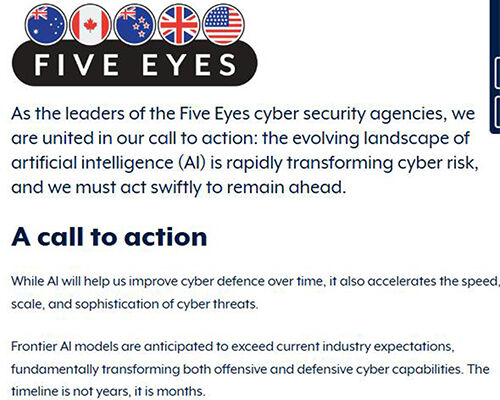
▲ A public warning by the Western intelligence alliance
Cyber security chiefs from Western nations have issued an unusual public warning, stating that cyber threats powered by new artificial intelligence (AI) technologies have emerged as a critical issue that could determine the survival of organizations and markets.
On June 22 (local time), Five Eyes—the intelligence alliance of five Western nations including the United States, the United Kingdom, Canada, Australia, and New Zealand—pointed out in a joint statement by the heads of their cyber security agencies that cyber threats have become faster, larger, and more sophisticated with the advancement of AI.
They assessed that "frontier AI models are anticipated to exceed current industry expectations, fundamentally transforming both offensive and defensive cyber capabilities," adding that "the timeline is not years, it is months."
They explained that cyber security-related technologies are advancing at a pace that existing countermeasures cannot keep up with, ushering in an era where even well-crafted security systems can easily be breached and rendered obsolete in just a matter of months.
The security chiefs emphasized the urgent need to build new defense strategies against AI-powered cyberattacks, stressing that a whole-of-society response is critical.
"AI is not a future consideration; it is already here," they pointed out. "AI is lowering the barrier to entry for malicious actors, increasing the speed and complexity of attacks, and narrowing the window of vulnerability to an unprecedented degree."
They added, "Cyber risk can no longer be treated as a purely technical issue," urging businesses and governments to deliberately employ defensive AI to build cyber resilience.
The cyber security chiefs of the Five Eyes did not specifically name the AI models or technologies at the center of the immediate threat.
However, the statement comes at a time when governments are alarmed by the emergence of AI models powerful enough to shift the cyber security paradigm.
The U.S. government recently blocked foreign nationals from using "Mythos" and "Fable," AI models developed by the American AI tech firm Anthropic.
Because these models, which detect vulnerabilities in cyber systems, are so powerful, there are significant concerns that they could be exploited for cyberattacks that could paralyze governments and businesses if leaked or fallen into the hands of hostile forces.
While the U.S. currently appears to have a head start on cyber tools utilizing AI technology, questions remain over whether this is truly the case and how long this reality will last.
Experts agree that much more powerful models could emerge outside the U.S. in the near future.
Olivia Shen, an AI expert at the University of Sydney in Australia, said in an interview with the Guardian, "The successor to Mythos and Fable is likely just around the corner."
She warned, "We only know about [Mythos and Fable] because they were released," adding, "States like China, or other actors and companies, could be developing other models that are just as sophisticated."
The security chiefs of the Five Eyes emphasized the need to act immediately to adapt to newly evolving cyber threats.
They pointed out, "Cyber resilience is not just an information technology (IT) issue, but is core to business continuity and market confidence," adding, "Leaders who act now will reduce risk exposure and build resilience, while those who delay will face growing and yet avoidable risks."
(Photo: Captured from Australian government announcement, Yonhap News)
※ Please note: This article was translated by AI and may contain errors.

 Video News



 Video News