
 KOR
KOR
▲ A total solar eclipse is observed in Palencia, Spain, on August 12, 2026.
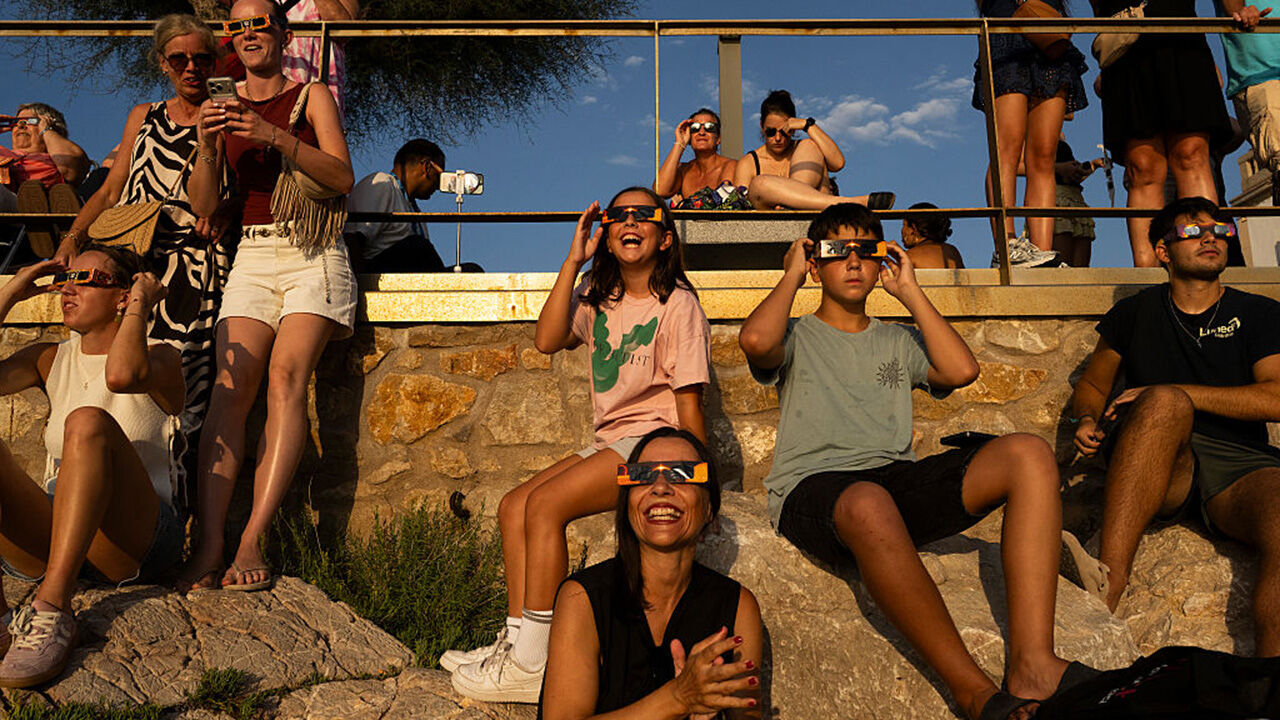
As a celestial solar eclipse show unfolded across Europe on the evening of the 12th local time, with the moon blocking the sun, crowds of citizens and tourists gathered in various places and let out cheers.
In Spain and Iceland, where the total solar eclipse was observed, as well as in the UK and France, where a partial solar eclipse of over 95 percent appeared, visitors flocked to areas with good views of the sky, leading to shortages of special glasses.
From astronomy enthusiasts who brought professional observation equipment to people wearing special glasses and children who brought hand-made equipment using cardboard boxes and tin foil for indirect observation, they flocked to every place where the sun was visible.
Sergio, an Italian who drove to Arija in northern Spain with his family in a camper, told Reuters, "I am overwhelmed with emotion because I will never have another chance in my life to see an eclipse like this."
Medinaceli, a hill village in northeastern Spain, was also crowded with people waiting from hours before to secure spots in prime locations to properly watch the total solar eclipse, which would last for a few minutes.
Akata Bonk, who works as a philosophy professor, said she came to this village from Madrid to properly view the eclipse, telling the AP, "It is thrilling to see darkness suddenly strike and the sun disappear."
Reuters stated that it is the first time a total solar eclipse has been visible from the Iberian Peninsula since 1912.
A total solar eclipse is scheduled to be observed once more on August 2, 2027, and an annular eclipse, where a bright ring appears around the edge of the sun, is expected to appear in January 2028, completing the Iberian eclipse trio.
It was expected that 8 million tourists would visit Spain on this day, and 80,000 people would flock to Iceland, which has a population of 400,000.
Steinsor Jonsson, manager of Hotel Keflavik in the Icelandic capital of Reykjavik, said, "People have flocked in huge numbers," explaining that this is the first sight of its kind since 1986, when the hotel opened and US President Ronald Reagan and Soviet leader Mikhail Gorbachev held a summit in Reykjavik.
Some people watched the eclipse from the sea.
The cruise ship MS Spitsbergen, located in Rypefjord east of Greenland, positioned itself in the middle of the sea while navigating the central Arctic route to show the magnificent view of the eclipse to its 126 passengers.
Sverre Ryd, captain of the cruise ship, told the AP, "All day long, passengers came and asked me to secure good spots for them," adding, "Everyone is immensely excited. It's an atmosphere like Christmas Eve."
In the UK and France, although it was not a total solar eclipse, the proportion of the sun blocked by the moon reached up to 96 percent and 99 percent, respectively.
The BBC reported that such an event has not occurred in the UK since 1999 and is a major event that will not be seen for the next 50 years.
In London, people gathered in Greenwich, home to the Royal Observatory, to watch it together.
(Photo: Getty Images)
※ Please note: This article was translated by AI and may contain errors.



 Video News
 Video News
 Video News
 Video News
 Video News