
 KOR
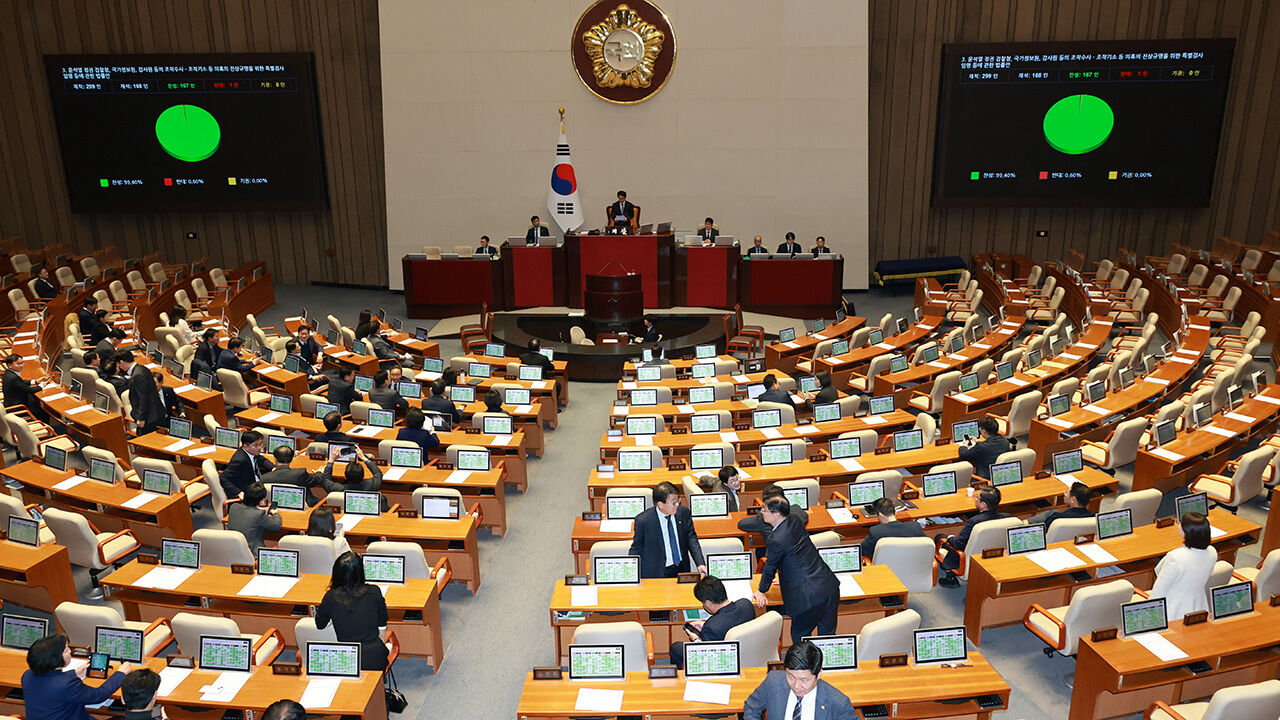
▲ The screen displays the passage of the special counsel bill on fabricated indictment allegations at the plenary session of the National Assembly on November 6.
The so-called "special counsel bill on fabricated indictment allegations," which mandates an investigation into allegations of manipulated indictments by the prosecution under the Yoon Suk Yeol administration—including cases involving President Lee Jae-myung—passed the National Assembly today (November 6), led by the Democratic Party of Korea.
With the Democratic Party pushing through the bill in swift fashion and the People Power Party launching hard-line protests, the year-end political climate is expected to freeze further.
At the plenary session on this day, the National Assembly passed the "Act on the Appointment of a Special Prosecutor to Uncover the Truth Behind Allegations of Fabricated Investigations and Indictments by State Agencies Including the Prosecution Service, the National Intelligence Service, and the Board of Audit and Inspection Under the Yoon Suk Yeol Administration," with 167 votes in favor and one against out of 168 lawmakers present.
Lawmakers from the People Power Party boycotted the vote, while Representative Lee Ju-young of the Reform Party cast the sole dissenting vote.
The Democratic Party voted to terminate a filibuster (lawful obstruction of proceedings through unlimited debate) requested by the People Power Party, which had lasted about 24 hours since the previous day, before voting to pass the bill.
The resulting special counsel on fabricated indictments will mark the seventh special counsel since the inauguration of the Lee Jae-myung administration, following the three major special counsels (the fallen Marine, insurrection, and Kim Keon-hee), the second comprehensive special counsel, the Coupang permanent special counsel, and the National Election Commission special counsel.
The scope of the investigation covers the prosecution's investigations and indictments related to allegations including: ▲ breach of trust regarding development projects in Daejang-dong, Wirye New Town, and Baekhyeon-dong; ▲ Public Official Election Act violations regarding the Daejang-dong and Baekhyeon-dong development projects; ▲ subornation of perjury by Kim Jin-sung; ▲ Ssangbangwool's unauthorized remittance to North Korea; ▲ bribery related to corporate sponsorships for Seongnam FC; ▲ corporate credit card misuse by former Gyeonggi Governor Lee Jae-myung; and ▲ false reporting intended to defame former President Yoon Suk Yeol.
The special counsel will also examine investigations into allegations including: ▲ statistics manipulation under the Moon Jae-in administration; ▲ the fatal shooting of a South Korean public official in the West Sea and the forced repatriation of North Korean fishermen; ▲ bribery related to the employment of former President Moon Jae-in's son-in-law; ▲ leaks of confidential information regarding the THAAD (Terminal High Altitude Area Defense) system; and ▲ the manipulation of the economic feasibility of the Wolseong Nuclear Power Plant Unit 1.
The investigation team has been capped at up to 20 dispatched prosecutors and up to 210 dispatched public officials excluding prosecutors.
Including special investigators, the team can consist of up to 309 personnel, a scale similar to the insurrection special counsel, which operated with up to around 310 members.
The investigation period will run for up to 200 days, including a 20-day preparatory period.
The bill stipulates that one candidate each be recommended by the Democratic Party and the People Power Party, which are parliamentary negotiating groups, as well as the Rebuilding Korea Party, which holds the largest number of seats among non-negotiating groups.
President Lee will appoint one among them.
In its supplementary provisions, the bill stipulates that when applying the Criminal Procedure Act mutatis mutandis regarding the duties and authority of the special prosecutor, assistant special prosecutors, and dispatched prosecutors, matters concerning investigative powers and command authority shall adhere to the provisions of the Criminal Procedure Act prior to the enforcement of its recent revision.
This means that the provisions of the Criminal Procedure Act revision that abolished prosecutors' direct investigative authority, passed at a plenary session led by the Democratic Party last July, will not be applied to this special counsel bill.
The bill takes effect on the date of its promulgation.
A special prosecutor could be appointed as early as November 22.
Democratic Party senior spokesperson Park Sung-joon told reporters at the National Assembly, "If the special counsel bill is promulgated on November 10, the National Assembly Speaker will request in writing that the president appoint a special prosecutor within two days.
The president then requests candidate recommendations from (political parties) within three days," adding, "The final appointment will likely take place around November 22."
After proposing the bill last April and postponing its handling due to public backlash, the Democratic Party excluded the controversial clause regarding the withdrawal of indictments, finalized the bill as a party platform on November 3, passed it through the Legislation and Judiciary Committee on November 4, and pushed it through the plenary session on this day.
During the Legislation and Judiciary Committee's review process, the Democratic Party removed the contentious clause granting the special counsel the authority to drop indictments.
Consequently, the previous provision allowing the special prosecutor to take over cases from prosecutors and decide whether to maintain indictments was omitted from the final draft.
The People Power Party immediately launched a filibuster as soon as the bill was tabled at the plenary session on the afternoon of the previous day.
During the filibuster, Representative Joo Jin-woo of the People Power Party argued, "Having the Democratic Party make the recommendation and (President) Lee Jae-myung make the appointment is a clear conflict of interest."
In a commentary issued following the passage of the bill, Senior Spokesperson Park Choong-kwon criticized, "Using their massive majority of seats, they have incapacitated the rule of law in the Republic of Korea and brutally trampled on parliamentary democracy to cover up the crimes of one man, the president," calling it "manipulated legislation and an evil law shielding Lee Jae-myung."
The People Power Party will stage an outdoor rally in front of Gyeongbokgung Station tomorrow (November 7) to launch a public opinion campaign exposing the unfairness of the special counsel on fabricated indictments.
In response, Democratic Party floor leader Han Byung-do emphasized at the party's Supreme Council meeting held at the National Assembly on this day, "We deleted not only the authority to withdraw indictments that the People Power Party had constantly taken issue with, but also the authority to request case transfers from the bill."
Criticizing the People Power Party's planned outdoor rally, Floor Leader Han remarked, "Holding outdoor protests ahead of the parliamentary audit, and holding outdoor protests during budget deliberations—when on earth do you plan to get real work done?"
Although the special counsel bill has now cleared the National Assembly, controversy surrounding the special counsel is expected to persist in the political arena.
Prior to the passage of the bill, Cho Kuk, head of the Innovation Policy Institute of the Rebuilding Korea Party, wrote on Facebook, "Applying an old law that has already lost its effect for the special counsel investigation raises constitutional and legal issues."
He took issue with the bill's supplementary provision stipulating that the investigative powers and command authority of dispatched prosecutors adhere to the provisions of the Criminal Procedure Act prior to its revision.
In response, Democratic Party Senior Deputy Floor Leader for Policy Kim Han-kyu countered to reporters at the National Assembly, "When the Criminal Procedure Act was revised, it was stipulated in the supplementary provisions that special prosecutors and dispatched prosecutors retain investigative authority under the former Criminal Procedure Act," adding, "The NEC special counsel act, which passed with bipartisan agreement, has the exact same provision."
While some claim that the Democratic Party has completely removed provisions related to indictment withdrawals, others point out that the possibility of indirect indictment dismissals still remains.
Such arguments suggest that the Ministry of Justice's Committee on the Respect for Human Rights and the Future of Prosecution could recommend the withdrawal of indictments to the Prosecution Service, or that courts could dismiss indictments after reviewing the findings of the special counsel's investigation.
(Photo: Yonhap News)
※ Please note: This article was translated by AI and may contain errors.


 Video News
 Video News
 Video News
 Video News
 Video News