KOR
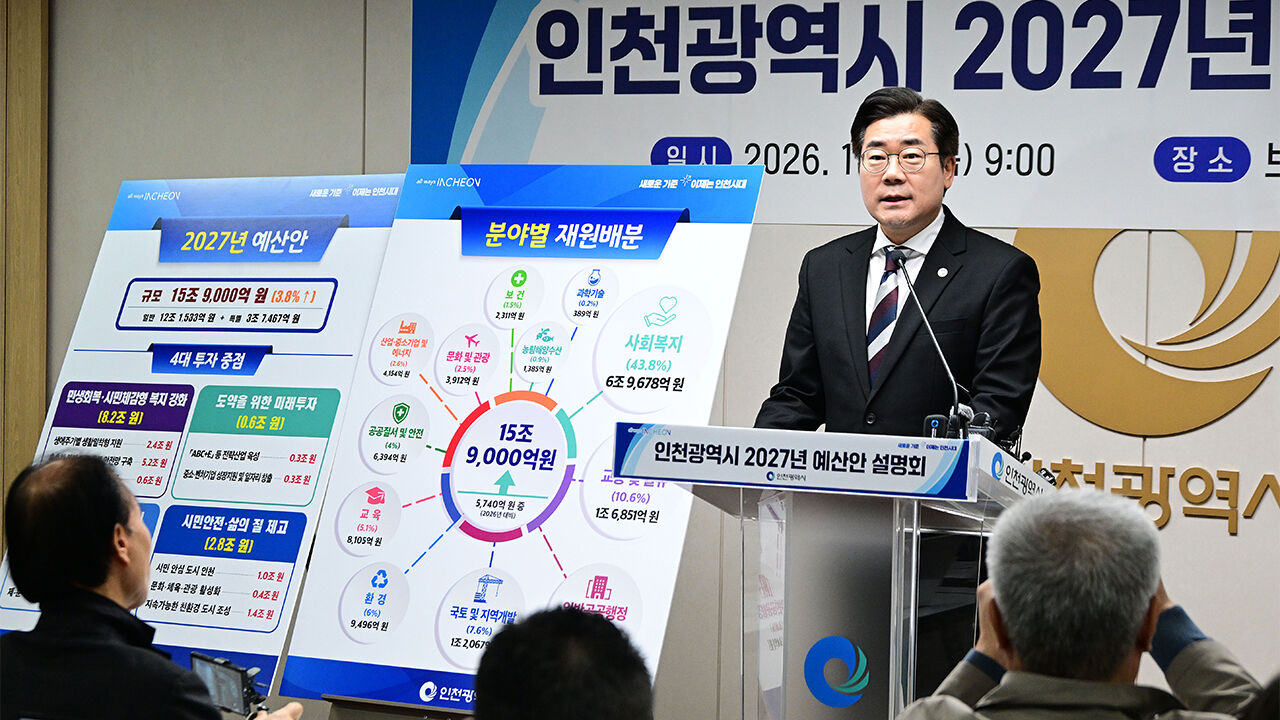
▲ Incheon Mayor Park Chan-dae explains the city's budget proposal for next year.
Following the declaration of a "fiscal emergency" after Mayor Park Chan-dae took office under the 9th popular election in July of this year, Incheon City has compiled its largest main budget on record for next year.
Incheon City announced today (the 5th) that it has formulated its 2027 main budget proposal at 15.9 trillion won, an increase of 574 billion won (3.8%) from this year's 15.326 trillion won.
The city explained that next year's budget proposal was prepared based on three principles: maintaining and expanding welfare and livelihood budgets directly tied to citizens' daily lives, investing financial resources secured through project restructuring into future growth sectors, and the planned utilization of local government bonds required for major investment projects.
Both local taxes and national subsidies, which serve as the main revenue sources for Incheon City's budget next year, are projected to increase compared to this year.
Self-generated revenues, such as local taxes and non-tax revenues, were compiled at 6.8744 trillion won, an increase of 27.6 billion won (0.4%) from last year, while dependent revenues, such as local share taxes and subsidies, were set at 7.0769 trillion won, up 780.1 billion won (12.4%).
The issuance of local government bonds was set at 324.7 billion won, a decrease of 39.9 billion won (10.9%) from 364.5 billion won in this year's main budget, and the managed debt ratio is expected to rise from 13.6% as of the second supplementary budget this year to 15.6% next year.
Incheon City formulated next year's general account at 12.1533 trillion won, a 6% increase from this year, and the special accounts at 3.7467 trillion won, a 3% decrease.
Among the special accounts, the Free Economic Zone special account and the waterworks special account decreased by 13.4% and 5% respectively, while the sewerage special account increased by 1.6%.
Fields that saw an increase in expenditure scale in the city's main budget proposal for next year compared to this year include social welfare (10.1%), transportation and logistics (5.4%), public order and safety (6.8%), and industry, small and medium enterprises, and energy (13.1%).
Fields that decreased include land and regional development (-14%), education (-7.4%), agriculture, forestry, fisheries, and marine (-9.7%), and science and technology (-4.2%).
The city plans to invest 316.6 billion won in fostering cutting-edge industries, including Mayor Park's core pledge "ABC (AI, Bio, Culture) + E (Energy)."
Reflecting the full 12-month amount for next year, the budget for the local currency Eum Card cashback, which saw its cashback benefits suspended for about two months this year due to budget depletion, was set at 210 billion won.
The Angel Support Fund (46.9 billion won) and pregnant women transportation expenses (7.2 billion won), which had been recommended for abolition starting next year by an Incheon City fiscal budget reform task force (TF) consisting of experts on the grounds that they "overlap with the expansion of national cash-like support," were maintained for next year.
In addition, cash-like support budgets such as the newly introduced marriage support fund (12.9 billion won) and child-welcoming support fund (35.4 billion won) were compiled, leading to criticism that the diagnosis of a "fiscal emergency" and the slogan of "budget and fiscal reform" have faded.
Next year's budget proposal will be finalized on December 15 after undergoing deliberations by the city council.
Mayor Park said, "Although the city's fiscal conditions are difficult, we will steadily continue the financial support necessary for citizens' lives, invest in future growth, and manage responsibly so that the compiled budget is executed on time in the field."
(Photo provided by Incheon City, Yonhap News)
※ Please note: This article was translated by AI and may contain errors.


 Video News

 Video News