
 KOR
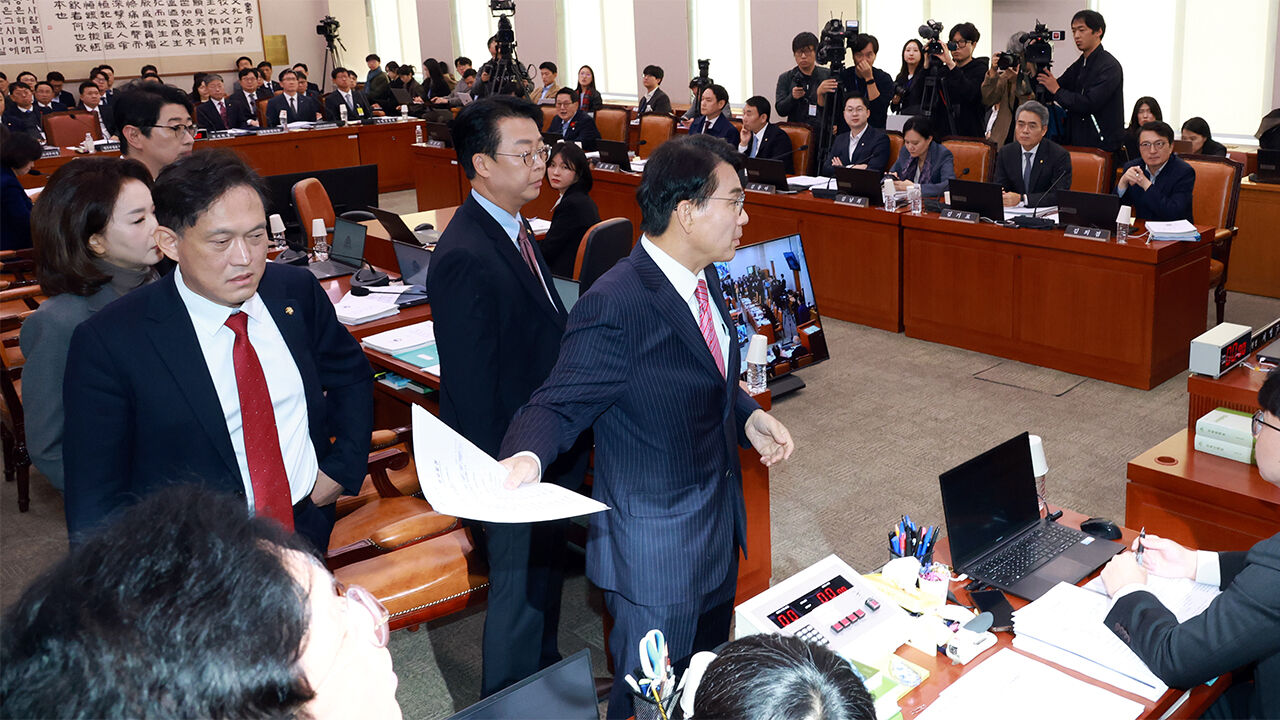
▲ People Power Party lawmakers walk out in protest of the proceedings during a plenary meeting of the Legislation and Judiciary Committee held at the National Assembly on November 4.
The so-called "Fabricated Indictment Special Counsel Bill," which aims to investigate allegations of fabricated indictments by the prosecution under the Yoon Suk Yeol administration, was swiftly passed on Wednesday (November 4) led by the Democratic Party of Korea, clearing a subcommittee of the National Assembly's Legislation and Judiciary Committee, an agenda coordination committee, and then the full committee meeting.
The Legislation and Judiciary Committee held a plenary meeting on Wednesday (November 4) and approved the "Bill on the Appointment of a Special Prosecutor to Uncover the Truth Behind Suspicions of Fabricated Investigations and Indictments by State Agencies, Including the Prosecution Service, National Intelligence Service, and Board of Audit and Inspection Under the Yoon Suk Yeol Administration."
People Power Party (PPP) lawmakers staged a collective walkout just before the vote on the special counsel bill.
Earlier, the committee's First Bill Examination Subcommittee also approved the bill led by the Democratic Party amid a walkout by PPP lawmakers.
The Democratic Party plans to pass the bill during tomorrow's (November 5) National Assembly plenary session. Lawmaker Kim Han-kyu met with reporters right after the vote and said, "Ultimately, deciding on the agenda is the authority of the National Assembly Speaker, and the Speaker will determine it after consulting with the floor leaders of the parliamentary negotiation blocs," adding, "We expect a wise decision."
The bill aims to investigate allegations that following the inauguration of the Yoon Suk Yeol administration, state agencies including the prosecution conducted targeted investigations against the then-opposition party and political rivals, carrying out fabricated investigations and indictments.
The Legislation and Judiciary Committee removed a clause from the bill originally proposed by the Democratic Party that was interpreted as granting the special counsel the authority to dismiss indictments.
The proposed bill initially contained a clause allowing the special counsel to take over cases from prosecutors and decide whether to maintain the indictments, but it was removed during the review process amid criticism, primarily from the opposition, that it was intended to drop charges against President Lee.
Existing language in the section defining the special counsel's scope of duties and powers that allowed the counsel to decide whether to maintain indictments was also deleted.
The scope of the special counsel's investigation covers the prosecution's investigations and indictments regarding allegations including: ▲ breach of trust related to the Daejang-dong, Wirye New Town, and Baekhyeon-dong development projects; ▲ violations of the Public Official Election Act related to the Daejang-dong and Baekhyeon-dong developments; ▲ subornation of perjury involving Kim Jin-sung; ▲ Ssangbangwool's unauthorized remittances to North Korea; ▲ bribery related to corporate sponsorships for Seongnam FC; ▲ former Gyeonggi Province Governor Lee Jae-myung's use of a corporate credit card; and ▲ false reports allegedly intended to defame former President Yoon Suk Yeol.
▲ Suspected manipulation of statistics under the Moon Jae-in administration; ▲ the fatal shooting of a South Korean fisheries official in the West Sea and the forced repatriation of North Korean fishermen; ▲ alleged bribery related to the employment of former President Moon Jae-in's son-in-law; ▲ leaks of confidential information regarding the Terminal High Altitude Area Defense (THAAD) system; and ▲ suspicions of manipulated economic viability assessments for the Wolseong-1 nuclear reactor were also included in the investigation's scope.
Among these, the forced repatriation of North Korean fishermen, the former President Moon case, the THAAD case, and the Wolseong reactor case were added during the committee's revision process.
Investigative personnel was set at up to 20 dispatched prosecutors and up to 210 dispatched civil servants, excluding prosecutors.
It will consist of up to 309 personnel, including special investigators.
The investigation period will last for up to 200 days, including the preparation period.
The bill provides that one candidate each will be recommended by the parliamentary negotiating blocs, the Democratic Party and the People Power Party, and the Rebuilding Korea Party, which holds the most seats among non-negotiating blocs.
President Lee Jae-myung will appoint one of the recommended candidates.
PPP Lawmaker Yoon Sang-hyun criticized the move during the plenary meeting, saying, "The Legislation and Judiciary Committee has become a law firm for President Lee alone," and "For someone who holds the legal status of a defendant to appoint a special counsel to look into his own cases is a violation of conflict of interest rules and the privatization of power."
Lawmaker Joo Jin-woo also criticized, saying, "When we pointed out that [the targets of the special counsel investigation] were cases related to Lee Jae-myung, they just crammed all the cases from the Moon Jae-in [administration] into [the revision]."
Lawmaker Kim Eui-kyeom, the ruling party's ranking member on the committee, countered when speaking to reporters at the National Assembly, saying, "By revising the bill, we significantly expanded the scope of the investigation and eliminated the clause regarding dismissal of indictments," adding, "We removed much of the conflict [of interest] regarding the president appointing the special counsel."
Legislation and Judiciary Committee Chair Suh Young-kyo, a Democratic Party lawmaker, emphasized, "The special counsel will investigate instances where prosecutors distorted evidence and conducted coercive investigations."
Meanwhile, an agenda coordination committee had been formed earlier at the request of the People Power Party to deliberate on the bill.
The agenda coordination committee, a body designed to resolve differences on disputed agenda items, can review bills for up to 90 days, but if at least four of its six members approve, the bill is referred back to the standing committee for an immediate vote.
This agenda coordination committee was composed of three Democratic Party lawmakers, two People Power Party lawmakers, and one Progressive Party lawmaker.
With the approval of the Democratic Party and Progressive Party lawmakers, the special counsel bill was referred back to the full Legislation and Judiciary Committee and passed.
If the Fabricated Indictment Special Counsel Bill passes the plenary session, it will become the seventh special counsel probe launched since the inauguration of the Lee Jae-myung administration, following the three major special counsels (the fallen Marine, the insurrection, and Kim Keon-hee), the second comprehensive special counsel, the standing special counsel for Coupang, and the National Election Commission special counsel.
(Photo: Yonhap News)
※ Please note: This article was translated by AI and may contain errors.


 Video News
 Video News
 Video News
 Video News
 Video News