
 KOR
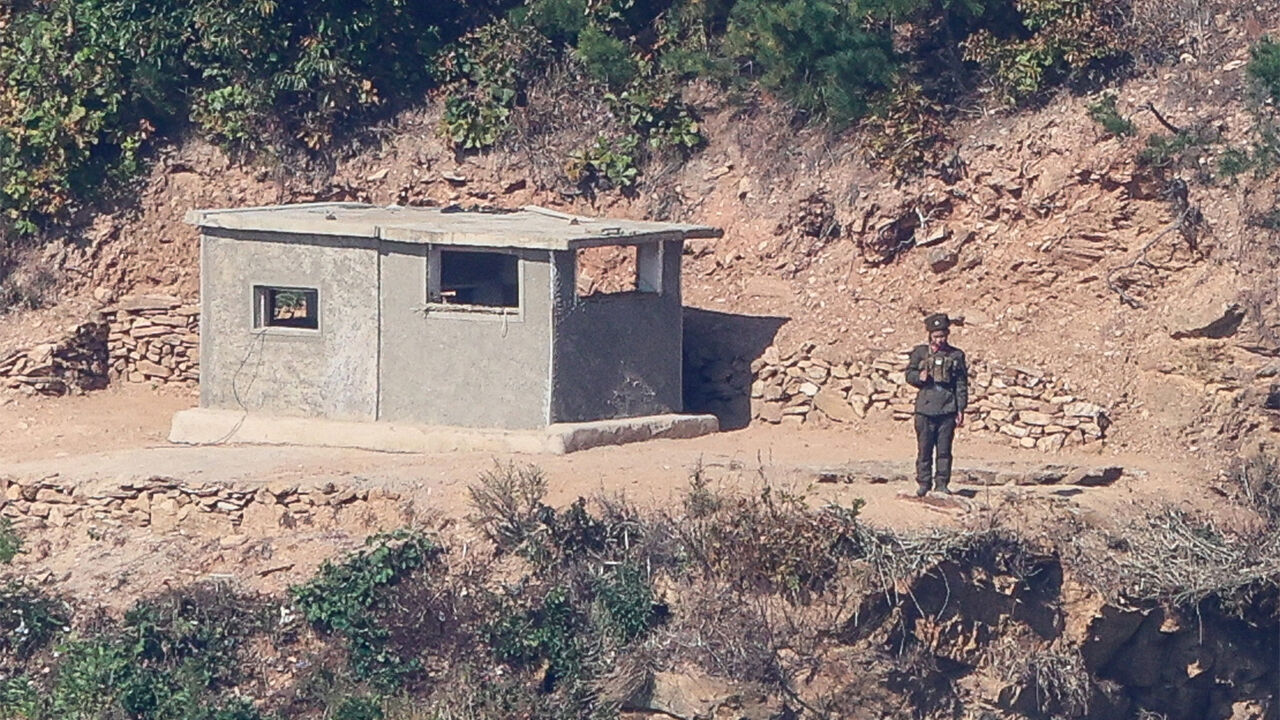
▲ A North Korean soldier is on guard duty in the coastal border area of Kaepung County, Hwanghae Province, North Korea, viewed from the Aegibong Observatory in Gimpo, Gyeonggi Province, on October 26.
The United Nations has made public a letter sent by the South Korean government to the President of the UN Security Council last month.
In the letter, the South Korean government called for the Security Council to "draw attention" to the North Korean landmine explosion incident and urged Pyongyang to issue an apology and take responsible measures.
However, the government did not request specific additional measures from the Security Council.
According to the UN on November 2 (local time), the letter sent by Ambassador Cha Ji-hoon of the Permanent Mission of the Republic of Korea to the UN to the Security Council president on October 22 has been officially registered as a UN document following a circulation process among Security Council member states.
The published letter shows that the South Korean government stated the purpose of sending the letter was to "draw the attention of the Security Council regarding the landmine explosion incident that occurred south of the Military Demarcation Line (MDL) within the Demilitarized Zone (DMZ) on September 21."
Citing the joint investigation results by the Joint Chiefs of Staff and the United Nations Command on October 5, as well as the forensic findings by the National Forensic Service, the government explained that the explosion was confirmed to have been caused by anti-personnel landmines intentionally planted by North Korea.
The government pointed out that North Korea's border fortification activities, including the laying of landmines, constitute violations of the Armistice Agreement.
It then urged North Korea to immediately halt actions that escalate tensions, issue an apology, take responsible measures such as removing the planted landmines and preventing recurrence, and engage in dialogue to prevent tensions on the Korean Peninsula and restore trust.
The letter also included content emphasizing the legitimacy of the South Korean military's response operations.
The government stated, "We hope the Security Council will take note of North Korea's recent attempts to portray legitimate operations by South Korean soldiers along the MDL as 'provocations' and shift the responsibility for escalating regional tensions onto South Korea."
It emphasized that "such operations, including warning broadcasts and warning shots, are legitimate and defensive measures designed to prevent North Korean forces from crossing the MDL and to ensure their withdrawal in the event of a crossing."
This is interpreted as a preemptive response and refutation against North Korea's claims branding the South Korean military's warning shots as "provocative acts" and arguing that they violated Article 2, Paragraph 4 of the UN Charter.
In fact, three days after the South Korean government sent its letter to the Security Council, North Korea sent a letter containing similar arguments to the Security Council president, which is currently being circulated among member states.
A Security Council presidential letter serves as a diplomatic tool to convey the positions of the parties involved in a relevant issue.
The South Korean government's letter did not contain requests for specific measures such as convening a Security Council meeting, adopting a presidential statement, or issuing a press statement.
This is interpreted as a realistic choice, taking into account that practical measures would be difficult to achieve given the positions of permanent members such as Russia and China.
Instead, the letter is seen as a strategic move to leave an official Security Council record stating that the South Korean military's MDL response measures are "legitimate defensive actions," thereby securing favorable diplomatic justification and public opinion grounds in the international community against future North Korean provocations or offensives.
(Photo: Yonhap News)
※ Please note: This article was translated by AI and may contain errors.


 Video News
 Video News
 Video News
 Video News
 Video News