
 KOR
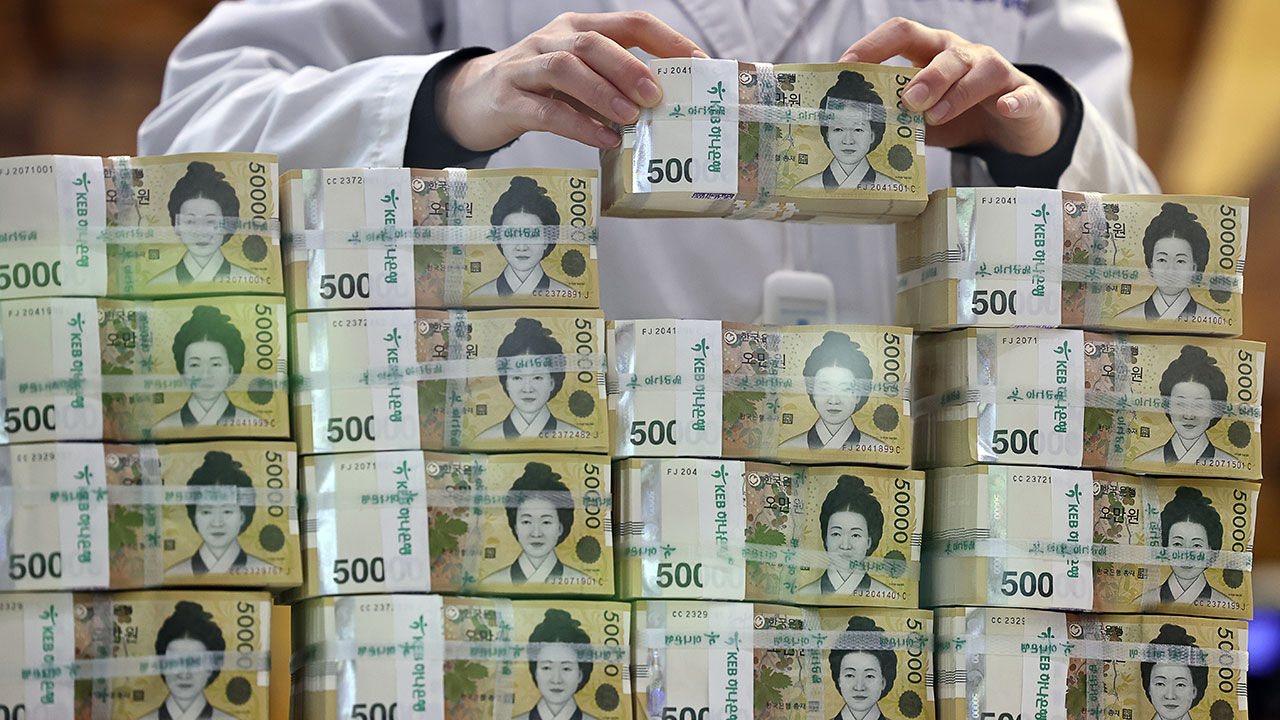
▲ Korean won cash
As a Board of Audit and Inspection audit revealed that tax revenue errors have averaged over 50 trillion won annually over the past four years, voices calling for legislative revisions to reduce these errors are growing louder.
Rep. Kim Nam-jun of the main opposition Democratic Party of Korea, a member of the National Assembly's Strategy and Finance Committee, announced today (November 1) that he has representative-proposed an amendment to the National Finance Act, which stipulates that the revenue budget estimation analysis report published by the government must include a revenue estimation model reflecting changed economic conditions and institutional changes such as tax law revisions.
The amendment also includes provisions requiring the government to receive quality diagnosis and management for revenue budget estimations, equivalent to regular national statistics quality diagnostics under the Statistics Act.
The intention is to have the government specifically disclose the grounds for tax revenue predictions and periodically verify whether the forecasting methods are appropriate.
The ultimate goal is to enhance the accuracy of tax revenue predictions.
Current laws stipulate that the government must attach a revenue budget estimation analysis report when submitting the budget bill to the National Assembly.
However, because there is no basis requiring the inclusion of specific estimation models, persistent criticisms have been raised that there are limitations in verifying the government's tax prediction methods and identifying the causes of errors.
In fact, the Board of Audit and Inspection's recently released audit on the operation status of major fiscal management systems pointed to errors in estimation models as a major cause of tax revenue discrepancies.
According to the Board of Audit and Inspection, tax revenue errors averaging about 51.5 trillion won occurred annually from 2021 through 2024.
By tax item, corporate tax (21.7 trillion won) and capital gains tax (11.9 trillion won) showed the largest errors in that order.
Corporate tax alone accounted for 42.1% of the total error, and combined with capital gains tax, the two items amounted to 65.2% of the total error.
It was analyzed that 81% (27 trillion won) of the average tax revenue errors (33.6 trillion won) occurring in these two tax items were caused by estimation model errors.
If tax revenues are overestimated, fiscal balances can become unstable due to reasons such as hurriedly issuing government bonds in the process of plugging tax shortfalls.
Conversely, if underestimated, the government may fail to properly spend money at a time when it actually needs to stimulate the economy, thereby impairing economic response capabilities.
Rep. Kim Nam-jun pointed out, "As there are limitations in accurately predicting increases and decreases in tax revenue using only existing time-series models, the government's revenue estimation model must be closely inspected and improved."
He emphasized, "Just as population estimations are subject to national statistics quality management, tax revenue estimations also need to undergo equivalent verification," adding, "We must reduce recurring tax revenue errors and establish a foundation for fiscal management that the public can trust."
(Photo: Yonhap News)
※ Please note: This article was translated by AI and may contain errors.


 Video News
 Video News
 Video News
 Video News
 Video News