
 KOR
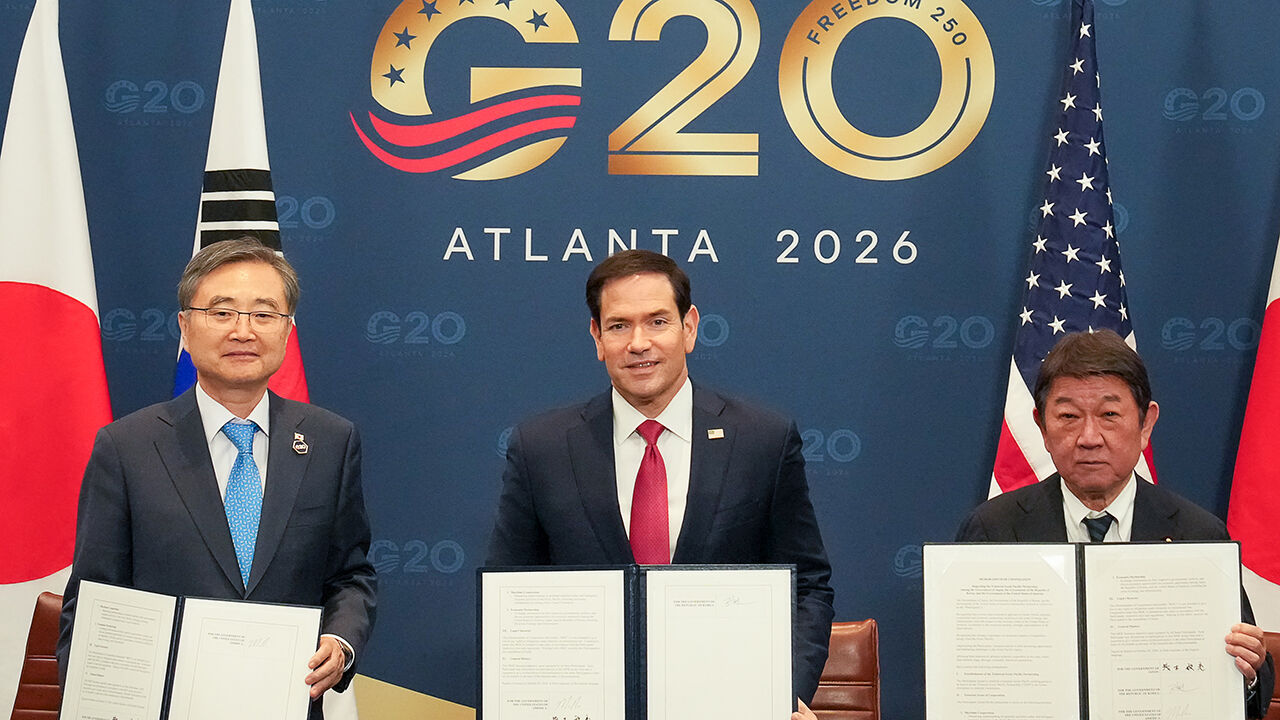
▲ South Korean Foreign Minister Cho Hyun (left) poses for a commemorative photo with U.S. Secretary of State Marco Rubio (center) and Japanese Foreign Minister Toshimitsu Motegi after signing a memorandum of cooperation on the Trilateral Arctic Pacific Partnership during a meeting of the foreign ministers of South Korea, the U.S., and Japan in Atlanta on October 30, local time.
The United States brought up China's "coercive behavior in the Yellow Sea" during a trilateral foreign ministers' meeting with South Korea and Japan, expanding its message of countering China into waters directly connected to South Korea.
On October 31, the U.S. Department of State stated that Secretary of State Marco Rubio raised China's attempts to gain control of the South China Sea, as well as its coercive behavior in the East China Sea and the Yellow Sea, during the trilateral foreign ministers' meeting held the previous day in Atlanta, United States.
This marks the first time that the U.S. State Department has explicitly stated China's "coercive behavior in the Yellow Sea" when announcing the outcomes of the trilateral foreign ministers' meetings, which have been held four times this year.
In the previous three meetings, peace and stability across the Taiwan Strait and China's missile launches were raised, but China's actions in the Yellow Sea were not directly pointed out.
The U.S. taking issue with China's actions in the Yellow Sea—waters where South Korea has direct interests—during the trilateral foreign ministers' meeting appears to reflect an intention to broaden consensus with South Korea and Japan on countering China.
In the Yellow Sea, a war of nerves between South Korea and China has continued over China's installation of structures and related issues.
Foreign Minister Cho Hyun explained during a comprehensive parliamentary audit by the National Assembly's Foreign Affairs and Unification Committee on October 27 that while China had removed one of three structures installed in the South Korea-China Provisional Measures Zone (PMZ) in the Yellow Sea, two remain, stating, "We are also considering constructing artificial structures if necessary."
However, the U.S. State Department merely stated that Secretary Rubio had raised the issue, without elaborating on the reactions of South Korea and Japan or any specific joint response measures.
In their press releases following the meeting, South Korea and Japan did not directly mention China or the Yellow Sea.
South Korea's Ministry of Foreign Affairs only stated that the three ministers shared assessments on major regional and global developments, including "attempts to unilaterally change the status quo."
Japan's Ministry of Foreign Affairs also mentioned "attempts to unilaterally change the status quo by force or coercion," but did not explicitly specify China or the Yellow Sea.
A slight difference in tone was also evident in the field of economic security; the State Department press release phrasing that the three nations "reaffirmed their shared opposition to economic coercion and the weaponization of supply chains" was not included in the announcements released by South Korea and Japan.
However, as each country's press release is prepared according to its own diplomatic interests and priorities, such differences in phrasing do not necessarily signify a rift in positions among the three countries.
The announcements from the three countries also showed some differences regarding the issue of North Korea's denuclearization.
The United States and Japan stated that they reaffirmed the three nations' commitment to the "complete denuclearization of North Korea," whereas South Korea's Foreign Ministry used the expression "realizing the goals of peace, stability, and denuclearization on the Korean Peninsula."
Such differences also appeared in the meetings held in July and September.
Particularly in last month's meeting, although the "complete denuclearization of North Korea" was specified in the trilateral joint statement, the separate press release from South Korea's Foreign Ministry contained the phrasing "maintaining peace and stability and realizing the goal of denuclearization on the Korean Peninsula."
The South Korean government maintains the position that because North Korea is the only party pursuing nuclear weapons on the Korean Peninsula, "denuclearization of the Korean Peninsula" and "denuclearization of North Korea" are substantially identical in meaning; however, because denuclearization of the Korean Peninsula is a broader term encompassing the exclusion of deploying tactical nuclear weapons in the South, the scopes do not completely coincide.
The government has also used the expression "a nuclear-free Korean Peninsula" instead of denuclearization in speeches such as President Lee Jae-myung's address to the United Nations General Assembly.
Interpretations suggest that the government, seeking to act as a "pacemaker" to foster dialogue between North Korea and the United States, is moderating its tone by avoiding the direct use of the term "denuclearization of North Korea," which could provoke Pyongyang.
While differences in nuance continue to be detected in the stances of South Korea, the United States, and Japan toward China and North Korea, the trilateral framework of coordination appears to remain on track in areas of substantive cooperation.
(Photo courtesy of the Ministry of Foreign Affairs, Yonhap News)
※ Please note: This article was translated by AI and may contain errors.


 Video News
 Video News
 Video News
 Video News
 Video News