How to Eradicate 'Relational Crimes' [Reporter's Notebook]
Je Hui-wonSeoul
Published2026.10.31 09:29ViewView Count
▲ Relational Crimes
Most of the violent crimes I have covered as a social affairs reporter since earlier this year are what we call "relational crimes." These crimes have shown no sign of stopping even this month alone. Incidents just this month included a case in Songpa-gu, Seoul, where a man murdered his mother-in-law and kidnapped his wife (October 11); a case in Yeon-dong, Jeju, where a man murdered a woman in her 40s with whom he was in a romantic relationship (October 12); and a case in Jeonju, North Jeolla Province, where a man who was issued a restraining order sought out and killed his estranged wife, along with a case in Asan, South Chungcheong Province, where a woman suffering from stalking was murdered (October 13).
In all these cases, female victims or their family members were murdered by men they knew. Statistics showing that 1 in every 5 murder cases is preceded by a relational crime such as dating violence or stalking clearly illustrate this grim reality.
"I want to live before the incident, not after it"
Beyond cases where crimes actually claimed victims' lives, incidents involving victims being threatened with weapons or their families being terrorized have also continued relentlessly.
The words of a stalking victim who said, "I want to live before the incident, not after it," have lingered in my ears for a long time. News of relational crimes pouring in day after day, even when not directly affecting us, leaves a heavy weight on our hearts, much like a boulder pressing down on the victims.
Various solutions have been proposed.
Above all, many pointed out that investigative and judicial authorities must develop a sharper awareness of the unique characteristics of relational crimes, meaning they need to heighten their sensitivity. In relational crimes, victims often hesitate to report out of fear of retaliation from the perpetrator. Therefore, even if a victim does not want to report or expresses an intent not to punish, authorities should examine the context of the relationship rather than taking those words entirely at face value. This is because a victim's withdrawal of a report does not guarantee their safety. This is why police officers encountering such cases for the first time must more actively persuade victims and closely monitor their safety.
"Victims shouldn't have to hide; active 'separation of perpetrators' is needed"
The criticism that relational crimes cannot be prevented simply by putting smartwatches on victims' wrists and stepping up patrols has been repeated with every such incident. Song Ran-hee, executive chairperson of Korea Women's Hotline, asked, "Smartwatches are merely auxiliary devices. What does it even mean to claim we are protecting crime victims while dodging basic sanctions against perpetrators?"
Even "restraining orders," which are among the most actively utilized provisional measures, are being violated in succession. As of August this year, violations of court-issued 100-meter restraining orders exceeded 950 cases. Perpetrators continue to linger near victims, while victims live in anxiety over threats that could strike at any moment, unable to fully enjoy even their daily lives. This is the reality currently faced by victims of relational crimes.
Approval rate for Provisional Measure No. 4 actually declines
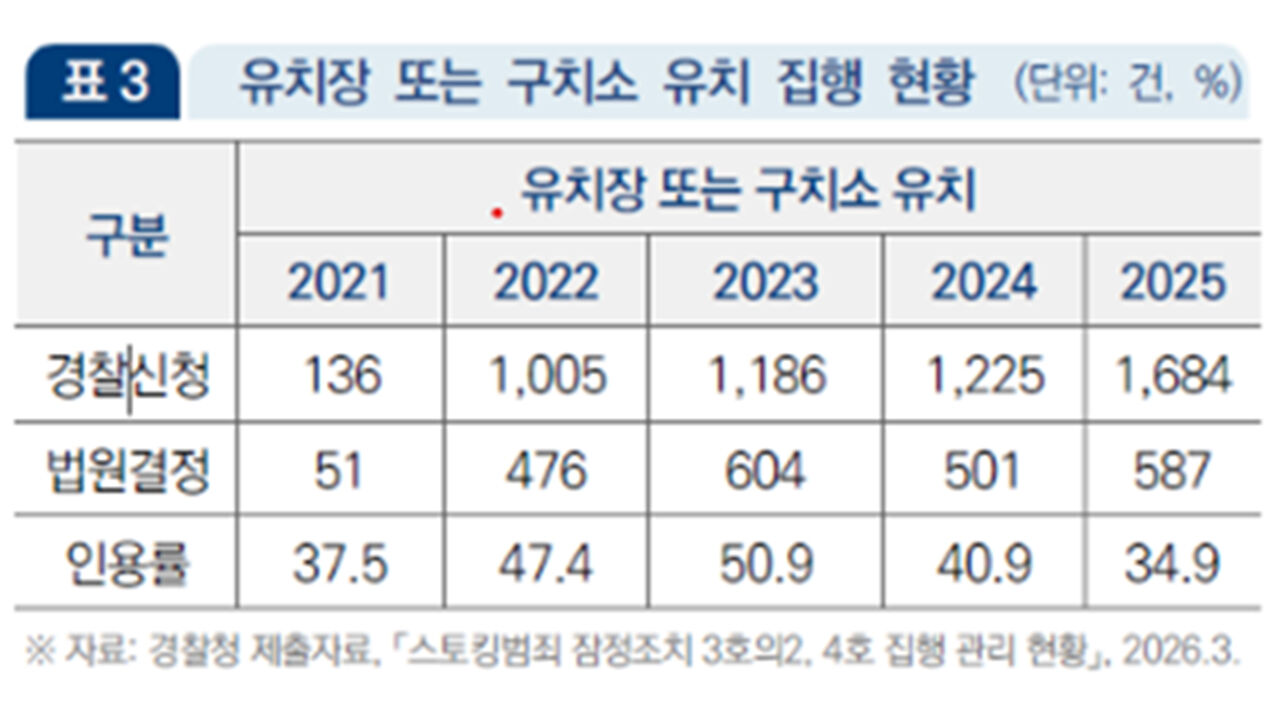
Police stated that as they strengthen their response to relational crimes, applications for physical separation, such as detention and the attachment of electronic monitoring devices, are increasing. However, the courts do not grant all of these increased applications. According to an analysis by the National Assembly Research Service, for Provisional Measure No. 4, which allows for "detention in a national police detention facility or correctional institution,"
while police application numbers have steadily increased as shown below, the court's approval decisions have actually decreased. The reasons given by courts for dismissing applications are also unclear.
The courts' low approval rate affects the judgment of frontline investigators dealing with relational crimes to a certain extent. An analysis suggests that while police officers who actually experience the effect of separating perpetrators through provisional measures continue to more actively utilize measures like detention, if experiences of applications being rejected by courts without clear reasons accumulate, they become reluctant to apply altogether.
The opinion is also gaining traction that repeated court rejections lead to passive responses in the field, and even means to physically separate perpetrators from victims may end up failing to be properly utilized.
To eradicate relational crimes
Looking back, measures to prevent relational crimes are already known to the world, meaning we are not failing to prevent them out of ignorance. What we need might not be another repetitive, comprehensive investigation. For the president's remark that "all available means at the government level must be concentrated to properly establish a foolproof victim protection and support system" not to become an empty echo, the desperation to "eradicate relational crimes" must be realized right now in the fields of investigation and justice.
※ Please note: This article was translated by AI and may contain errors.

 KOR




 Video News
 Video News
 Video News
 Video News
 Video News