
 KOR
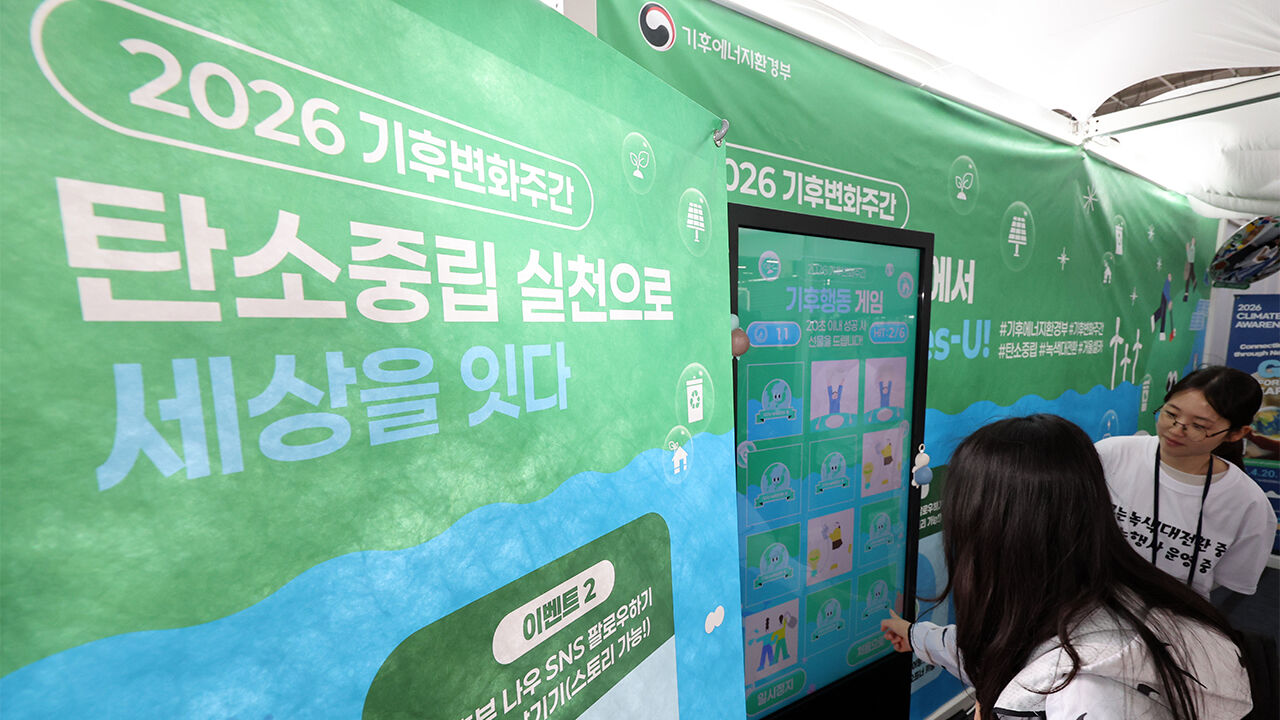
▲ Visitors solve environment-related puzzles at a booth during the 2026 Korea Climate, Environment and Energy Fair held at the Expo Digital Gallery of the Yeosu World Expo venue in Jeollanam-do on April 20.
Carbon neutrality policies are expected to lower South Korea's average annual economic growth rate by 0.06 to 0.07 percentage points and raise the producer price inflation rate by 0.04 percentage points through 2060, according to an analysis by the Bank of Korea (BOK).
The BOK announced these findings today (October 28) in a report titled "BOK Issue Note: Economic Impacts of Carbon Neutrality Implementation Pathways." The study analyzed the economic impacts of achieving carbon neutrality by 2050 by dividing the trajectory into two scenarios based on the upper and lower limits of the 2035 reduction target: a linear reduction pathway (reducing emissions at a constant rate) and an early reduction pathway (accelerating reduction speeds starting in 2030).
The analysis showed that under the early reduction pathway, gross domestic product (GDP) would decrease by 1.7% around 2030 compared to a baseline scenario (growing along past trends without carbon neutrality at an average annual rate of 1.0%), and further decline to 2.5% in 2035, 3.5% in 2040, 6.1% in 2045, and 8.2% in 2050.
After 2050, the contraction is projected to gradually recover, narrowing the decline to 2.2% by 2060.
Under the linear reduction pathway, the contraction in GDP would remain at 2.1% in 2035 and 2.7% in 2040, before expanding to 4.7% in 2045 and 10.2% in 2050.
After 2050, the decline is analyzed to narrow to 2.5%.
The BOK explained, "The change in the average annual growth rate shows a decline of 0.07 percentage points for the linear reduction and 0.06 percentage points for the early reduction, making the early reduction pathway slightly smaller. However, since this value does not apply a discount rate and given the characteristics of the early reduction pathway where costs are concentrated in the early stages, it is difficult to conclude which pathway is superior in terms of total volume."
Regarding producer prices, similar to the impact on GDP, the early reduction pathway experiences intensified upward pressure on producer prices between 2030 and 2045 due to aggressive early regulations, whereas the linear reduction pathway sees increased price pressure during 2045 and 2050.
The BOK noted, "A distinct feature is that the periods when burdens are concentrated differ clearly between the two pathways," adding, "It is necessary to examine the potential trade-offs between price stability and economic stability during the low-carbon transition process, and to strengthen risk management in the financial sector."
The BOK added that its research estimated the costs of carbon neutrality policies without accounting for the benefits of climate change mitigation, noting that previous studies estimated mitigation benefits at around 0.3 percentage points in growth, which exceeds the cost estimates.
(Photo: Yonhap News)
※ Please note: This article was translated by AI and may contain errors.




 Video News
