
 KOR
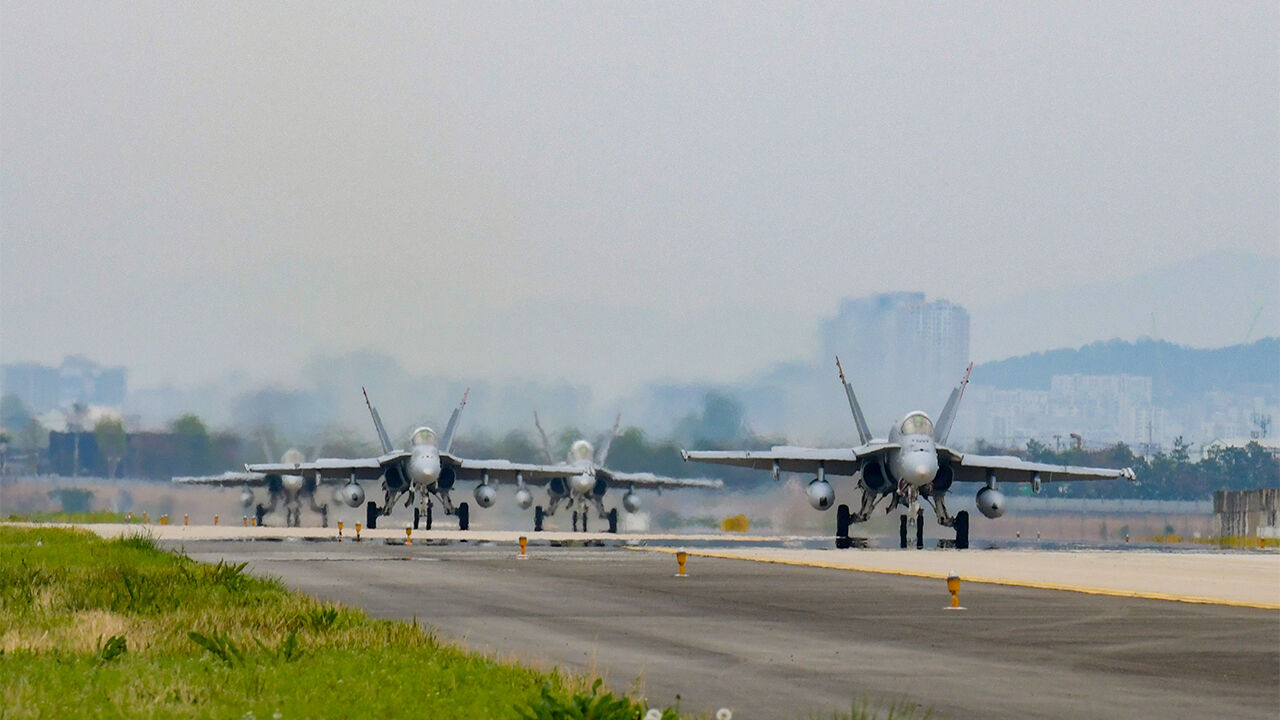
▲ A U.S. Marine Corps F/A-18 fighter jet moves along a taxiway for takeoff during the Freedom Flag 26-1 joint air exercise between South Korea and the United States in April.
The South Korean and U.S. Air Forces are launching "Freedom Flag," a large-scale joint air exercise aimed at enhancing combined operational capabilities and survivability, the South Korean Air Force said today (October 26).
The exercise will take place for two weeks from today to November 6 at Kunsan Air Base.
The Freedom Flag exercise is conducted twice a year, in the first and second halves of the year, with this event marking the second iteration held in the second half of this year.
The exercise's name was created by combining "Freedom," symbolizing liberal democracy, and "Flag," a term widely used in air force combined exercises.
It embodies the commitment to defend freedom and peace based on the robust combined defense posture of the South Korean and U.S. Air Forces.
From the South Korean Air Force, F-5E/F, F-15K, and KF-16 fighter jets, FA-50 light attack aircraft, F-35A stealth fighters, KC-330 aerial refueling tankers, C-130J transport aircraft, E-737 airborne early warning and control aircraft, and HH-47 and HH-60 search-and-rescue helicopters are participating.
The U.S. Air Force is mobilizing F-16 fighter jets, RC-135 reconnaissance aircraft, and KC-135 aerial refueling tankers, while the U.S. Navy is deploying MH-60S multi-mission helicopters, and the U.S. Marine Corps is deploying F-35B stealth fighters and MQ-9 unmanned combat aircraft, among other assets.
Through this exercise, South Korea and the United States will enhance interoperability by carrying out missions such as Defensive Counter Air (DCA), Airborne Alert Interdiction (XINT), and Air Interdiction (AI).
In addition, they plan to develop wartime operational and mission execution procedures by operating day and night Mission Planning Cells (MPCs).
In particular, reflecting changes in modern warfare environments, the two sides will examine integrated operational capabilities of fourth- and fifth-generation fighter jets and master the latest tactics through realistic scenarios utilizing adversary aggressor aircraft.
Combined training led by the South Korean side will also be planned and executed in preparation for the transfer of wartime operational control (OPCON).
"Through intensive and realistic training, we will share strategies and know-how between the two countries tailored to modern battlefield environments and continue to advance our combined defense posture," said Lee Seung-hwan, chief of the operations and training division at the Air Force Operations Command. "We will make this an opportunity to solidify teamwork between South Korean and U.S. pilots and hone their combat skills, while also building capabilities in preparation for the OPCON transfer."
(Photo: Yonhap News)
※ Please note: This article was translated by AI and may contain errors.


 Video News
 Video News
 Video News
 Video News
 Video News