
 KOR
Protests against high inflation held across France on October 24 (local time) proceeded without a repeat of last week's extreme violence or looting, thanks to active measures and the deployment of massive law enforcement by authorities.
Foreign media outlets, including Bloomberg, reported that the scale of the protests decreased compared to October 17, and the heated atmosphere calmed down somewhat as authorities issued protest restrictions to prevent a recurrence of violence, deployed 70,000 police officers along with helicopters and armored vehicles, and signaled a strict response to radical behavior.
According to the French Ministry of the Interior, about 110,000 people participated in the protests restricted to the outskirts in the capital city of Paris on this day, while approximately 300,000 took to the streets nationwide, bringing the total number of participants to around 400,000, which is fewer than the 550,000 or so from the previous week.
However, the General Confederation of Labour (CGT), a major French labor union that encouraged participation in these protests, estimated the number of participants at 800,000, showing a discrepancy with the government.
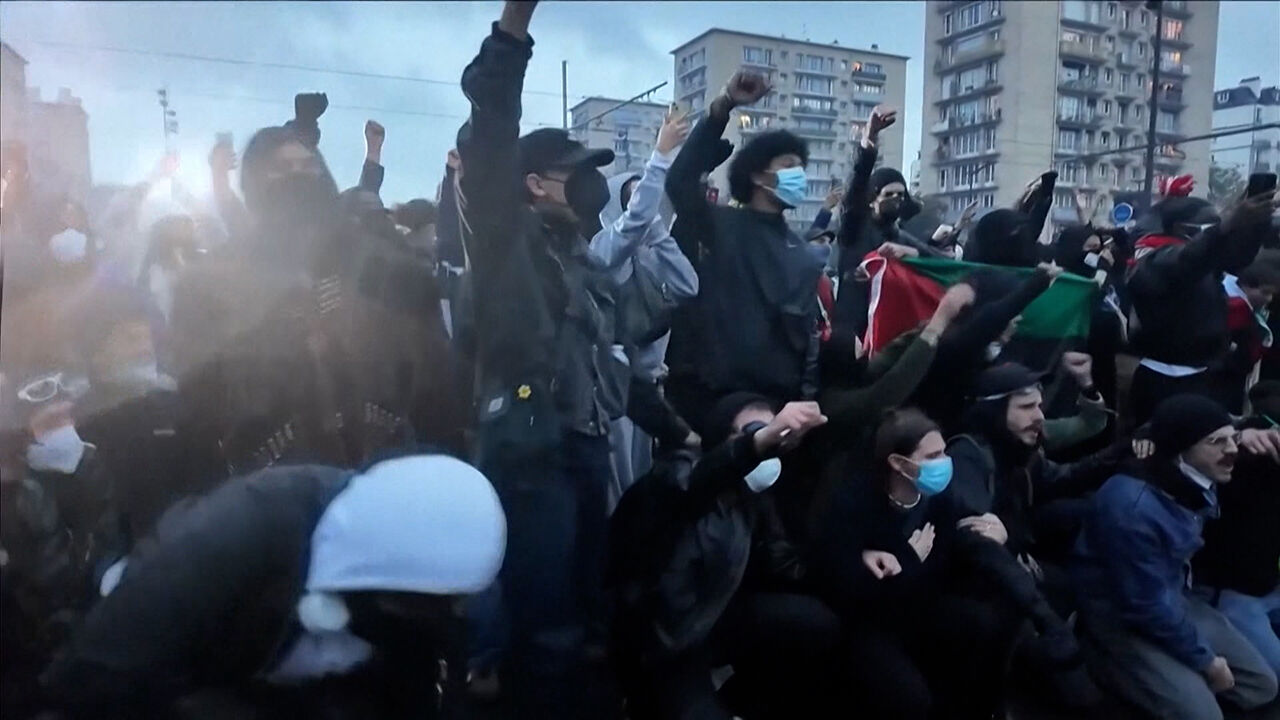
While most of the protests remained peaceful, sporadic clashes between some demonstrators and police occurred toward the end of the demonstrations in major cities such as Paris, Marseille, Lyon, Bordeaux, and Toulouse, leading to the arrest of about 1,000 people across France.
Police deployed tear gas and water cannons to disperse protesters who dressed in black, covered their faces, and confronted officers, while some demonstrators reportedly fired fireworks toward the police, escalating tensions.
Interior Minister Laurent Nuñez blamed far-left groups for the clashes on this day, claiming that they sought to start and end an uprising.
Minister Nuñez emphasized that while violence directed at the police remained at a high level, the deployment of a massive police force successfully "prevented the looting of stores and destruction of buildings seen last week," adding, "We will focus all our capabilities over the coming days and weeks to respond to these threats."
Caught off guard last week as massive protests escalated into nationwide violence and looting, the French government went all out to prevent a recurrence of chaos by deploying about 70,000 security personnel, including counterterrorism special forces.
Amid the closure of subway stations across central Paris, major museums and art galleries such as the Louvre and the Musée d'Orsay closed for the day, and football matches between Paris Saint-Germain and Olympique Lyonnais were postponed.
From luxury boutiques to grocery stores, shops prepared for vandalism and looting by blocking windows with wooden boards and clearing merchandise from display shelves.
Although the protests on October 24—dubbed "Act II" by organizers to signify the next phase—passed without extreme violence, large-scale demonstrations are expected to continue for the time being, meaning French authorities will likely remain on high alert.
The French high school student organization "The Renouveau Lycéen," which sparked the nationwide mass protests by demanding improvements to poor educational environments, stated that it is prepared to continue demonstrations if concrete government measures are not presented ahead of its scheduled meeting with Prime Minister Sébastien Lecornu on October 26.
With labor unions also having announced a general strike for November 5, the CGT vowed to expand protests until the government and employers accept the demands of workers.
As French protests protesting poor educational conditions and soaring prices spread like wildfire to other European countries facing very similar situations, large-scale protests and clashes also broke out successively in Spain, Italy, Belgium, and Albania on this day.
In Barcelona, Spain, unrest broke out around Catalonia Square in the city center where protesters set fire to garbage bins, looted shops, and threw stones at police, resulting in a total of 128 arrests on charges including property damage and looting.
Local media reported that more than half of them, or 73 people, were minors.
In Italy as well, small and large rallies were held in major regions including the capital Rome, the second-largest city Milan, Turin, and Florence.
In Rome, amid clashes between police and demonstrators, some protesters managed to enter the Colosseum.
In Milan, where 1,400 military and police personnel including paratroopers were deployed, no luxury store looting acts like those from the previous weekend were reported.
In the Belgian capital of Brussels, about 400 protesters also sporadically clashed with police, resulting in nine arrests, according to the Brussels Times.
※ Please note: This article was translated by AI and may contain errors.
French Protests Avoid Repeat of Looting, but Sporadic Clashes Lead to 1,000 Arrests

Copyright Ⓒ SBS & SBSi. All rights reserved.
Copying, redistribution, and unauthorized use in AI training are strictly prohibited.
Copying, redistribution, and unauthorized use in AI training are strictly prohibited.

Trending Now
-
 Video News
Elementary Schooler Dies in Late-Night Fishing Site Tragic Accident After Leaving to Find Father
-
Video News
Exclusive: "Smiled Before Setting Fire"… Shocking CCTV Footage of Yeoksam-dong Arsonist
-
Video News
Wife Breaks Down at Sight of Husband: "What Else Could This Be If Not Attempted Murder?"
-
Video News
Woman Found Dead in Broad Daylight... Had Cried for Help Twice Before
-
Video News
Following Death Rumors, an 'Unusual' Move: What Lies Behind Kim Jong Un's Visit to a Chinese Bus Factory?
 Video News
 Video News
 Video News
 Video News
 Video News