KOR
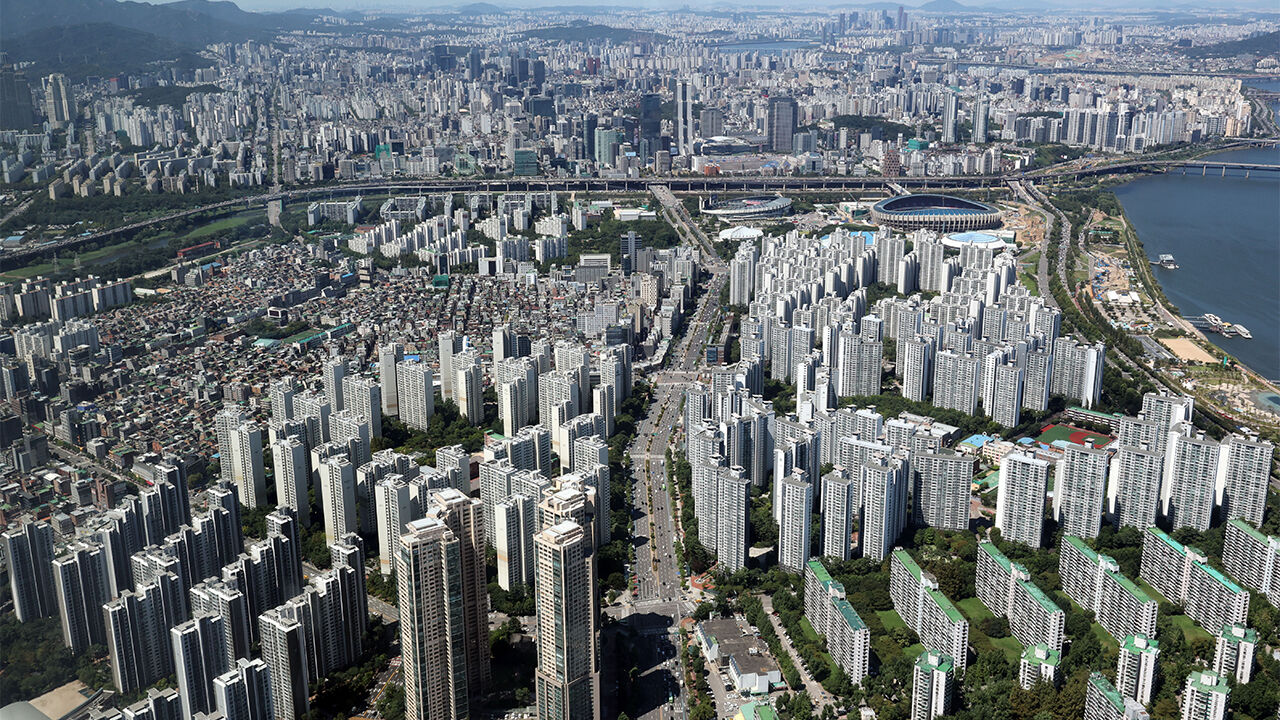
▲ Apartments in Gangnam and Songpa districts
The imposition of the Rebuilding Excess Profit Recovery charge, which is expected to send shockwaves through the rebuilding market, is projected to begin in earnest within the year.
This comes as Seocho-gu announced plans to levy the charge within the year on Banpo Hyundai, the first complex in the Gangnam area subject to the rebuilding excess profit recovery system.
Rebuilding associations are pushing back, threatening legal action once the charges are levied, while market confusion grows as "dual pricing" emerges in moved-in complexes due to uncertainties surrounding the recovery charges.
At Banpo Raemian Trinione in Seocho-gu, which began occupancy last August, price gaps of more than 1.8 billion won have opened up even for units of the same housing type.
Prices have varied depending on who will shoulder the rebuilding excess profit recovery charge, on top of general differences in floors, orientations, views, or the presence of urgent sales.
For the exclusive 84㎡ area of this apartment complex, a 35th-floor unit is listed at 5.7 billion won, while a 32nd-floor unit is priced at 5.15 billion won.
The difference between the two units lies in whether the recovery charge is included: the 5.7 billion won unit is to be paid by the seller, while the 5.15 billion won unit operates under a condition where the buyer assumes the charge separately.
In effect, a dual pricing system is forming based on who bears the rebuilding excess profit recovery charge.
The rebuilding excess profit recovery charge is levied on associations when excess profits—calculated by evaluating asset values at the time of association establishment authorization and at the time of occupancy, excluding normal housing price increases and costs such as construction expenses—exceed a certain level.
For Trinione, Seocho-gu notified an estimated charge of an average of 402 million won per household during the management disposal plan in 2020. However, observations suggest that the actual charge could reach up to 7 billion won per household due to higher general sales prices and surging apartment prices in the surrounding area.
The market price for the 84㎡ exclusive area of this apartment currently ranges from a low of 4.5 billion won to a high of 6.3 billion won, depending on urgent sales status and the recovery charge conditions.
However, local real estate agencies explain that even urgent sale units are difficult to trade due to uncertainties over when and how much the charges will be imposed.
Another certified public realtor in Banpo-dong noted, "Although the Rebuilding Excess Profit Recovery Act has remained in effect, collections have been deferred or suspended for years, so few union members actually expected to pay the charge," adding, "If actual collections begin, market confusion will be massive."
It is estimated that more than 60 complexes nationwide are slated to face rebuilding excess profit recovery charges.
Among them, 46 complexes and 18,000 households are concentrated in Seoul alone.
Although an amendment implemented on March 27, 2024, delayed the assessment timing of the recovery charge to the association establishment authorization stage and required local government heads to calculate and notify associations within five months of completion, no complex has been levied yet.
This is because in June 2024, People Power Party lawmaker Kim Eun-hye proposed a bill to abolish the system, and the Ministry of Land, Infrastructure and Transport under the Yoon Suk Yeol administration officially pursued the abolition of the rebuilding charge.
However, with the launch of the new administration, discussions on abolition have faded below the surface, and actual impositions are now moving forward.
Since Seocho-gu maintains its stance to levy the recovery charge within this year on Banpo Hyundai (currently Banpo Centraville Asterium), designated as the Gangnam area's "first" complex, actual collections are expected to materialize in other local governments as well.
Banpo Hyundai (currently Banpo Centraville Asterium) began occupancy on July 30, 2021, and has surpassed five years since completion.
Seocho-gu cites Article 18 of the Rebuilding Excess Profit Recovery Act, which stipulates that provisions regarding the payment and collection of rebuilding charges shall apply mutatis mutandis from the Restitution of Development Gains Act, as the rationale for rushing the imposition within the year.
The Restitution of Development Gains Act sets a five-year statute of limitations—starting from the time the right becomes exercisable—for both the authority to collect development charges and the right to claim refunds for overpaid charges, after which the rights are deemed extinguished.
Therefore, considering the completion date and the five-month assessment period, the district plans to issue the levy within this year.
In addition to Banpo Hyundai, Seocho-gu is currently proceeding with charge calculation procedures for other rebuilding complexes, including Banpo 3-ju-gu (Raemian Trinione), Shinbanpo 21 (Authere Banpo), Shinbanpo 18 Building 337 (Authere Shinbanpo), and Shinseong Villa.
Meanwhile, the Ministry of Land, Infrastructure and Transport interprets that since the law was amended in March 2024, the levy can be issued within five years following the implementation of the amended law, which is by 2029.
Rebuilding complexes across the country are objecting, raising issues with the calculation method of the rebuilding recovery charges and threatening to immediately file for injunctions and administrative lawsuits if actual levies are imposed.
They argue that business implementation will become difficult as levies ranging from tens of millions of won to hundreds of millions are expected not only in Seoul but also in regional areas.
The core issues of the Rebuilding Excess Profit Recovery Act raised by associations are that it is a punitive tax levied on unrealized gains and a lottery-like charge where development profits vary by complex depending on market prices at the time of occupancy.
Complexes where rebuilding took place during the Moon Jae-in administration, such as Banpo Hyundai in Seocho-gu, oppose applying the Korea Real Estate Board's housing price trend index—which has faced statistical manipulation controversies—as the "normal housing price increase rate" subtracted from excess profits.
This is because the Real Estate Board's housing price statistics during the Moon Jae-in administration showed lower growth rates than other price survey agencies, such as actual transaction price indexes or KB Real Estate, leading to over-calculated excess profits.
The Beomeo Ubang 1-cha Rebuilding Association in Suseong-gu, Daegu, also argues that it is problematic to apply the higher figure between the "average housing price increase rate of the entire Si/Gun/Gu" and the "regular deposit interest rate" as the normal housing price increase rate.
During the rebuilding project period, apartment prices in three neighboring complexes near Beomeo-dong rose by an average of 44.59%, whereas the overall increase rate for Suseong-gu stood at a mere 9.94%, falling short of the regular deposit interest rate (18.07%) during the same period, making the levy unfair.
Equity issues are also raised regarding the fact that redevelopment projects expected to generate massive development gains, such as Seongsu, Hannam, and Noryangjin, are exempt from separate charges, whereas charges are levied exclusively on rebuilding projects that involve significant public contributions like land donations, comparable to redevelopment.
The imposition method is another problem.
Critics point out that because union members acquire their shares at different times and thus have different final market price gains (development profits), the final remaining union members must shoulder all the charges, creating severe equity issues between union members and general buyers.
Yongmun District 1, 2, and 3 in Seo/gu, Daejeon (currently Dunsan The Sharp Elif), which began occupancy in February of last year, proceeded as a detached housing rebuilding project rather than redevelopment, and is expected to face rebuilding excess profit recovery charges of 100 million to 200 million won per household.
(Photo: Yonhap News)
※ Please note: This article was translated by AI and may contain errors.


 Video News
 Video News
 Video News
 Video News