
 KOR
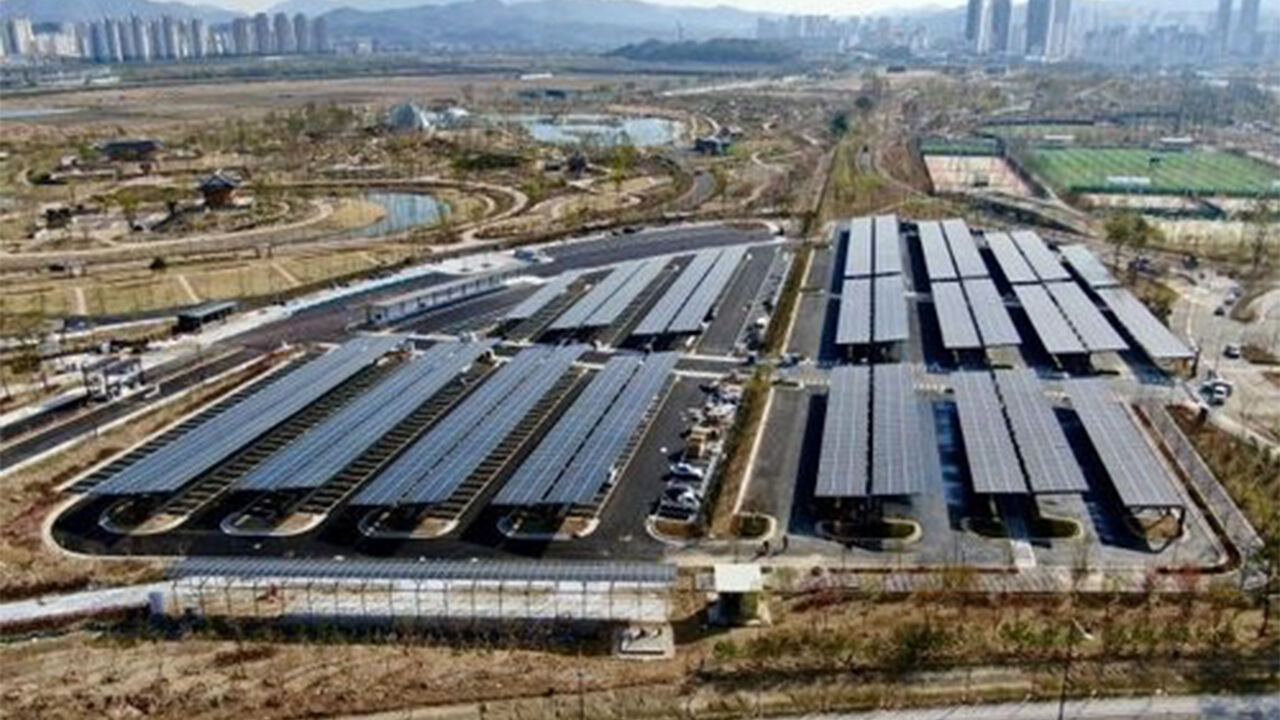
▲ Solar power generation facilities installed in the parking lots of Sejong Central Park and the National Sejong Arboretum
A plan to impose renewable energy generation targets on public institutions, including local public enterprises, is expected to be introduced next year.
According to the Ministry of Climate, Energy and Environment and the Korea Energy Agency on October 25, the Climate Ministry is pushing for the introduction of a "renewable energy target management system for public institutions."
The target management system will be introduced in line with the abolition of the Renewable Portfolio Standard (RPS) scheduled for next year.
The RPS is a system that mandates power generators with generation facilities of 500 megawatts (MW) or more, such as Korea Electric Power Corporation (KEPCO) and its power generation subsidiaries, to supply a certain percentage of their electricity generation from renewable energy.
The system is being phased out as more businesses chose to fulfill their obligations by purchasing Renewable Energy Certificates (RECs) from other renewable energy generators rather than expanding their own renewable energy generation facilities.
Following the abolition of the RPS, the renewable energy generation market will primarily operate under a system where businesses that successfully bid through competitive bidding within government-set price ceilings enter into long-term contracts with KEPCO to supply electricity at fixed prices.
The Climate Ministry is pushing to introduce the target management system as it deems necessary to ensure that public institutions continue to play a role in expanding renewable energy even after the RPS is abolished.
The targets will be established by dividing them into the "capacity of renewable energy generation facilities to be directly installed by the respective public institution" and the "scale of idle land to be provided to renewable energy generators."
Establishing targets based on the "scale of idle land provided to power generators" is intended to assign targets to public institutions other than power generation public enterprises that are capable of conducting power generation businesses on their own.
Korea Expressway Corporation and Korea Railroad Corporation (Korail) are expected to be prime examples of such targets.
The Climate Ministry plans to conduct a comprehensive survey of idle land status targeting public institutions and local public enterprises to first assess their renewable energy generation potential.
An official from the Climate Ministry said, "Competitive bidding will be held in the first half of the year after the RPS is abolished on January 1 of next year, and we plan to introduce the target management system before then."
The government, which aims to expand renewable energy generation facility capacity to more than 100 gigawatts (GW) by 2030, is emphasizing the role of public institutions.
This year, the government added "joining and implementation performance of K-RE100 (Korea-100% Renewable Energy Program)" to the management evaluation criteria for public institutions under the Act on the Management of Public Institutions, through which it has decided to raise the renewable energy usage rate of public institutions from the current average of 14% to 60% by 2030.
(Photo provided by the National Agency for Administrative City Construction, Yonhap News)
※ Please note: This article was translated by AI and may contain errors.


 Video News
 Video News
 Video News
 Video News
 Video News