
 KOR
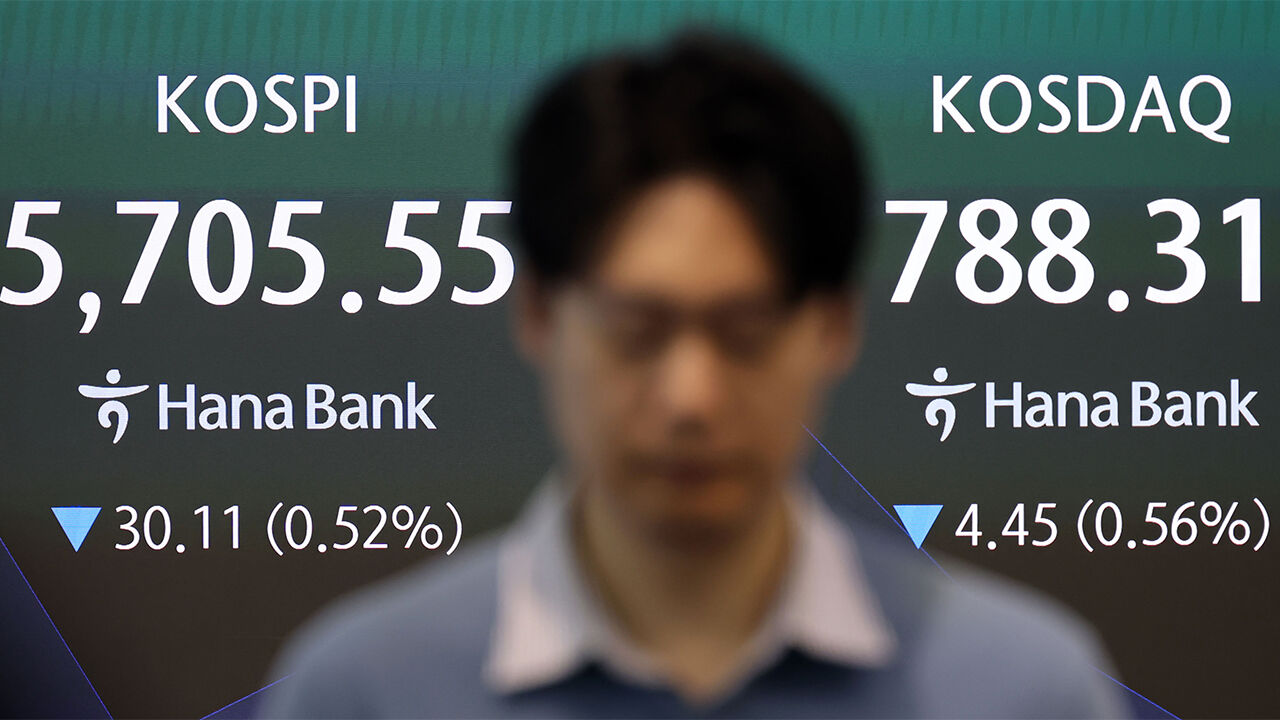
▲ Market conditions, including the KOSPI index, are displayed on an electronic board at the dealing room of Hana Bank in Jung-gu, Seoul, on the 22nd. On this day, the KOSPI opened at 5670.11, down 65.55 points (1.14%) from the previous session. The KOSDAQ opened at 789.84, down 2.92 points (0.37%) compared to the previous session.
The KOSPI is experiencing a sharp decline during trading today (22nd) as the market struggles to shake off skepticism regarding investment profitability, despite consecutive strong earnings reports from AI-related companies.
According to the Korea Exchange, as of 2:57 PM today, the KOSPI has plummeted by nearly 4% compared to the previous trading day, hovering in the 5,500 range.
Although it attempted a rebound by reducing its losses early in the session, the index soon widened its downward trajectory.
Market heavyweights Samsung Electronics and SK hynix, which account for approximately 51% of the KOSPI's total market capitalization, are dragging down the index with declines in the 4% to 5% range.
Samsung Electronics showed a slight rebound early in the session, and SK hynix narrowed its losses, but both stocks soon turned sharply downward.
This appears to be driven by profit-taking following the previous day's surge of over 5% in these large-cap semiconductor stocks, alongside ongoing controversy regarding potential double listing related to SK hynix's push for the initial public offering of its U.S. subsidiary, Solidigm.
Additionally, analysts interpret that market pressure mounted after hyperscaler Meta released strong third-quarter earnings before the regular market opened but failed to provide specific capital expenditure guidance for next year.
Meta's third-quarter free cash flow (FCF) also turned into a deficit of USD 2.12 billion.
Furthermore, supply-demand gaps emerged as the large-scale treasury stock purchases by Samsung Electronics and SK hynix—which previously acted as a buffer against downward pressure on the KOSPI—recently concluded.
Samsung Electronics completed its KRW 15 trillion treasury stock acquisition on the 6th, while SK hynix finished its KRW 40 trillion treasury stock acquisition on the 21st.
Consequently, net buying by other corporations, which once averaged KRW 1.6 trillion per day, has weakened to the KRW 20 billion range as of the same time.
Foreign investors, who maintained a net buying advantage of around KRW 650 billion in the KOSPI market the previous day, shifted back to a net selling advantage of about KRW 250 billion, while institutions also net-sold around KRW 230 billion, leaving no clear supply-demand driving force to pull up the index.
Meanwhile, the Bank of Korea's decision to freeze the benchmark interest rate at 3.00% per annum today, which was evaluated as a hawkish freeze favoring monetary tightening, also appears to have impacted the market.
BOK Governor Shin Hyun-soong strongly hinted at the possibility of future rate hikes, stating, "Because growth and inflation pressures are expected to be even stronger than our August projections, it is necessary to maintain the current restrictive policy stance."
(Photo: Yonhap News)
※ Please note: This article was translated by AI and may contain errors.



 Video News
 Video News

