
 KOR
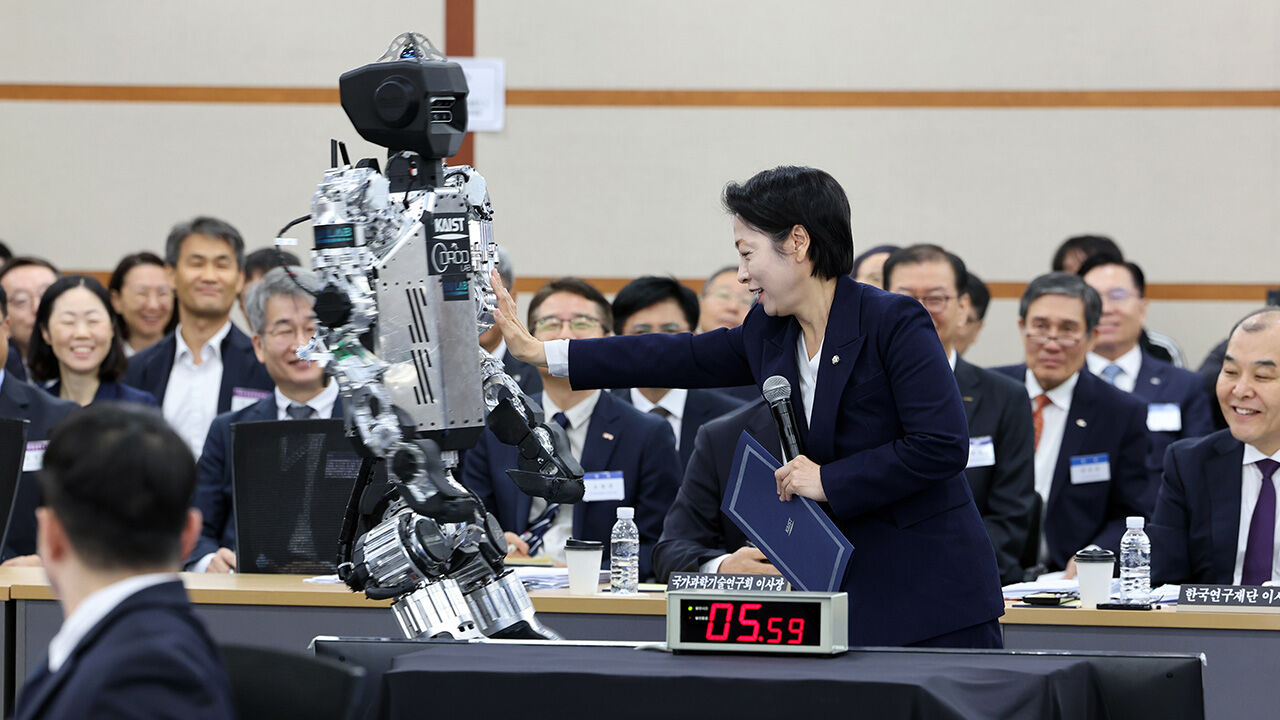
▲ Rep. Hwang Jung-a of the Democratic Party of Korea explains the balance control capabilities of a humanoid developed by Professor Park Hae-won's team and pushes the robot during a parliamentary audit held at the Korea Advanced Institute of Science and Technology (KAIST) in Yuseong District, Daejeon, on October 20.
Today, a KAIST humanoid robot made an appearance at the National Assembly's Science, ICT, Broadcasting and Communications Committee parliamentary audit of 54 government-funded agencies, including the National Research Council of Science and Technology, the Korea Institute of Science and Technology, and the Electronics and Telecommunications Research Institute, held at the Korea Advanced Institute of Science and Technology (KAIST) in Yuseong District, Daejeon.
Rep. Hwang Jung-a of the Democratic Party of Korea, who earned her bachelor's, master's, and doctoral degrees in physics from KAIST, remarked during her questioning turn that many lawmakers had visited her alma mater, and introduced the humanoid developed by KAIST.
As the doors to the meeting room opened, a silver-and-black humanoid standing about 180 centimeters tall entered the audit chamber with a natural walking gait.
Named "KAIST Humanoid v0.7," this bipedal walking robot was developed by a team led by Professor Park Hae-won of KAIST's Department of Mechanical Engineering.
According to KAIST, the humanoid developed by Professor Park's team is roughly the size of an adult male, weighing about 75 kilograms, and is capable of high-speed running at up to 12 to 13 kilometers per hour and overcoming obstacles of 30 centimeters or higher.
The research team directly designed and manufactured core components in-house, including the motors, reducers, and motor drivers.
The humanoid can also perform dynamic full-body control movements such as duck-walking, playing soccer, and carrying objects.
Rep. Hwang also highlighted these capabilities, saying, "I am on the stronger side, but it does not fall over even when pushed," and directly shoved the humanoid's chest several times.
The robot reportedly detects external force when applied and restores its balance by mobilizing dozens of joint motors.
The KAIST humanoid's exit was also extraordinary.
The robot exited the meeting room performing a moonwalk to the King of Pop Michael Jackson's song "Billie Jean".
At the sight, ruling and opposition lawmakers as well as heads of the audited institutions broke into broad smiles and applause.
A KAIST official stated that the humanoid developed by Professor Park's team is an example of overcoming the gap between simulation and reality by applying a reinforcement learning-based artificial intelligence controller, adding that the moonwalk was not an action programmed by humans, but one that the AI learned on its own through reinforcement learning.
Rep. Hwang stated that through the parliamentary audit, the committee will seek ways to help science and technology institutions operate better and work together to pave the way for more of such outstanding technologies to emerge.
(Photo: Yonhap News)
※ Please note: This article was translated by AI and may contain errors.


 Video News
 Video News
 Video News
 Video News
 Video News