
 KOR
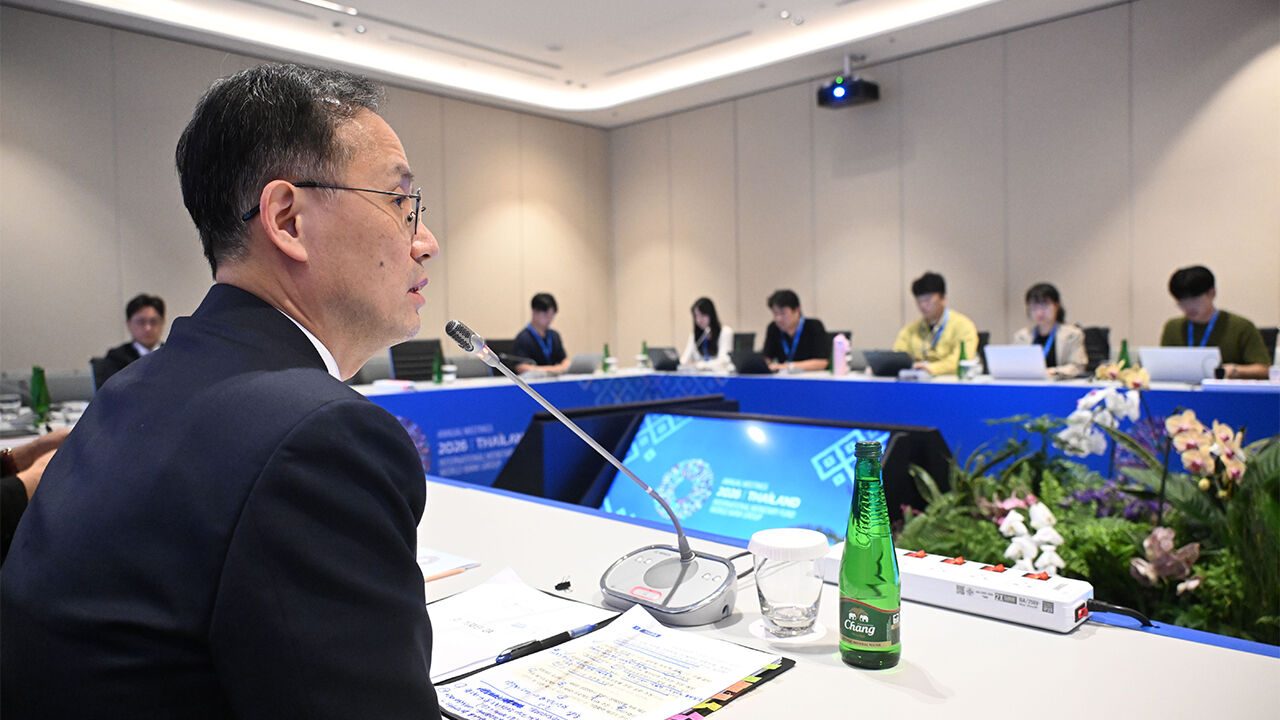
▲ Deputy Prime Minister Lee Hyoung-il answering questions from reporters
Deputy Prime Minister and Minister of Economy and Finance Lee Hyoung-il stated, "If private rental apartments in regulated areas are sold to the public sector and used for public purposes, we are also considering additional capital gains tax reductions."
Deputy Prime Minister Lee revealed these supplementary plans for real estate tax reform during a press conference with the accompanying press corps held on October 16 (local time) at the Queen Sirikit National Convention Center (QSNCC) in Bangkok, Thailand, where he was visiting to attend the G20 and G7 Finance Ministers and Central Bank Governors Meetings and the International Monetary Fund (IMF) and World Bank (WB) Annual Meetings.
Private rental housing is a type of registered rental business where the government provides tax benefits, such as exemptions from heavy capital gains taxes, provided that operators observe the mandatory rental period—usually 8 to 10 years—and do not increase rent by more than 5% per year.
However, amid criticisms that tax special exceptions related to private rental apartment operators were excessive, the government decided to abolish the heavy capital gains tax exemption for private rental apartments in regulated zones under the 2026 tax reform proposals announced in August.
Nevertheless, the government has announced a policy to partially pivot toward easing tax burdens exclusively for sales to the public sector in order to revitalize transactions.
According to the Ministry of Economy and Finance, automatically expired private rental apartments in regulated zones from 2021 to 2026 amount to 63,000 units (including previously disposed volumes).
Deputy Prime Minister Lee explained, "There are concerns that even when housing rental business operators try to sell their private rental apartments, transactions do not go well, and from the tenants' perspective, there are concerns that key-money deposits and monthly rent prices may become unstable."
Regarding the public sector, he added, "Korea Land and Housing Corporation (LH) would be a representative example, but the exact scope of where the public sector extends is something we need to deliberate further down the road."
Regarding the prospects of the real estate tax reform proposals, including this measure, passing through the National Assembly, he noted, "We will sufficiently discuss it in the (taxation) subcommittee in November, and if reasonable opinions are provided, we are fully willing to review them."
Regarding housing price forecasts, he replied, "There will be various factors, and I suppose we need to continue monitoring and observing them."
Regarding the taxation of virtual assets currently being discussed in the National Assembly, he refrained from making extensive comments, asking to "understand this as a process of listening [to opinions]."
Asked to evaluate recent consumer inflation trends, he diagnosed, "As the Middle East war continues, upward pressure on prices persists, and we are in a situation where we must pour all our efforts into responding to inflation every single month."
On the timing for terminating the ceiling price system for petroleum, he also said, "There is still plenty of room to observe before making a judgment, given issues like the Middle East war."
Regarding the newly established sovereign wealth fund, he evaluated, "While the Korea Investment Corporation (KIC) invests solely overseas, the sovereign wealth fund can invest in both domestic and foreign markets, so it will serve as a great opportunity to foster our country's strategic industries."
When asked if there are plans to additionally implement emergency buybacks to stabilize government bond yields, he replied, "It will be decided depending on market conditions."
(Photo provided by Ministry of Economy and Finance, Yonhap News)
※ Please note: This article was translated by AI and may contain errors.


 Video News


 Video News
