
 KOR
⚡ Spread Key Summary
Self-checkouts were introduced as a system to cut labor costs and shift the burden of checkout onto customers. However, as missed scans and inventory shrinkage rates (rising by up to 33%) surged, along with a growing need for error handling and supervision, the role of employees was restructured from "cashiers" to "supervisors and problem solvers."
Experiments with cashierless stores, such as Amazon Go, either stagnated due to technical and economic limitations or shifted toward off-site avatar labor. Meanwhile, Korean-style unmanned stores, such as unmanned ice cream shops, are also facing side effects as the costs of discerning intent, monitoring theft, and judicial processing are dispersed across store owners, the police, and the courts.
Automation and unmanned operations did not simply eliminate the work previously performed by workers; instead, they fragmented the tasks and shifted them onto other parties—including customer self-labor, post-hoc surveillance by store owners, technology-driven remote customer service, and criminal determinations by judicial authorities.
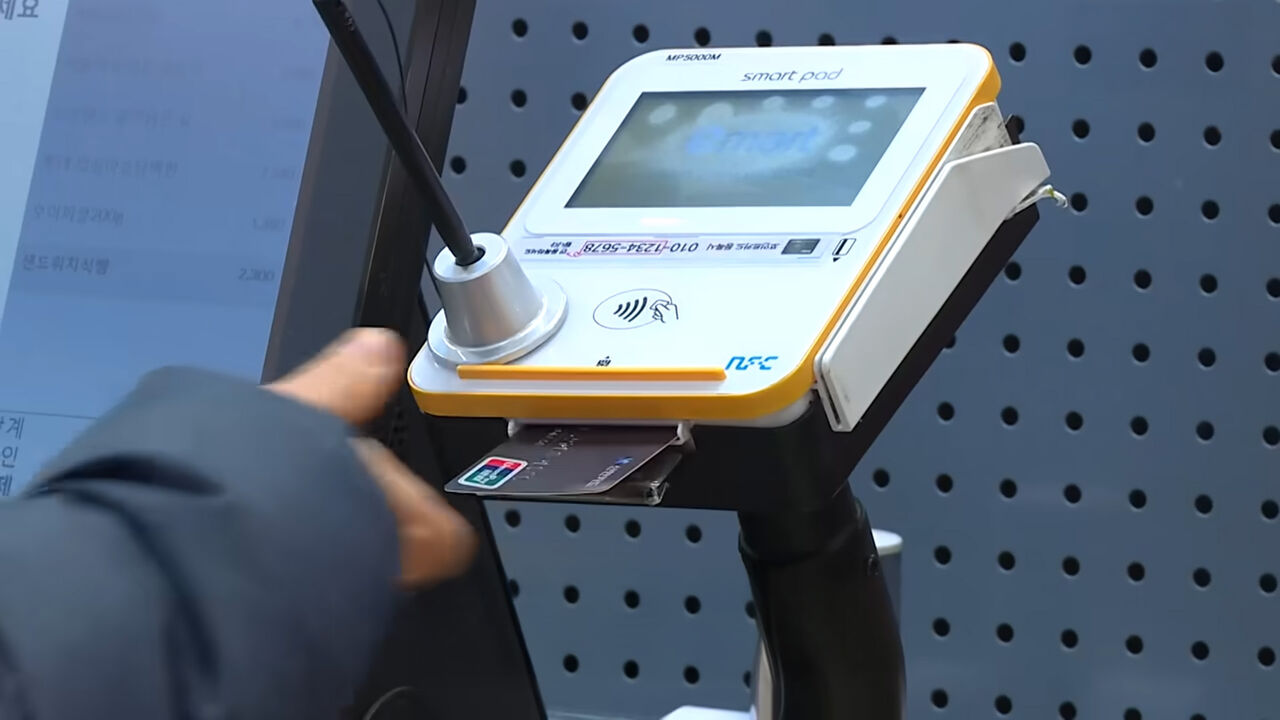
Scanning items, bagging them, inserting payment cards, and collecting receipts all on one's own—this is the self-checkout. By having customers handle the checkout process themselves, supermarkets aimed to reduce staff while allowing shoppers to check out faster.
Yet, something unexpected is happening. In 2024, U.S. discount retail chain Dollar General eliminated or significantly scaled back self-checkout kiosks across approximately 12,000 stores. One of the main reasons was "shrinkage." What is even stranger is that reducing staff did not make the work disappear. Where did the work go once humans were removed from those posts?
01. The Work Done by Employees Was Passed on to Customers
In stores equipped with self-checkout kiosks, 54% of all transactions go through self-checkouts. In terms of sales revenue, it accounts for roughly 41%, primarily used by shoppers with small baskets purchasing only a few items.
For supermarkets, the advantages appear clear. Several machines simultaneously handle the work previously carried out by one cashier per customer. While cutting labor costs, the checkout work once done by employees was shifted to the customers. Keep this concept of "shifted" in mind.
02. The Numbers Kept Falling Short
A study released in June 2026 illustrates the problem. Professor Matt Hopkins of the University of Leicester in the UK analyzed data from 39 major retail companies. In the first year of adopting self-checkouts, inventory shrinkage grew by an average of 22% compared to previous levels. Stores with self-checkouts experienced an inventory loss rate that was on average 33% higher than stores without them. Because this compared different stores, self-checkouts cannot be definitively identified as the sole cause.
The most common issue is missed scans—customers walking through without scanning an item. This occurred in anywhere from 1% to up to 4.8% of all transactions. The problem is that a machine cannot discern whether an unscanned item was an honest mistake or an intentional act from the start. Retailers' estimates of the "deliberate proportion" varied wildly, ranging from 6% to 80%.
Matt Hopkins | Professor of Criminology, University of Leicester, UK
How can anyone know what is going on inside a person's head? There are also many genuine mistakes. Distinguishing between intent and error is extremely difficult.
How can anyone know what is going on inside a person's head? There are also many genuine mistakes. Distinguishing between intent and error is extremely difficult.
Unfamiliar screens, hard-to-scan items, and finicky barcodes—missed scans can happen for very ordinary reasons.
03. Humans Were Brought Back
Retailers sought to resolve the issue through technology. When ceiling cameras detect an unscanned item, video footage pops up on the screen prompting the shopper to scan it again—a so-called soft nudge. Research showed that when such alerts appeared, more than 80% of customers rescanned the item on their own.
Even so, humans were still needed. An analysis of approximately 5.7 million transactions across 241 stores with self-checkouts at a European grocery chain showed that for every 10,000-transaction increase in self-checkout usage, calls for staff assistance rose by about 1,000.
Mike Burger | Ralphs Employee (31 years of service)
The company does not want to open more staffed registers. Because instead of one register per employee, they can assign one employee to oversee seven self-checkout kiosks.
The company does not want to open more staffed registers. Because instead of one register per employee, they can assign one employee to oversee seven self-checkout kiosks.
The city of Long Beach, California, mandated that starting in September 2025, stores must assign one dedicated staff member for every three self-checkout kiosks. Stores were also required to keep regular staffed registers open. Ahead of the ordinance taking effect, five stores in Long Beach closed their self-checkouts. The retail company cited provisions in the ordinance, such as restrictions prohibiting the sale of locked merchandise via self-checkout, as reasons for the decision.
In the United States, Target converted self-checkout kiosks at most of its stores starting in 2024 into "express checkouts" for customers with 10 items or fewer, while operating staffed traditional lanes alongside them. In an announcement in 2025, Target reported that overall checkout wait times decreased by roughly 8%.
Large discount stores in South Korea already present a similar scene. Staff members stand right beside self-checkout areas. Monitoring several kiosks at once, they clear error messages, verify customer age for restricted purchases, and resolve payment glitches. Their role has transformed from being a cashier into a problem solver and site manager.
04. What Happened When Humans Were Completely Removed
What happens if both cashiers and supervisory personnel are eliminated entirely? One of the most famous experiments was Amazon's "Amazon Go." Cameras and sensors automatically tracked who picked up what items, allowing shoppers to simply walk out without passing through a checkout counter.
However, in January 2026, Amazon decided to shutter its own brick-and-mortar Amazon Go and Amazon Fresh locations. Amazon explained that it had been unable to develop an economic model suitable for large-scale expansion while providing a sufficiently differentiated customer experience.
Cashierless technology itself did not vanish. Amazon's "Just Walk Out" technology continues to be utilized in stores and venues operated by third-party retailers.
Experiments in fully unmanned retail also continued elsewhere. In 2021, French retailer Carrefour opened a 50-square-meter cashierless test store in Paris. Equipped with 60 cameras and 2,000 shelf sensors, the store employed only four staff members. Their duties involved managing store opening and operations and preparing online orders. Eliminating the checkout register did not mean the work of running the store had ceased to exist.
Lawson in Japan introduced "avatar staff." Workers remotely control on-screen avatars inside the stores from distant locations. They direct customers to product aisles and explain how to use self-checkout kiosks.
Aoi | Lawson Avatar Operator
I connect to this store from my home in Osaka. I really wanted to continue doing customer service work.
I connect to this store from my home in Osaka. I really wanted to continue doing customer service work.
Aoi, who had previously stepped down from a position at Lawson due to back trouble, was able to interact with customers again as an avatar operator. Lawson also operates a system where telecommuting operators oversee avatars across multiple stores. While on-site headcount was reduced, human labor did not vanish completely. Part of the work had simply moved beyond the store walls.
05. South Korea's Unmanned Stores: A Different Model
The unmanned stores familiar in South Korea follow a slightly different model. Unmanned ice cream shops, unmanned stationery stores, and unmanned snack shops. Rather than relying on cameras and AI to tally bills automatically, they resemble a low-cost unmanned model where scanning and payment are left to customers, while surveillance is left to store owners. According to data from the National Police Agency, thefts at unmanned stores surpassed 10,000 cases in 2024. Yet, an unpaid item does not automatically mean theft took place.
06. A Mistake or Theft?
In July 2025, at an unmanned ice cream shop, a student preparing for college entrance exams paid for four ice creams and a plastic bag, but left without paying for a single 1,500-won snack. The prosecution issued a suspension of indictment on theft charges. The Constitutional Court overturned the disposition in a unanimous ruling by all nine justices, stating that criminal intent to steal could not be definitively established, given that the student had paid normally for the other items and used a credit card in their own name. While surveillance cameras clearly captured the individual leaving without paying for the item, the footage alone could not prove whether it was an innocent mistake or theft.
Had an employee been present, the situation might have ended with a simple phrase: "You missed scanning this one item." In an unmanned store, however, the owner must replay CCTV footage, reconcile payment records, and evaluate what the customer's intent might have been after the fact.
Unmanned Store Owner
When a customer visits at a specific time and no payment record exists, you think, 'This person left without paying,' and you start replaying the CCTV footage.
When a customer visits at a specific time and no payment record exists, you think, 'This person left without paying,' and you start replaying the CCTV footage.
Although store owners are not physically in the stores, they monitor CCTV on their smartphones, check payment logs, and report incidents to the police if necessary. The checkout task has been passed to customers, surveillance to store owners, and adjudication to the police and the courts. Even then, store owners cannot draw conclusions at will based on CCTV footage. In Incheon, an unmanned store owner who posted a CCTV snapshot of an 8-year-old child who left without paying for ice cream inside the store was sentenced on appeal to a fine of 2 million won for child abuse and defamation.
It seemed that removing human staff would make the work they performed disappear, but it did not vanish. Instead, it was fractured, displaced, and transferred to others. In the spaces where workers once stood, who is doing that work now?
Deep Dive Q&A
Q1. What were the decisive factors and statistical grounds that prompted major retailers, including Dollar General in the U.S., to withdraw or restrict self-checkouts?
A1. The most decisive factor was the massive "inventory shrinkage" stemming from self-checkout implementation. According to a study published in 2026 by Professor Matt Hopkins of the University of Leicester, stores with self-checkouts experienced an inventory loss rate that was an average of 33% higher than those without, with losses swelling by 22% in the first year of adoption alone. As "missed scans"—passing through without scanning barcodes—occurred in up to 4.8% of all transactions, retailers could no longer absorb the retail losses from errors and theft, leading them to curtail or dismantle self-checkout operations.
Q2. What is meant by the criticism that the rollout of unmanned stores and self-checkouts did not eliminate human labor entirely, but rather "transferred" it onto others?
A2. The labor of scanning goods and processing payments previously performed by cashiers was shifted onto shoppers. Furthermore, the labor of detecting and assessing checkout errors or simple oversights—once handled immediately on site—became fragmented and transferred into store owners' post-hoc CCTV reviews, as well as police investigations and judicial evaluations. In addition, while in-store cashiers disappeared, human labor merely altered its form and location—such as on-site attendants assisting with error resolution and age verification, or remote avatar operators located outside the store. This underscores that human labor remains essential to keeping retail stores running.
※ Please note: This article was translated by AI and may contain errors.


 Video News
 Video News
 Video News
 Video News
 Video News