
 KOR
KOR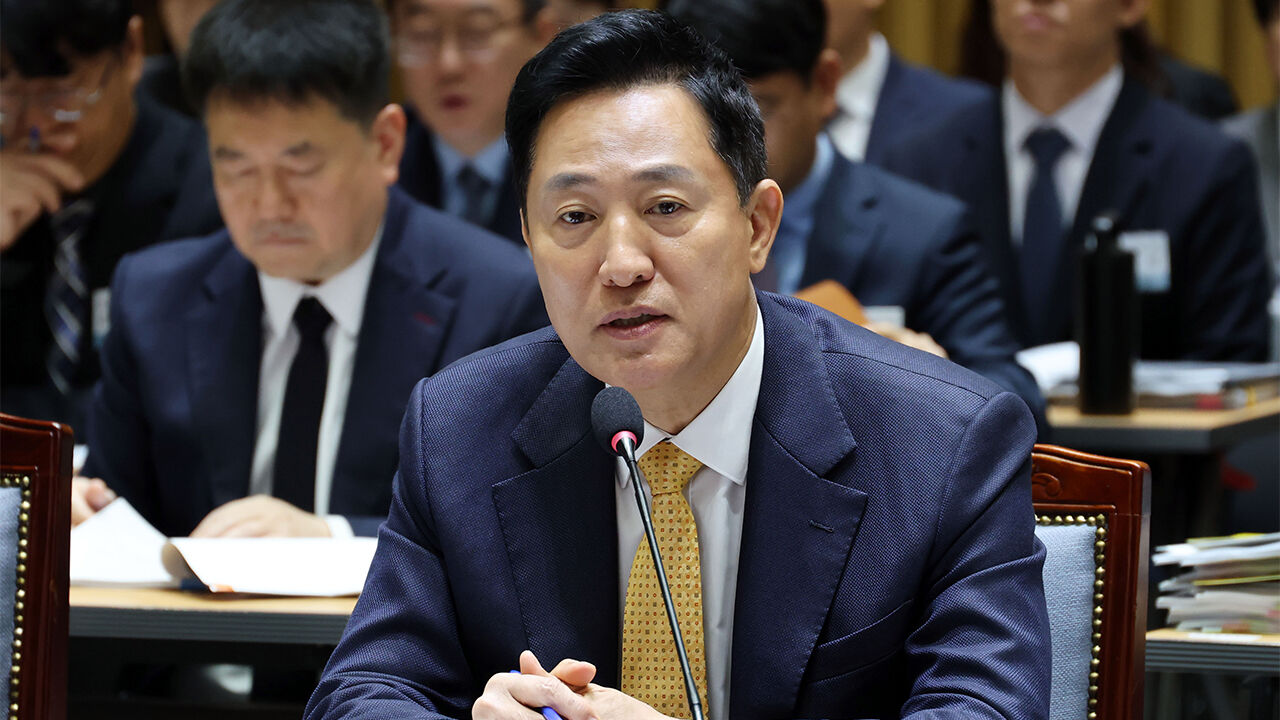
▲ Seoul Mayor Oh Se-hoon answers questions from lawmakers during a parliamentary audit by the Public Administration and Security Committee held at Seoul City Hall on the 15th.
Seoul Mayor Oh Se-hoon has once again voiced opposition to the current administration's plan to supply housing on parts of the Yongsan Park site, urging a major overhaul of the government's housing policy direction.
Mayor Oh expressed these views today (the 15th) during the Seoul Metropolitan Government audit by the National Assembly's Public Administration and Security Committee.
In response to a question from People Power Party lawmaker Joo Ho-young regarding plans to preserve Yongsan Park and utilize the Tancheon Water Recycling Center site as an alternative housing supply location, Mayor Oh criticized, "The government's plan to develop apartments on the main Yongsan Park site, particularly the officer quarters or military apartment sites, is a measure that directly defies the Special Act on Yongsan Park."
He added, "According to a poll conducted by the Seoul Metropolitan Government targeting Seoul citizens, close to half of the respondents are opposed to the development (of Yongsan Park), and I plan to strongly emphasize this to the incoming Minister of Land, Infrastructure and Transport soon."
Mayor Oh explained, "Even if we were to utilize Yongsan Park, there are various obstacles that make it impossible to even break ground during this administration," noting, "The soil is contaminated, so it will take at least three to four years, or six to seven years, to purify it."
He continued, "Since the plan for the Tancheon site was also established with a horizon of about 10 years ahead, we judged that whether we utilize the Tancheon site or the sewage treatment plant, we can supply apartments at almost the same time as utilizing Yongsan Park," adding, "I plan to meet with the new Minister of Land, Infrastructure and Transport soon to begin discussions on this matter as well."
Regarding the rise in housing prices in the metropolitan area, he emphasized the importance of citizens' trust in housing supply.
Mayor Oh remarked, "I think the key is whether Seoul citizens can have prediction and conviction regarding the housing supply," asking, "Since Seoul citizens cannot have conviction (in the supply), isn't that why preemptive speculative demand arises to buy (homes) before prices go up?"
He emphasized, "I see this as the primary cause (of rising housing prices)."
Addressing the recent upward trend in apartment prices in Seoul's outer areas, he argued it is closely related to soaring jeonse (lump-sum housing lease) and monthly rent prices.
Mayor Oh analyzed, "Because of the current government's policy emphasizing actual residence, jeonse and monthly rent prices are rising sharply right now. To add insult to injury, there is a shortage of jeonse listings themselves," explaining, "As a result, a phenomenon is occurring where people are being driven toward buying homes."
He also agreed with a point raised by People Power Party lawmaker Seo Myung-ok that the cancellation of Newtown redevelopment zones during former Mayor Park Won-soon's tenure has impacted the current housing supply shortage.
He pointed out, "Because the housing units that were supposed to be supplied sequentially by the tens of thousands every year disappeared all at once at that time, it inevitably has an impact that extends 5, 10, or even 15 years down the road."
He added, "Since Seoul is not a city with much available land, the trio of redevelopment, reconstruction, and Moa Town projects serve as the primary sources of new housing supply."
As measures to accelerate housing supply, Mayor Oh proposed two recommendations to the government: easing restrictions on the transfer of union membership status and providing relocation cost support.
He stated, "Restrictions are placed on transferring union membership status, but if you temporarily lift this for just three years, sources of conflict within unions will decrease significantly, speeding up (housing supply)," and added, "This is a way the government can help Seoul."
He further noted, "We believe that helping ensure a smooth supply of relocation costs will also be helpful in accelerating the process."
He also suggested measures to expand tax and financial support for private rental housing businesses.
Mayor Oh argued, "Private rental businesses supplying rental housing helps stabilize the jeonse and monthly rent market," asserting, "In a situation where jeonse and monthly rent prices are rising so steeply, tax and financial benefits for private rental housing businesses must be dramatically increased."
He added, "Creating a policy environment that allows them to enter various rental housing markets, including youth rental housing and youth safe housing, is what the government should be doing, but they are falling very short in this regard."
Regarding the ruling party and government's plan to transfer authority for approving redevelopment and reconstruction projects of 500 households or fewer to autonomous districts, Mayor Oh criticized that "(the supply) will become even slower."
In response to People Power Party lawmaker Kang Myung-gu's remark questioning whether the policy is a strategy to "strip Mayor Oh of his power," he stated, "Whether the mayor's power is diminished or not is not what matters; ultimately, procedures will become more protracted, confusion in the field will grow, and it will end in chaotic development that we will come to regret."
When Democratic Party lawmaker Lee Hae-shik argued that the policy would accelerate small-scale redevelopment and reconstruction, Mayor Oh retorted, "Does the district office have the personnel to handle this?"
Furthermore, responding to a question from People Power Party lawmaker Park Sang-woong regarding why the negative assessment rate for President Lee Jae-myung is relatively high in Seoul, Mayor Oh answered, "It must be due to the triple strong trend—namely, the rise in home purchase prices, increases in jeonse and monthly rent, and the agony of not being able to find jeonse listings even if you search for them."
He also raised concerns that the government's tax overhaul proposal will ultimately increase the burden on tenants.
Mayor Oh stated, "If the government's tax reform proposal is implemented as announced, the increasing tax burden will be passed back onto tenants with a time lag, leading to another round of jeonse and monthly rent increases," adding, "Many experts' view is that it will be difficult to escape this vicious cycle where rising jeonse and monthly rent prices push purchase prices back up."
He also raised concerns that the government's expansionary fiscal stance could fuel instability in the real estate market.
Mayor Oh pointed out, "Looking at historical statistical figures, real estate price increases are precisely proportional to the total money supply in circulation," noting, "With the Lee Jae-myung administration excessively pursuing expansionary fiscal policy, next year's budget is also expected to increase significantly."
He added, "Experts believe that if that happens, it will once again serve as the biggest foundation for instability in the real estate market."
(Photo: Yonhap News)
※ Please note: This article was translated by AI and may contain errors.


 Video News


 Video News
 Video News