
 KOR
KOR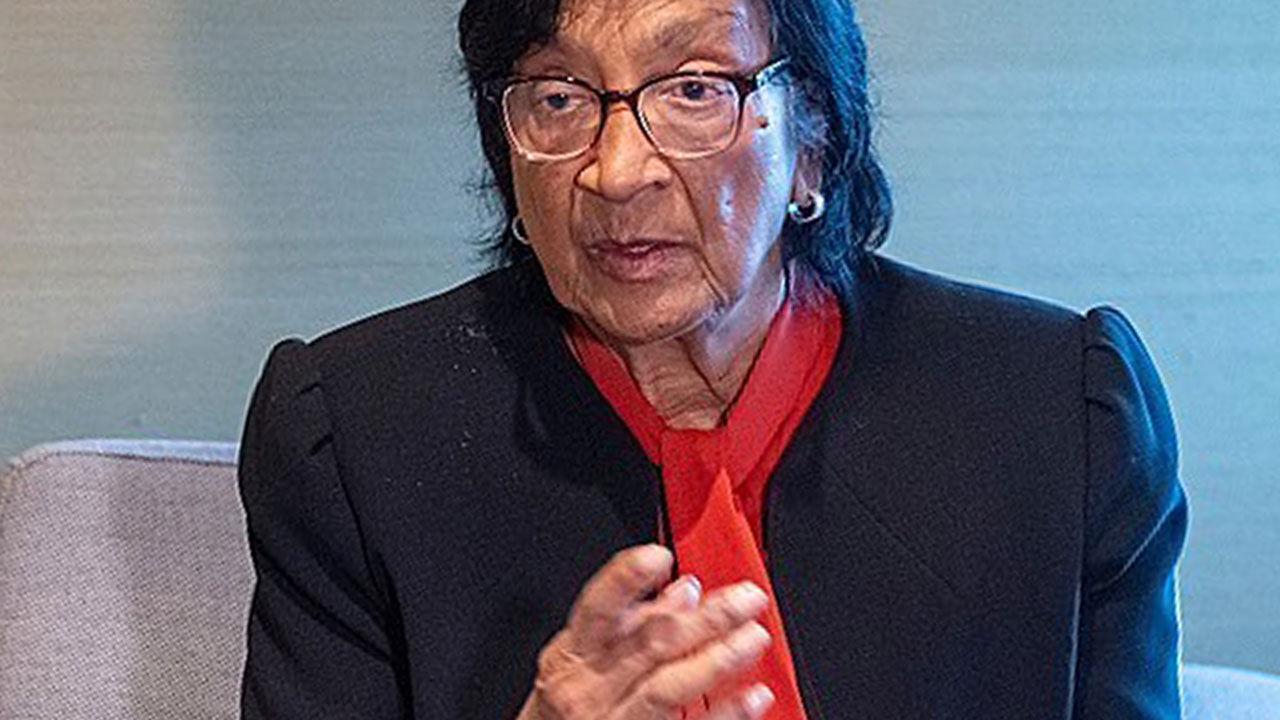
▲ 2026 Nobel Peace Prize laureate Navi Pillay
Navi Pillay, the 85-year-old winner of this year's Nobel Peace Prize, criticized U.S. President Donald Trump's sanctions against the International Criminal Court (ICC) as "illegal" on the 14th (local time), stating that President Trump is in need of education on international law.
In an interview with AFP, Pillay claimed that the announcement of U.S. sanctions against the ICC just hours after her Nobel Prize win was no coincidence, suggesting it was a reaction to the award not going to President Trump.
Born in 1941 to an Indian family in South Africa, Pillay served as an ICC judge from 2003 to 2008.
Asked what message she would like to convey to President Trump, Pillay said, "Tell him to call in his legal advisers and ask them to explain what international law is," adding, "He should have his advisers explain to him why his interference with an independent international court is what we call illegal."
Previously, the Trump administration announced sanctions on the 9th, the day of the Nobel Peace Prize announcement, aimed at paralyzing the ICC's routine operations, including its bank transactions and information technology (IT) systems.
The Trump administration has vowed to dismantle the ICC, infuriated by ICC judges issuing arrest warrants for Israeli Prime Minister Benjamin Netanyahu.
Pillay pointed out that this move is "selective, double-standardized, and wrong," noting that previous U.S. administrations welcomed ICC arrest warrants for Russian President Vladimir Putin.
The U.S. sanctions against the ICC are set to take effect in six months.
Dutch Prime Minister Dick Schoof urged talks with the U.S. during the period before the measures take effect to discuss "ICC reform."
However, Pillay stated that the term "ICC reform" is a "euphemism" and that what Trump wants is "a guarantee that investigations against U.S. citizens will not proceed."
"That should not be done, because you cannot apply double standards," Pillay said. "You cannot selectively investigate one group and not investigate another. That would set a very bad and dangerous precedent."
Pillay also responded to Israeli officials who reacted with outrage to her Nobel Peace Prize win.
The Independent International Commission of Inquiry on the Occupied Palestinian Territory, including East Jerusalem, and Israel (COI OPTEJI), which she chaired until last year, issued a report in September of last year stating that Israel is committing genocide in the Gaza Strip.
The commission was established by a 2021 UN Human Rights Council (UNHRC) resolution.
The Israeli Foreign Ministry previously criticized Pillay's Nobel Peace Prize win by claiming that Nazi propagandist Joseph Goebbels (1897–1945) would be "applauding from hell."
In response, Pillay said, "I think that is very hurtful and insulting," adding, "Goebbels had blood on his hands... He was responsible for the deaths of thousands of people, not only Jews, but people of color like me."
Asked whether Prime Minister Netanyahu might one day stand in the ICC dock, Pillay replied, "I have spent my life watching people overcome difficulties. So I am certain that such a day will come."
Pillay mentioned that she initially found it hard to believe when she heard the news of her award, saying, "Because it is very rare for the award to be given to women. There has been serious inequality in awarding practices so far."
Pillay said she is consulting with people on how best to use her Nobel prize money of 12 million Swedish kronor (approx. 1.61 billion won), hinting that a portion could be invested in her homeland, South Africa.
"Africa is suffering. South Africa is suffering. It is very difficult to raise funds there," she said, adding, "The University of KwaZulu-Natal (UKZN) has established an organization named after me, so I intend to start discussions with them. I believe in the value of education for children and youth."
Pillay is an alumna of the University of Natal, the predecessor to UKZN in South Africa.
Under the UKZN School of Law, there is the "Navi Pillay Research Group," which handles fields such as human rights, social justice, and policy studies.
(Photo: AP, Yonhap News)
※ Please note: This article was translated by AI and may contain errors.




 Video News
 Video News
 Video News