
 KOR
KOR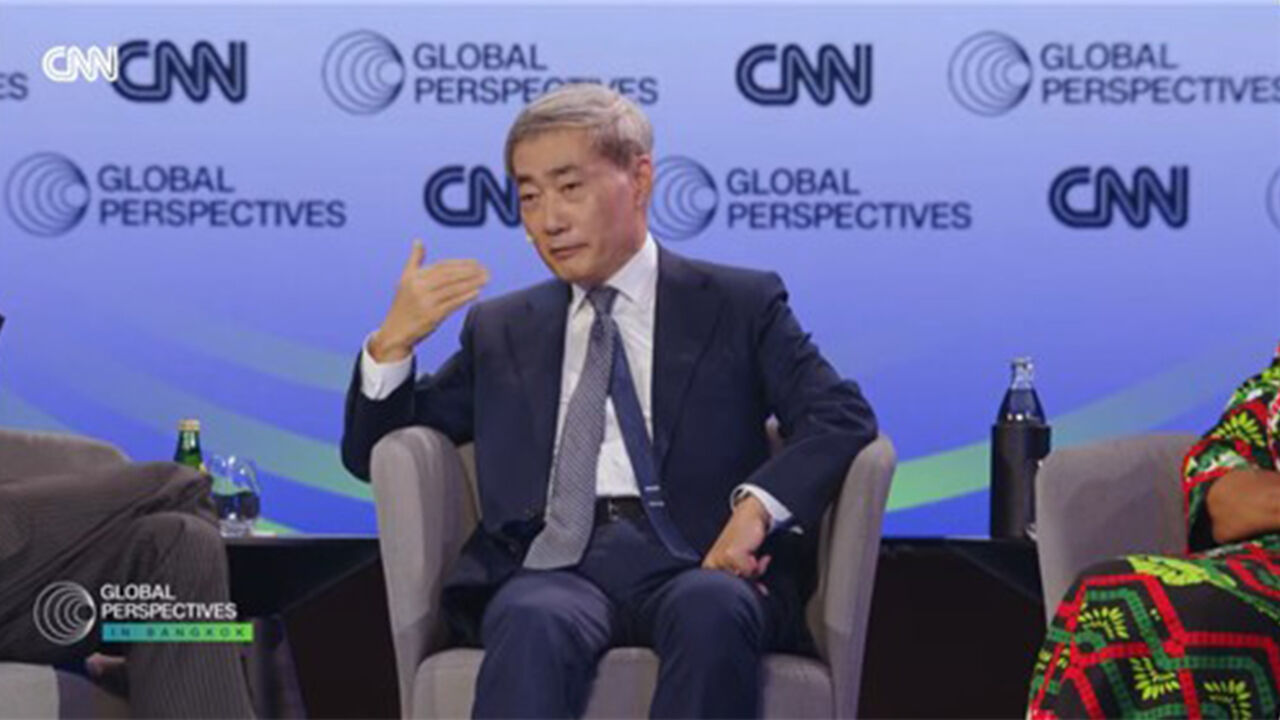
▲ Bank of Korea Governor Shin Hyun-song participating in a panel discussion on CNN's Global Perspectives.
Bank of Korea Governor Shin Hyun-song diagnosed that the artificial intelligence investment boom is overpowering the negative impacts of the Middle East war, but noted that both factors are acting as upward pressure on inflation.
He also warned against South Korea's "K-shaped polarization" and emphasized the importance of appropriately operating monetary policy to stabilize prices.
Speaking on the 14th (local time) at a CNN "Global Perspectives" panel discussion held in connection with the International Monetary Fund (IMF) annual meetings in Bangkok, Thailand, Governor Shin stated, "South Korea is currently at the intersection of two most critical trends: one is AI and the massive investment boom, and the other is the Middle East war, which is operating in the exact opposite direction."
He continued, diagnosing that "in terms of economic activity, the two factors operate in opposite directions, and the positive effects of the AI economy are overpowering the negative impacts of the Middle East war," while pointing out that "the two factors combine to increase upward pressure on inflation."
In response to the host's question about whether strong exports face the possibility of encountering downside economic risks, he answered, "It depends on how long the massive AI investments will last."
Governor Shin said, "Forecasting institutions are looking ahead to 2030 and expecting investments exceeding 1 trillion dollars over the next 3 to 4 years," adding, "These investments will vitalize global trade and ultimately have a positive impact on South Korea's economy as well."
Regarding the polarization phenomenon in South Korea's economy, he diagnosed, "In reality, South Korea is in a situation where a K-shaped economic pattern is distinct."
He emphasized, "The most important thing for a central bank to consider is the fact that inflation hits low-income groups the hardest," adding, "This is why we must lower inflation, and to achieve this, it is crucial to operate monetary policy correctly."
Governor Shin also mentioned regarding the experiences of financial crises that Asian nations like South Korea and Thailand went through in the late 1990s, saying that they are "engrained in our DNA," and that "those experiences have had a decisive influence on our policy approach toward macroeconomic and financial stability."
He warned, "We must be able to curb excessive leverage—meaning investment through borrowing—and excessive risk-taking before they spiral out of control," adding, "If we respond belatedly after risks have accumulated, it is like bursting a bubble."
Regarding South Korea's financial stability situation, he stated, "The Financial Vulnerability Index (FVI) is around 46, which corresponds to the long-term average level," and "since securing financial stability is one of the core responsibilities of the Bank of Korea, we monitor this indicator constantly."
He also mentioned the consumer inflation target of 2%, stating, "We will steadfastly uphold this principle without wavering."
(Photo: Capture from CNN YouTube, Yonhap News)
※ Please note: This article was translated by AI and may contain errors.



 Video News
 Video News

 Video News