
 KOR
KOR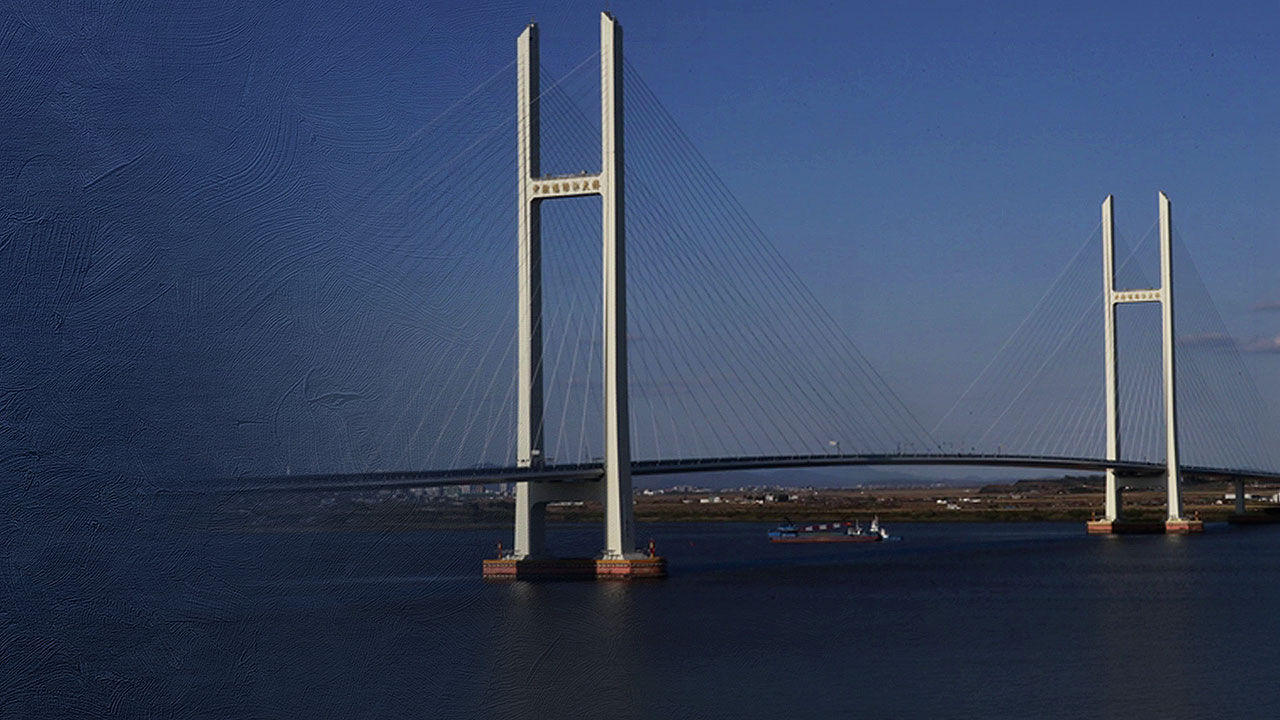
▲ New Yalu River Bridge between North Korea and China
The New Yalu River Bridge, connecting Dandong in China's Liaoning Province and Sinuiju in North Korea's North Pyongan Province, is scheduled to officially open on October 15.
China's state-run Xinhua News Agency reported on October 14 that following consultations between China and North Korea, the newly built New Yalu River Bridge will officially open on October 15, with a joint opening ceremony scheduled to take place on the same day.
Featuring four lanes and a total length of 3,026 meters, the New Yalu River Bridge was completed in 2014, but its opening to traffic had been delayed due to issues such as unfinished connecting roads and customs facilities on the North Korean side, finally opening officially after 12 years.
Until now, overland cargo transport between Dandong and Sinuiju, the largest trade hubs between North Korea and China, has relied on the Sino-Korean Friendship Bridge, which was completed in 1943.
The Sino-Korean Friendship Bridge has been viewed as having limitations in handling growing logistics due to its unusual layout, featuring a railway track on one side and a single-lane roadway on the other.
China invested approximately 2.2 billion yuan to build the New Yalu River Bridge to secure a new logistics corridor to replace the aging crossing.
Left neglected for a prolonged period after its completion, the New Yalu River Bridge was once cited as a prominent example reflecting unusual strains in bilateral relations.
Since 2024, when North Korea capitalized on the war in Ukraine to bolster military and economic cooperation with Russia, Pyongyang and Beijing experienced a chilly atmosphere, marked by rare high-level exchanges and the dispatch of lower-ranking officials than usual to events marking the anniversary of their friendship treaty.
However, following North Korean State Affairs Commission President Kim Jong-un's attendance at China's military parade commemorating the 80th anniversary of Victory Day in September last year, the two countries accelerated their exchanges.
Following the resumption of international passenger train services in March for the first time in six years, Chinese Foreign Minister Wang Yi visited Pyongyang in April to meet with Chairman Kim and Foreign Minister Choe Son-hui, and bilateral ties gained rapid momentum with a summit between Kim and Chinese President Xi Jinping during Xi's visit to North Korea in June.
Concurrently, speculation began circulating in Dandong that the opening of the New Yalu River Bridge was imminent.
Following the completion of work on connecting roads and customs facilities, final preparations for the opening were observed, including repainting traffic lanes at the Chinese border checkpoint and conducting test runs with trucks and passenger vehicles.
On October 13, large North Korean national flags and Chinese five-star red flags, which had not been present until the day before, were hung on the pillars on both sides of the bridge's northern gate, signaling that an opening ceremony was near.
The fact that trade exchanges have shown a swift recovery—with total bilateral trade between North Korea and China increasing by 19.6% year-on-year in the first half of this year and annual trade volume in 2025 recovering to 98.1% of pre-COVID-19 levels in 2019—also added weight to speculation of an imminent opening.
However, people-to-people exchanges, such as group tours to North Korea for Chinese tourists and the issuance of visas and tourist passes, have yet to normalize, prompting analysis that the impact of the bridge's opening will initially be confined to certain freight transport sectors for the time being.
Although North Korea and China have resumed international passenger train operations and direct flights, Chinese regular passport holders still require a North Korean visa or tourist pass to travel to North Korea.
Moon Il-hyun, a professor at China University of Political Science and Law, explained that even if the bridge opens, travel will inevitably remain limited as long as visas are not being issued, adding that substantial flows of both people and goods are necessary to cover the considerable costs of operating and maintaining the bridge.
Professor Moon analyzed that North Korea's delay in issuing visas to China appears to be a strategic move aimed at securing further concessions from Beijing.
Prior to this, on September 7, North Korea and Russia opened their first vehicular bridge connecting Rason in North Korea and Khasan in Russia—measuring about 1 kilometer long with two lanes—strengthening a hub for vehicular cargo and personnel traffic between the two countries.
※ Please note: This article was translated by AI and may contain errors.




 Video News
 Video News
 Video News