
 KOR
KOR
▲ Dr. Park Ji-ae (second from left) and her research team
A domestic research team has successfully analyzed how MXene, a next-generation nanomaterial drawing attention for cancer treatment and diagnosis, moves through, resides in, and is eventually cleared from the body.
The Korea Institute of Radiological and Medical Sciences announced today (October 13) that a research team led by Dr. Park Ji-ae has successfully tracked the movement and excretion processes of MXene—tagged with a radioisotope—inside mice for 21 days using positron emission tomography (PET) imaging.
MXene is an ultra-thin nanomaterial several atoms thick whose surface can be attached with drugs or imaging agents, and it has the property of generating heat when exposed to light.
Because of this, active research is underway to apply it to treatments that deliver drugs to cancer cells or attack cancer cells with heat by shining light on them, as well as to biosensors for detecting diseases.
However, applying this to actual medical practice requires understanding which organs the nanomaterial moves to, how long it stays, and through which pathways it is excreted, but long-term observation and quantification have posed challenges.
The research team modified the surface of MXene and attached the radioisotope zirconium-89, confirming that it remained almost intact even after 21 days.
When administered to mice, the results showed that MXene accumulated most heavily in the lungs immediately after administration, before shifting to the liver and spleen over time.
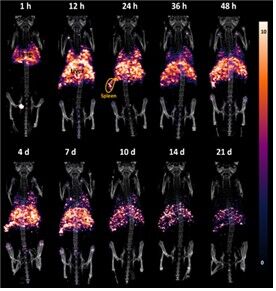
Accumulation in the liver peaked on the 7th day after administration and decreased thereafter. Excretion initially occurred mainly through urine, and excretion through feces also increased starting 2 days later.
Even after 21 days, some residue remained in the liver and spleen, but tissue examinations revealed no problems such as necrosis or fibrosis.
The research team explained that more long-term and comprehensive toxicity evaluations are necessary for practical medical application.
Dr. Park said, "The in vivo behavior of MXene was previously known only through fragmented information at specific time points, but this study has made it possible to track the flow from administration to excretion over time." She added, "We expect this to serve as important foundational data for evaluating the safety of MXene-based diagnostic and therapeutic materials and reviewing their potential for medical application."
The results of this study were published on October 9 in the international academic journal 'Nanoterranostics'.
(Photo provided by the Korea Institute of Radiological and Medical Sciences, Yonhap News)
※ Please note: This article was translated by AI and may contain errors.


 Video News

 Video News
 Video News
 Video News