
 KOR
KOR
⚡ Key Takeaways
More than half of newly recommended videos on TikTok are AI-generated, and that figure reaches 97% in children's content, highlighting an alarming proliferation of AI slop.
Users of YouTube and streaming platforms waste dozens of hours every year trying to choose the optimal video amid an endless deluge of content, suffering severe decision fatigue.
Content consumption patterns that rely on algorithms and frequent video skipping through "digital switching"—such as fast-forwarding—fragment information, erode autonomy, and ultimately induce deep boredom.
Have you ever felt something was off while browsing YouTube, TikTok, or Instagram Reels lately? Videos you feel you've already seen keep popping up, and while they might be entertaining, an increasing number seem awkward and crudely made. They are, in fact, AI-generated content. While video quality has improved compared to the early days of AI models—to the point where some clips are hard to distinguish from real life—low-quality, mass-produced "AI slop" continues to overflow the internet.

After creating a brand-new account on TikTok, an analysis was conducted on the first 500 videos recommended by the platform. Out of those 500 clips, 294—more than half—were AI-generated.
Looking by category, the situation is particularly severe in children's content, especially videos tagged with cartoons. Among #cartoons videos, 83% were AI-generated, and for #cartoonkids, an overwhelming 97% was AI slop. The fact that children's content is flooded with AI trash is deeply concerning. At an age when kids should be learning from accurate information and growing up healthy, popular characters they love are being used as bait to deliver incorrect information and sensational content. For example, in an educational video teaching numbers that was generated by AI without proper verification, it turned out to be riddled with errors.

It is not just videos; AI-generated music is also flooding the web. According to global music streaming platform Deezer, 44% of all new tracks uploaded daily are made by AI. While the volume stood at around 10,000 songs a day early last year, it has now surged to 75,000 tracks. Spotify also disclosed that it removed more than 75 million "spam tracks" last year alone.
The country that consumes the most of this cascading AI slop worldwide is South Korea. As of November last year, cumulative views on AI slop channels in South Korea reached 8.45 billion. That puts the country in first place by a massive margin—roughly equal to the combined totals of Pakistan in second place and the United States in third.

The problem is that while consumers want to know whether the videos they are watching were made by AI, it is becoming increasingly difficult to tell. In a survey conducted on Americans, 76% answered that being able to tell whether content was created by AI is important. At the same time, however, 53% of respondents said they were not confident they could actually distinguish it themselves. This gap inevitably adds to user fatigue.

You open YouTube to relax and unwind, only to find yourself forced to judge whether what you just watched is real or made by AI. Of course, an even earlier source of fatigue comes before that: the process of deciding what to watch in the first place. AI-created content is pouring in, but platforms like YouTube and streaming services were already oversaturated to begin with.
So Much to Watch... Yet Nothing to Watch?
Which country watches the most YouTube in the world? It is South Korea. As of 2025, people in South Korea spent an average of 161 minutes and 30 seconds per day—nearly three hours—watching YouTube. Compared to the global average of 99.1 minutes, the difference is substantial.
Whether commuting to school or work, eating meals, or getting ready for bed, YouTube is always there. Watching an endless stream of videos without pause can make one wonder just how many videos exist on YouTube.

As of December 2025, the cumulative number of videos on YouTube was estimated at around 29 billion. That number is projected to surpass 30 billion in 2026. The primary reason this already massive library continues to expand is Shorts. According to research, Shorts account for more than 90% of all newly uploaded videos.
Despite more than 30 billion videos pouring out, viewers rarely feel they are being exposed to a diverse variety of content. Videos they have already seen reappear, or similar types of videos continue to be recommended and surfaced. Because people only see heavily promoted content, encountering genuinely new videos is rare. Consequently, high-exposure content gains even more views, while other videos struggle to get any views at all.

This trend is also confirmed by real data. While home screens are packed with videos boasting hundreds of thousands or millions of views, what happens when videos are sampled completely at random? Based on data from 2024, an analysis was conducted on a random sample of 25,953 videos. The median view count for the random sample was just 41. It had a median of 2 likes and 0 comments. For reference, the median view count for Oh Graph videos is around 170,000, showing just how much love our viewers give us, for which we are truly grateful.
The feeling that there is nothing to watch despite the vast number of videos is not unique to YouTube. At least YouTube continuously recommends videos so the viewing continues, but on streaming services like Netflix and Disney+, just deciding what to watch can take forever.
In fact, options for both streaming channels and videos have grown exponentially compared to the past. The number of streaming channels themselves has increased, and while offerings were once limited to movies and TV shows, sports content has recently entered the mix. However, as choices multiply, the time spent searching for content on these platforms is also growing considerably.

According to data from Gracenote, the content solutions division of market research firm Nielsen, a survey of 3,000 consumers across six countries—including the United States, the United Kingdom, and France—found that global consumers spend an average of 14 minutes searching for content on streaming platforms. Assuming one searches for content on a streaming service just once a day, that adds up to 5,110 minutes a year. That means spending roughly 85 hours a year simply agonizing over what to watch.
In South Korea, where 9 out of 10 people use streaming services, users subscribe to an average of 2.1 platforms, showing remarkably high usage. While South Korea was not included in Gracenote's survey, 14 minutes is likely a conservative estimate rather than an unrealistic figure when applied to Korean users.
Why is it that with so much to watch, we struggle to choose and only end up fatigued? Some researchers argue that our video consumption habits are responsible for generating this boredom. Let's delve into that story.
Does 'Digital Switching' Breed Boredom?
What do you do when a YouTube video gets boring? Fast-forward through it, or immediately switch to another clip? A research team at the University of Toronto coined this consumption habit "digital switching." They published a study showing that digital switching behavior aimed at avoiding boredom actually intensifies it.

The researchers conducted experiments with Americans and undergraduate students at the University of Toronto. Participants were first asked whether they would feel more bored when they could skip videos or when they could not. Naturally, they responded that being unable to skip would be more boring. Contrary to expectations, however, the actual experimental results showed the exact opposite.

A higher score indicates greater boredom. Before the experiment, participants predicted they would feel more bored if they could not switch. But in practice, moving between videos and fast-forwarding within them—that is, engaging in digital switching—led participants to report feeling more bored. The same result held true when conducting experiments involving actual YouTube viewing.
Another notable finding was that once participants experienced switching, it was difficult to go back. When switching was allowed first and then blocked, participants felt even more bored. Even without looking at experimental data, we already feel this in everyday life: once you start watching short-form content like Shorts or Reels, it becomes difficult to sit through long-form videos.

Why did these results occur? Researchers interpret the phenomenon through the lens of opportunity cost and meaningfulness. On the home page of platforms like YouTube or Netflix, users face countless choices. Constantly seeing attractive alternatives raises the opportunity cost of whatever choice is currently made. Because both this and that look entertaining, the value one gives up by choosing a single video inevitably feels larger. In that process, we experience fatigue, which in turn leads to boredom.
Another factor is the fatigue caused by fragmented information. In the past, traditional media like television, radio, newspapers, and books delivered coherent narrative structures. Today's content, by contrast, bombards us with far more fragmented pieces of information. An Instagram post about pizza is immediately followed by a video of a dancing dog, which is then followed by a science podcast, and then chefs cooking.

For information to carry greater meaning, the pieces we consume must be interconnected. However, researchers point out that the information we receive today via YouTube and streaming platforms lacks coherence. Each fragment is engaging and catches our eye, but the pieces never come together into a single picture. As a result, our brains perceive these massive volumes of information as "meaningless," a signal that translates into fatigue.
The engines feeding us this fragmented information are the algorithms of big tech companies. When our sense of controlling our own actions diminishes—that is, when autonomy is low—we experience fatigue. While it may look as though algorithms read our minds and spoon-feed us what we want, the reality may be that we are the ones being chosen. When our decision-making is delegated to algorithms, our agency gradually erodes, which can lead to boredom.
In fact, many people do not feel they have control over these algorithms.
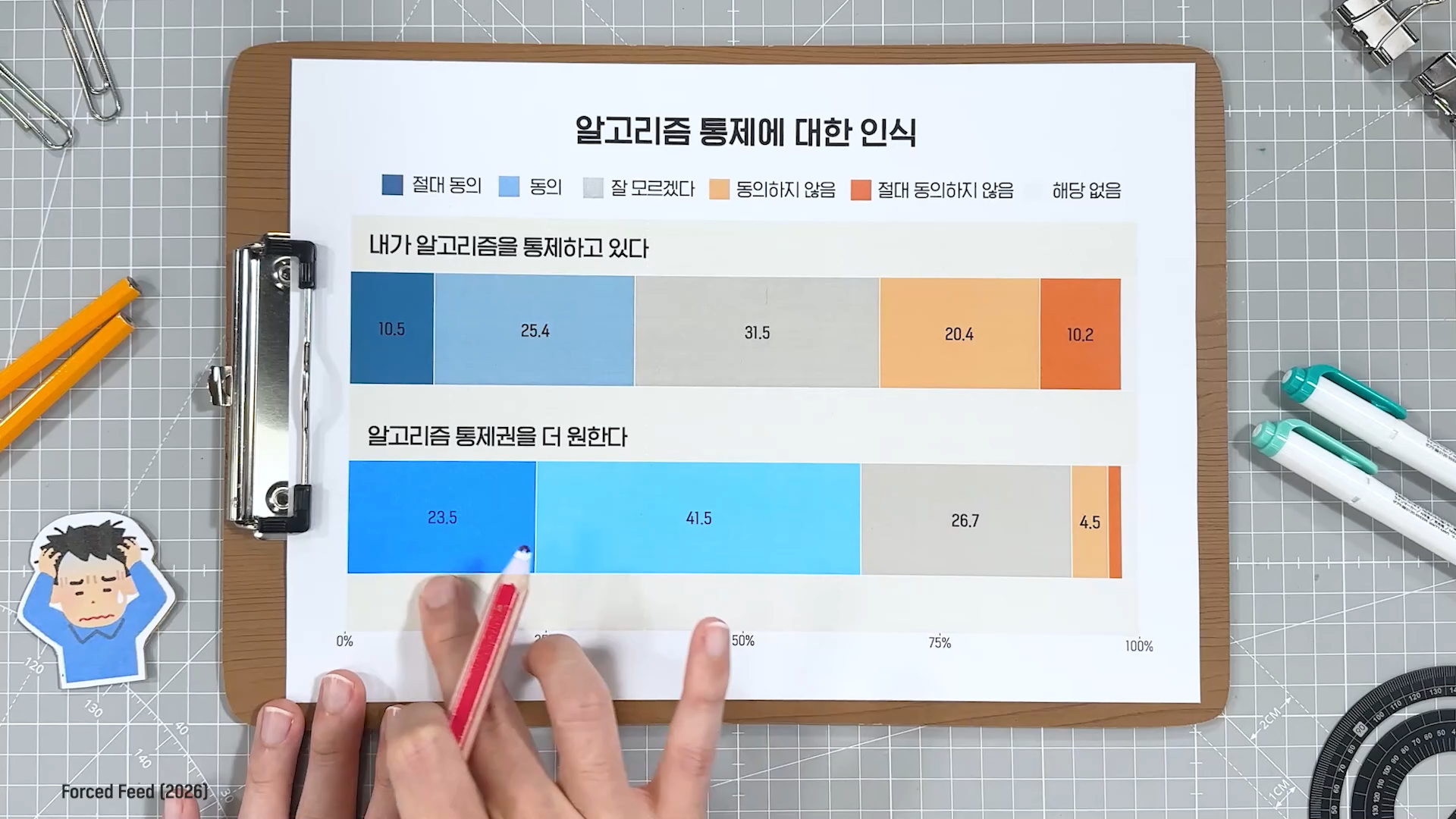
According to survey data from the United Kingdom, only about 36% of respondents felt they were in control of algorithms. While those who felt they lacked control were slightly fewer at 30.6%, a striking 65% answered "yes" when asked whether they wanted more personal control over algorithms. Although algorithms are making choices on their behalf, the vast majority of users desire to reclaim their agency.
If you find yourself overwhelmed by an abundance of content yet unsure of what to watch, it may not be a lack of willpower or a matter of personal taste. We live in an era where making choices is increasingly difficult, and on top of that, we have to filter out whether what we watch was generated by AI. The platforms we use are optimized to make us watch more and stay longer. In such an environment, protecting our own autonomy may have become entirely up to us. That concludes today's Oh Graph. Thank you very much for reading this long piece.
References
- The TikTok AI Slop Report | Kapwing
- Deezer: AI-generated tracks now represent 44% of all new uploaded music | Deezer
- Spotify Strengthens AI Protections for Artists, Songwriters, and Producers | Spotify
- AI Slop Report: The Global Rise of Low-Quality AI Videos | Kapwing
- How Americans View AI and Its Impact on Human Abilities, Society | Pew Research Center
- YouTube reaches 29 billion videos as music and Shorts dominate viewing | Omdia
- YouTube Random Sample Statistics | TubeStats
- 2025 State of Play | Gracenote
- 2025 Survey on Content Usage | Korea Creative Content Agency
- Katy Y. Y. Tam and Michael Inzlicht, "Fast-Forward to Boredom: How Switching Behavior on Digital Media Makes People More Bored," 2024
- Forced Feed Report (2026) | The Cybersmile Foundation
Written by: An Hye-min Design by: Ahn Jun-seok Intern: Shin Yeon-seong
※ Please note: This article was translated by AI and may contain errors.




 Video News
 Video News
 Video News