
 KOR
KOR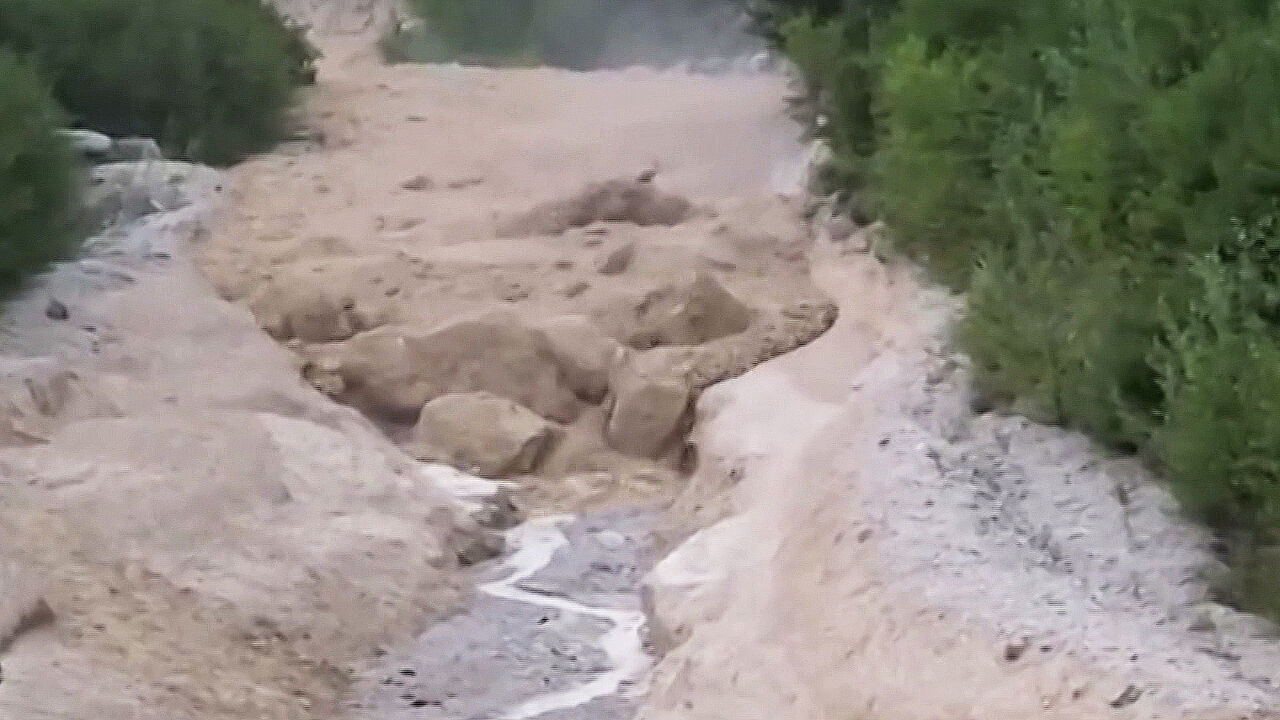
▲ Debris Flow
An area of glaciers equivalent to 3.6 times the size of Seoul has decreased in China's northwestern Xinjiang Uygur Autonomous Region over the past 30 years, a survey showed.
Warnings have been issued that as temperatures rise rapidly due to global warming, the risks of natural disasters such as glacier collapses, floods, and debris flows are also increasing.
According to China's state-run Global Times, a comprehensive scientific expedition team in Xinjiang composed of Chinese experts held a press conference in Urumqi on October 10 and released the survey results.
The survey showed that as of 2020, there were a total of 24,202 glaciers in the Xinjiang region, covering a total area of 23,629 square kilometers.
Xinjiang is the region with the largest distribution of glaciers in China, but the glacier area is rapidly shrinking due to the effects of global warming.
The glacier area that disappeared over a period of about 30 years from the 1990s to 2020 was tallied at 2,167 square kilometers.
This corresponds to about 3.6 times the entire area of Seoul, which is approximately 605 square kilometers.
Temperature increases caused by global warming were cited as the main cause of the glacier reduction.
Over the past 30 years, temperatures in the Xinjiang region have risen by an average of 0.34 degrees Celsius every 10 years, a rate that is about 1.7 times the global average and 1.13 times China's overall average, the researchers said.
The researchers warned that the reduction of glaciers not only affects the local ecosystem but can also lead to large-scale natural disasters.
They explained that if melting glaciers increase river water volume and weaken glacier stability, the risks of glacier collapses, floods, and debris flows could increase.
They also stated that the area of lakes and wetlands in the Xinjiang region increased by about one-third, and that the impact of melting glaciers played a partial role.
This survey is a five-year project launched in 2021 led by China's Ministry of Science and Technology, with participation from 46 research institutions across China.
The researchers are tracking glacier movement and temperature changes using satellites and drones, while also conducting joint research with Central Asian countries on glacier changes and disaster risks.
Recently, large-scale natural disasters caused by glacier collapses have occurred in the Himalayan mountainous region.
On August 26, a massive debris flow and flood triggered by a glacier and rock collapse occurred in the border region between Nepal and China's Tibet Autonomous Region, leaving thousands of people dead or missing in both countries.
China and Nepal recently formed a joint investigation team and launched on-site investigations to determine the cause of how the glacier and rock collapse led to the large-scale debris flow and flood.
※ Please note: This article was translated by AI and may contain errors.


 Video News


