
 KOR
KOR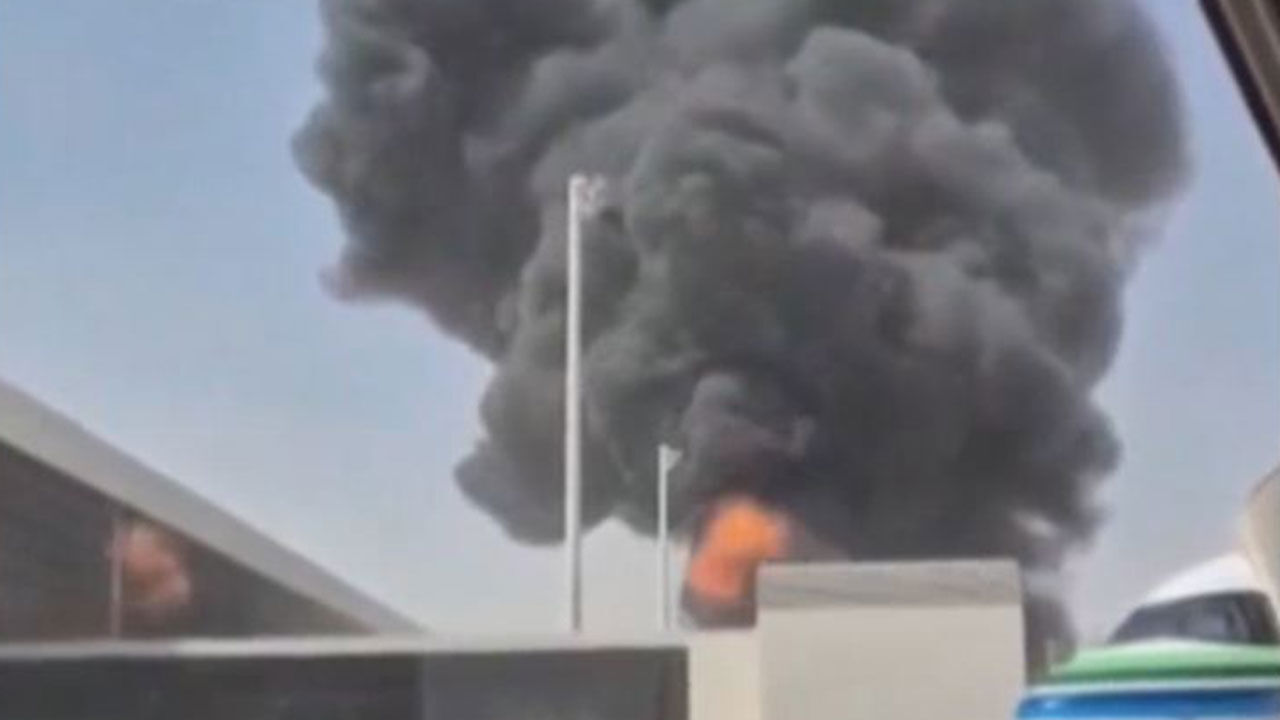
▲ Flames and smoke rise from King Khalid International Airport in Riyadh, the capital of Saudi Arabia, on the 8th (local time).
King Khalid International Airport in Riyadh, the capital of Saudi Arabia, was attacked once again on the 10th (local time), leaving at least 12 people dead and 309 others injured.
This attack is understood to have resulted in the highest number of casualties from an attack in a Gulf Arab state since the U.S. and Israel launched a war against Iran last February.
As attacks by Yemen's Iran-backed Houthi rebels expand across Saudi Arabia, including a projectile landing near the international airport in Dammam in eastern Saudi Arabia, U.S. President Donald Trump has signaled the possibility of intervening in the conflict.
According to Reuters, the General Authority of Civil Aviation (GACA) of Saudi Arabia announced that the attack on King Khalid International Airport killed at least 12 people and injured 309.
GACA stated that among the fatalities were 4 Saudi nationals, 2 Bangladeshi nationals, and 1 each from the United States, Jordan, Palestine, Syria, Sudan, and Egypt.
This is at least the third time King Khalid Airport has been attacked since Yemen's Iran-backed Houthi rebels announced a large-scale offensive targeting Saudi airports and oil facilities on the 5th.
Sources reported that the attack occurred without prior warning and that no alarms were triggered by Saudi threat warning systems.
A witness at the airport stated that after the explosion, they saw multiple people lying injured inside the terminal.
Another injured person said that shortly after seeing something flying across the sky outside the airport, part of the ceiling near the boarding gate collapsed.
The U.S. daily The Wall Street Journal (WSJ) reported that missiles struck the facility housing Terminals 3 and 4 of the airport.
Mohammed al-Bukhaiti, a senior Houthi official, told The New York Times (NYT) that the group was responsible.
Claiming that the attack was in retaliation for Saudi airstrikes targeting civilian infrastructure in Yemen, he asserted, "This is to make the world understand that Yemen's airports, ports, wedding halls, funerals, hospitals, and markets are civilian facilities that must not be attacked or harmed."
GACA has temporarily suspended airport operations to inspect the damage to airport facilities and ensure safety.
According to the flight tracking website Flightradar24, all flights heading to Riyadh were either diverted to other airports or canceled.
Kuwait Airways, Etihad Airways, and Qatar Airways also successively canceled their routes to Riyadh, and the suspension of some flights is scheduled to continue until the 12th.
On the same day, a projectile also landed near the airport in the major eastern Saudi city of Dammam.
Turki al-Maliki, spokesperson for the Saudi-led coalition, stated via X in the early hours of the 11th, "A projectile landed near King Fahd International Airport in Dammam."
He also reported that a ballistic missile launched by the Houthis was intercepted and destroyed in the Al-Kharj region of central Saudi Arabia.
Previously, the Houthi rebels claimed to have attacked King Khalid Airport, the Aramco oil facility in the western coastal city of Yanbu, and Abha International Airport in the southwest on the 5th, continuing missile attacks targeting major Saudi facilities.
On the 6th and 7th, attacks on Riyadh and Abha airports left 3 people dead and 36 injured, and on the 8th, two separate attacks targeting King Khalid Airport resulted in 3 deaths, including a Saudi airline pilot.
As Saudi Arabia's air defense system reveals vulnerabilities amid successive attacks, attention is focusing on whether the United States will take military action.
Asked by reporters at the White House on the 10th whether the U.S. planned to join Saudi Arabia in countering the Houthi attacks, President Trump responded, "That's possible. We'll take a look," adding, "I just heard about the recent attacks, so we'll make a decision. We'll respond very quickly."
Given that the United States launched massive airstrikes against the Houthis last year as well, attention is drawn to the possibility that this situation could escalate into direct U.S. military intervention.
Concerns are rising that as the Houthi offensive intensifies, major international events scheduled in Saudi Arabia could face disruptions.
The World Petroleum Congress (WPC) energy general assembly, attended by figures from the global energy industry, is scheduled to open in Riyadh on the 11th, and the Future Investment Initiative (FII), a large-scale international investment event led by Crown Prince Mohammed bin Salman, is scheduled for later this month.
While event organizers maintain that they will proceed as planned, difficulties are expected in securing transportation and safety for participants due to flight disruptions and the possibility of additional attacks.
The Saudi-led coalition and the Yemeni government forces declared the launch of the 'Dawn of Yemen' operation on the 4th to recapture Houthi-controlled Yemeni territory, initiating efforts to retake key strongholds around the Bab el-Mandeb Strait connecting the Red Sea and the Gulf of Aden.
While engaging Yemeni government forces on the ground, the Houthis are retaliating with ballistic missiles and other means targeting the Saudi mainland, which provides aerial support to Yemeni forces.
※ Please note: This article was translated by AI and may contain errors.



 Video News
 Video News
 Video News
 Video News