
 KOR
KOR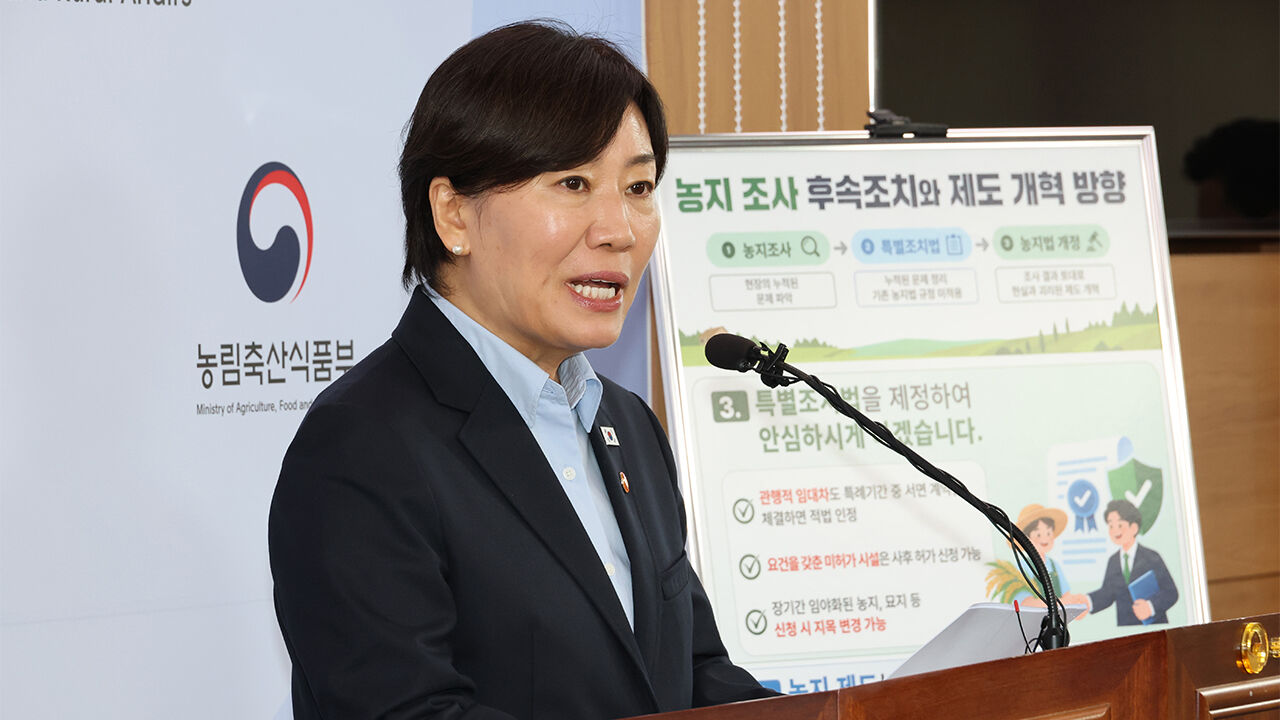
▲ Minister of Agriculture, Food and Rural Affairs Song Mi-kyung briefs reporters on follow-up measures for the nationwide farmland inspection and institutional reform directions at the Government Complex-Sejong in Sejong City on the 8th.
The government has decided to exclude five types of farmland, including inherited plots, from disposal under the ongoing nationwide farmland inspection.
Minister of Agriculture, Food and Rural Affairs Song Mi-kyung stated during a briefing at the Sejong Complex on the 8th, "Farming agricultural workers will face no harm whatsoever, so there is no need to worry," adding, "We will push for the enactment of a special act to ensure that general cases, rather than speculative ones, do not lead to disposal procedures under the Farmland Act based on the results of this inspection."
Minister Song explained, "This means that even if aspects not aligned with current Farmland Act regulations are identified during the inspection, we will block them from leading to disposal procedures through a special act that takes precedence over the Farmland Act."
The categories expected to be excluded from disposal under the special act include: ▲ inherited farmland; ▲ farmland rented out by elderly farmers or through customary leasing; ▲ farmland with complex ownership structures such as those belonging to family clans, temples, or unregistraed inheritances; ▲ landlocked or difficult-to-farm plots; and ▲ unauthorized facilities such as agricultural warehouses.
Minister Song stated, "Regardless of whether the farmland is entrusted to the Farmland Bank, these general cases will not be subjected to disposal procedures," adding, "Farmers can choose to lease or sell them to the Farmland Bank if they wish." She further emphasized, "Our basic stance is that unless there is clear speculative activity, the results of this inspection will not force anyone to dispose of farmland or incur compelling compliance fines."
However, the Ministry of Agriculture, Food and Rural Affairs (MAFRA) plans to decide whether to issue disposal orders under the current Farmland Act for clear speculative activities after going through a sufficient explanation process.
The types of speculation subject to potential disposal include: ▲ acquiring farmland by submitting a farming plan in a land transaction permission zone, only to leave it idle or lease it out without farming; ▲ acquiring fractional shares of farmland through auctions and submitting false farming plans with the intent to resell after price increases, while leaving the land idle or leasing it out; and ▲ acquiring farmland through agricultural corporations and generating real estate profits by splitting and selling or leasing the land without engaging in direct farming.
Minister Song noted, "Such cases are typically concentrated in areas with high development demand," and added, "Considering this, most rural areas will not be affected."

During the validity period (special period) of the special act, the government will refrain from taking disposal measures for non-speculative cases. At the same time, it will permit ex-post approvals upon application for customary leases, qualified unauthorized facilities, and changes in land categories where the official land category differs from actual use.
MAFRA is currently considering setting the special period at two to three years.
MAFRA and the Democratic Party of Korea plan to propose the special act this month and push for its legislation so that parliamentary procedures can be completed by December.
This is a three-stage roadmap: first, grasping accumulated problems in rural areas and the actual state of farmland use through the farmland survey; second, enacting the special act; and third, revising the Farmland Act in the first half of next year to reform the farmland system based on the survey results.
Minister Song outlined the vision, stating, "Rather than discussing the Farmland Act right away, we will first prevent a legislative vacuum through a special act, and then discuss the Farmland Act early next year to reform the farmland system to fit the times."
The direction of the Farmland Act revision will focus on: reexamining the allowable scope for farmland leasing and idle land recognition to fit rural realities; strengthening the rights of actual farming tenants; establishing measures allowing actual farmers to sign legitimate contracts even on farmland owned by family clans, temples, or through unregistered inheritances; improving regulations related to agricultural facilities and difficult-to-farm plots; and enhancing farmland utilization efficiency by connecting elderly farmers' retiring farmland to young and full-time farmers.
Minister Song noted, "Currently, the ratio of leased farmland stands at 47% of the total," adding, "We view establishing a framework to protect tenant farmers as extremely important." She also said, "There are currently 300,000 hectares of inherited farmland, which are fragmented into small pieces. Enabling them to be utilized as scaled-up farmland will significantly increase productivity."
In addition, MAFRA plans to build an integrated farmland platform linking fragmented information—such as registries, land ledgers, farmland ledgers, agricultural management entities, and farmland conversion permits—and operate a Farmland Inspection Counseling Center (☎ 1811-8852) starting next week.
The role of the Farmland Bank will also be expanded.
The government plans to consult with the National Assembly to increase next year's budget to reduce pending purchase volumes, and expand the Farmland Bank's acquisition targets from the current promotion-area farmland to non-promotion-area farmland available for agricultural use.
Furthermore, the government will prioritize purchasing and supplying necessary farmland in consideration of regional demand from young and full-time farmers, and improve procedures so that visitors can handle related agency tasks all at once simply by visiting the Farmland Bank.
(Photo: Yonhap News)
※ Please note: This article was translated by AI and may contain errors.




 Video News
 Video News
 Video News