
 KOR
KOR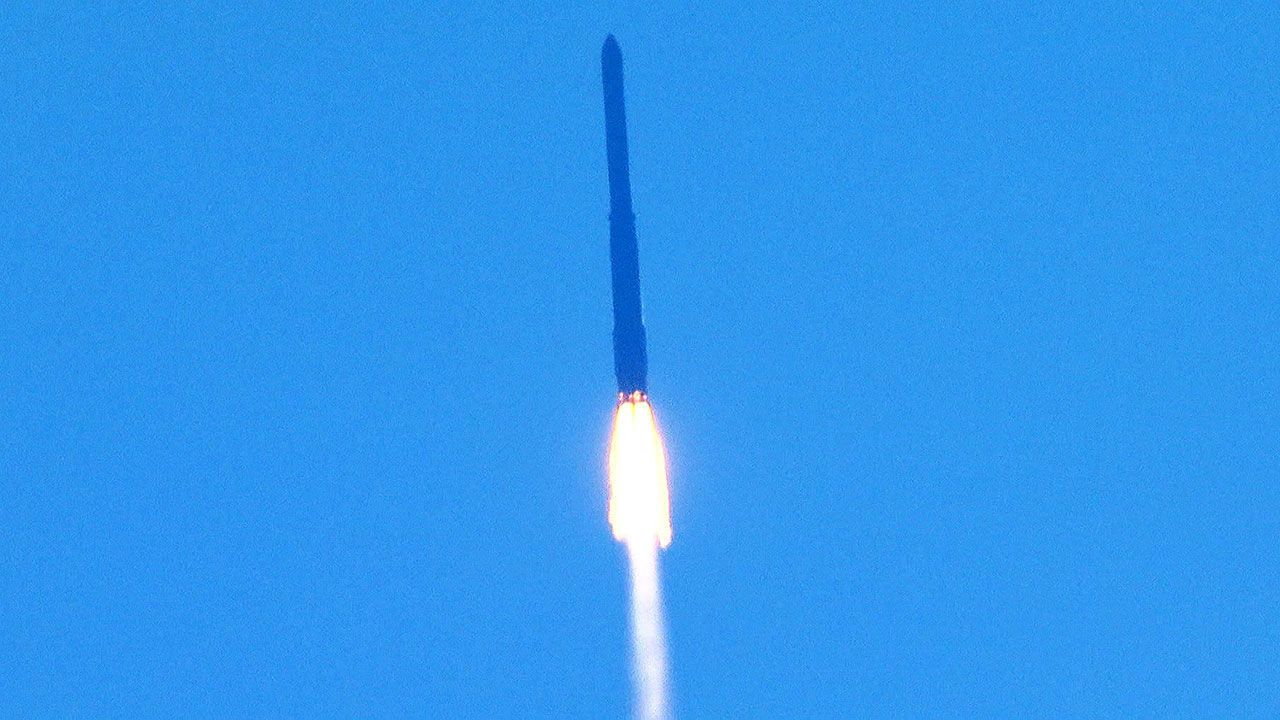
▲ The 5th Launch of the Nuri Rocket
South Korea's space launch vehicle Nuri has successfully completed its mission during its fifth launch on the 7th, successfully placing five micro-constellation satellites into their target orbit.
Marking its fourth consecutive success following the failure of its inaugural launch in 2021, Nuri has raised its launch success rate to 80%. By deploying five micro-satellites simultaneously into space for the first time, it enhanced its multi-satellite transport capability and launch reliability, taking another step closer to transitioning into a private-led commercial launch service.
The fifth launch of Nuri proceeded smoothly under favorable conditions, including good weather.
Nuri lifted off into the sky carrying 15 satellites—including five primary micro-constellation satellites (Nos. 2 through 6) and 10 cube-satellites—at the scheduled time of 12:25 PM today (the 7th) set by the Korea AeroSpace Administration (KASA).
This was the first time that Nuri was launched at its scheduled time.
The fourth launch, which took off at night, was delayed by about 18 minutes due to an abnormal pressure sensor signal, and the third launch was also postponed by a day due to a communication glitch between the ground valve control computer and the launch pad facility control computer.
Today, following the separation of the first stage, the fairing (satellite protective cover), and the second stage, Nuri successfully separated the micro-constellation satellites one by one at intervals of 35 to 40 seconds.
The benchmark for the success or failure of Nuri was to place the micro-constellation satellites within an error margin of 15 km from the target altitude of 570 km, and these satellites were separated at altitudes between 575 and 580 km.
KASA announced that it successfully established its first communication with micro-constellation satellite No. 6, one of the primary payloads, via the Jang Bogo Antarctic Station (King Sejong Station) at around 1:08 PM today.
It added that starting at 2:00 PM, it plans to communicate with micro-constellation satellites Nos. 2 through 5 using domestic ground stations in Daejeon and Jeju, as well as an overseas ground station in Norway.
Among the 10 cube-satellites carried on Nuri, 9 were ejected, excluding 1 satellite developed by Quaternion.
KASA initially stated that all 10 had been separated, but later corrected its statement during a briefing.
With the success of Nuri's fifth launch, the era of "New Space," where the private sector leads space development, and the commercialization of launch vehicles are expected to accelerate.
Oh Tae-seok, Administrator of KASA, emphasized during a briefing today, "This is the first time our country has simultaneously placed five micro-satellites into space. Through the successful orbital insertion of the constellation satellites, we have demonstrated a higher level of space transport capability capable of carrying out various missions tailored to the orbits and times desired by customers."
This launch marks the second launch under the Korean Space Launch Vehicle Advancement Project, evaluated as a turning point that goes beyond verifying Nuri and accelerates the transition to private-led operations.
Unlike the first to third launches, where the Korea Aerospace Research Institute (KARI) oversaw the manufacturing of Nuri, Hanwha Aerospace oversaw the related work for the fourth and fifth launches.
For the fifth launch, the number of private personnel deployed in launch preparation and operation processes also increased.
For Nuri's sixth launch, which KASA plans to conduct in the second half of next year, the stage assembly site will also change from the existing Naro Space Center to the stage assembly plant built by Hanwha Aerospace in Suncheon.
Administrator Oh stated, "The main mission of the sixth launch, just like the fifth, is to place five micro-constellation satellites into space orbit. We will further improve reliability and promote the transition to private-led commercial launch services by launching Nuri at least once a year until 2032."
Deputy Prime Minister and Minister of Science and ICT Bae Kyung-hoon noted that the mass production of satellites and constellation operations are the significance of the fifth launch, adding, "We will support the stable continuation of Nuri's regular launches."
※ Please note: This article was translated by AI and may contain errors.


 Video News

 Video News

