
 KOR
KOR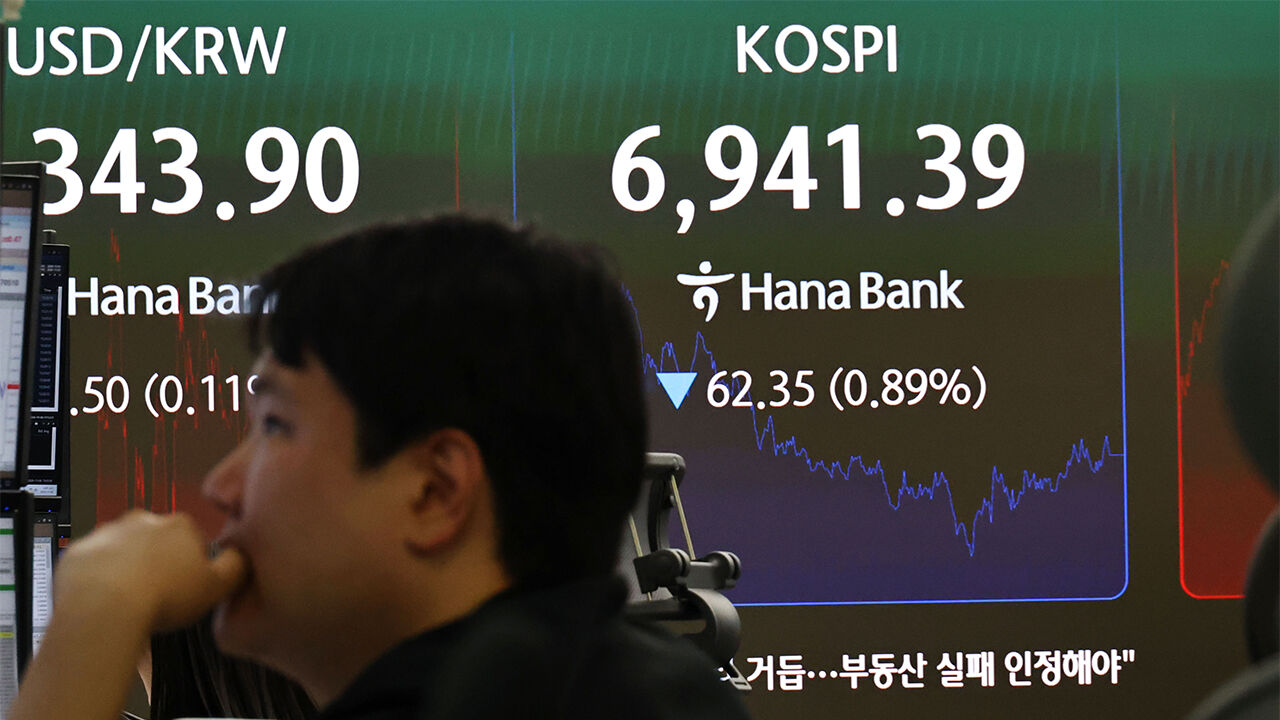
(Photo: Yonhap News) ▲ The KOSPI and other market indicators are displayed on the electronic board at the dealing room of Hana Bank's headquarters in Jung-gu, Seoul, on the 6th. On this day, the KOSPI closed down 62.35 points (0.89%) at 6,941.39, while the KOSDAQ finished up 26.63 points (2.98%) at 919.92.
The KOSPI pulled back below the 7,000 threshold today (the 6th), right after the Gaecheonjeol (National Foundation Day) holiday, weighed down by rising U.S. Treasury yields.
According to the Korea Exchange, the KOSPI closed down 62.35 points, or 0.89 percent, at 6,941.39 compared to the previous trading session.
Just one trading session after reclaiming the 7,000 level by finishing the regular session at 7,003.74 on the 2nd, the index relinquished the 7,000 mark once again.
The index started the day up 40.93 points, or 0.58 percent, at 7,044.67, but its gains soon dwindled before shifting into negative territory.
In the KOSPI market, individual investors net purchased 740.5 billion won, while foreign investors and institutions net sold 1.7491 trillion won and 1.9 billion won, respectively, pulling the index down.
Other corporations, which had previously propped up the downside of the index, maintained a net buying advantage of 1.0122 trillion won on this day as well, though the purchase volume decreased compared to the previous daily average of around 1.6 trillion won.
Other corporations had drawn significant attention as major supply-and-demand agents in the KOSPI market due to the share buybacks by KOSPI heavyweight champions Samsung Electronics and SK Hynix.
However, as Samsung Electronics' 15 trillion won share buyback was expected to wrap up on this day, buying momentum appeared to weaken.
In the KOSPI 200 futures market, foreign investors recorded a net selling advantage of 455 billion won.
As of 3:30 p.m. today, the won-dollar exchange rate in the Seoul foreign exchange market stood at 1,343.6 won, down 0.4 won from the previous session.
The KOSPI opened higher following overnight gains across all three major U.S. stock indices, particularly driven by the tech-heavy Nasdaq Composite closing at an all-time high.
However, as Samsung Electronics, which holds a large market capitalization weight in the KOSPI, turned downward and SK Hynix also showed weakness, the index sloped downward.
The two stocks fell 1.45 percent and 3.69 percent, respectively.
This is interpreted as pressure stemming from U.S. Treasury yields soaring to their highest level in about 22 years during the holiday period.
The yield on the 10-year U.S. Treasury note, a benchmark for global bond yields, rose to 5.347 percent during trading on the 5th local time, recording its highest level since April 3, 2002.
The 30-year yield reached 5.702 percent during the session, the highest since May 2002.
Lee Kyung-min, an analyst at Daishin Securities, noted, "Although sluggish employment figures further pushed back expectations for an October rate hike by the U.S. Federal Reserve, U.S. Treasury yields remained at high levels." He added that the KOSPI "continued its breather amid an absence of new momentum to offset these macroeconomic pressures."
He further stated, "Samsung Electronics' preliminary earnings announcement scheduled for the 8th will act as a major variable to gauge the future direction of the index."
Among other large-cap stocks, SK Square (0.09%), Samsung Electro-Mechanics (5.95%), and LG Energy Solution (5.12%) rose, while Samsung Biologics (-3.25%), KB Financial Group (-0.30%), and Samsung Life Insurance (-1.38%) declined.
By sector, medical and precision equipment (6.53%), chemicals (1.59%), and machinery and equipment (0.82%) advanced, while transportation equipment and parts (-1.43%), electrical and electronics (-1.31%), and pharmaceuticals (-1.09%) retreated.
In the KOSPI market, 425 stocks advanced, 461 declined, and 32 remained unchanged.
The KOSDAQ index closed up 26.63 points, or 2.98 percent, at 919.92.
This marks the first time in about three months that the KOSDAQ has recovered the 900 line on a closing basis since it finished at 929.35 on July 1.
The index opened 8.87 points (0.99%) higher at 902.16 and expanded its gains, touching 919.92 at one point and coming close to the 920 line.
In the KOSDAQ market, foreign investors and institutions engaged in twin-engine buying by net purchasing 119.3 billion won and 102.7 billion won, respectively, while retail investors net sold 210.5 billion won.
The sectors driving the index were semiconductor materials, parts, and equipment (components) and secondary batteries.
As large-cap semiconductor stocks stalled in the KOSPI market recently, a rotation of funds into KOSDAQ semiconductor component stocks led to strength in related equities.
In particular, equipment maker Jusung Engineering surged 17.51 percent, narrowing the market cap gap with EcoPro to just 8 billion won and challenging the second spot in the KOSDAQ market capitalization rankings.
Along with this, semiconductor component stocks positioned near the top of the market cap, such as Wonik IPS (2.24%), Simmtech (4.67%), EO Technics (2.26%), Leeno Industrial (3.08%), and HPSP (5.04%), moved higher.
Kim Rok-ho, an analyst at Hana Securities, said, "Due to massive capacity expansions by major domestic and overseas semiconductor companies, projections for the 2027 equipment market are also highly likely to be continuously upgraded." He added, "Investment ideas remain valid for both front-end and back-end process companies."
In addition, secondary battery stocks such as EcoPro (7.31%) and EcoPro BM (11.41%) showed strength following news of an MOU signed between EcoPro BM and Samsung SDI for cooperative development of materials for all-solid-state batteries.
Except for Alteogen (0.00%), the top-ranking market cap leader that closed flat, all stocks ranked 2nd to 20th by market capitalization saw their share prices rise.
In the KOSDAQ market, 1,012 stocks advanced, 645 declined, and 81 remained unchanged.
Trading values for the KOSPI and KOSDAQ markets were tallied at 19.394 trillion won and 8.691 trillion won, respectively.
Trading value for the pre-market and main market of alternative trading system Nextrade totaled 10.4289 trillion won.
(Photo: Yonhap News)
※ Please note: This article was translated by AI and may contain errors.


 Video News
 Video News
 Video News
 Video News
 Video News