
 KOR
KOR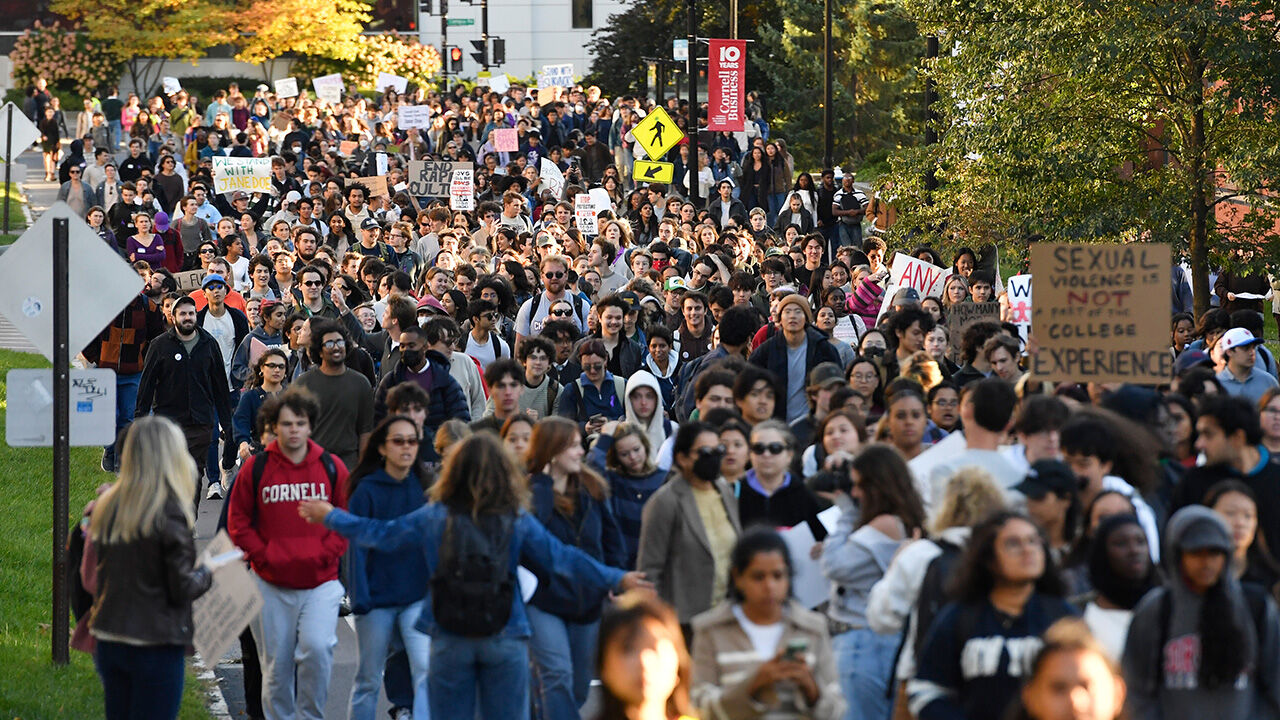
▲ Protesters gather at Cornell University on October 5 (local time).
Students and faculty outraged by the university's inadequate response held a large-scale protest on campus Monday (local time) at Cornell University, a prestigious U.S. institution where a group sexual assault case from two years ago recently came to light.
Protesters marched toward the administration building, strongly pressing the university for responsible measures.
According to foreign media outlets including The New York Times (NYT) and the Associated Press (AP), thousands of students and faculty members gathered on the Cornell campus in New York State that afternoon.
This marks the largest gathering of Cornell community members since the filing of the lawsuit.
Participants wore "Jane Doe" name tags symbolizing the anonymous victim and purple ribbons signifying solidarity with victims of sexual violence.
Placards reading "Justice for all Jane Does" and "Support survivors and expel the perpetrators" were visible at the scene.
Jane Doe is a pseudonym conventionally used in U.S. court documents to protect the identity of a female victim.
Whenever Interim President Michael Kotlikoff's name was mentioned at the rally podium, participants chanted "Resign."
They criticized President Kotlikoff and the university administration for prioritizing the school's reputation over student safety.
Chants of "Ban fraternities" also erupted.
Some 20 student organizations that organized the protest demanded a complete overhaul of the university's sexual assault reporting response policies.
They also called for restructuring the campus disciplinary system and taking measures such as expelling students involved in the incident or revoking their degrees.
Furthermore, they urged the introduction of a standardized investigation timeline for sexual misconduct allegations and the reinforcement of campus police response capabilities.
Prior to the protest early that morning, a vandalism incident occurred, believed to be the work of someone angered by the university's lukewarm response to the case.
Glass doors of the administration building were shattered, and phrases such as "The university protects rapists" and "Smash patriarchy" were spray-painted in red on the entrance wall.
It has not been confirmed who damaged the building and left the graffiti overnight.
However, anonymous activists released a statement claiming responsibility and criticizing the university.
The university subsequently took temporary measures, removing the graffiti and covering the broken glass doors with plywood.
The university stated that it is investigating the incident.
While acknowledging that it understands the "frustrations and strong emotions" of campus members, the university added that "property destruction is not the solution."
Following this rally, the protest organizers announced further acts of protest throughout the week, including campus town hall meetings, class boycotts, and a seven-hour sit-in.
The controversy surfaced after a female student attending Cornell in October 2024 recently filed a civil lawsuit against the university and the perpetrators, alleging she was sexually assaulted by seven male students at an on-campus fraternity house.
Although the victim notified the campus police at the time, it did not lead to criminal prosecution.
Cornell University expelled two students following its own internal investigation, but imposed lighter penalties such as suspension or writing an essay on the remaining students.
The State of New York recently appointed the state attorney general as a special prosecutor to order a reinvestigation of the case.
(Photo: AP, Yonhap News)
※ Please note: This article was translated by AI and may contain errors.


 Video News
 Video News
 Video News
 Video News
 Video News