
 KOR
KOR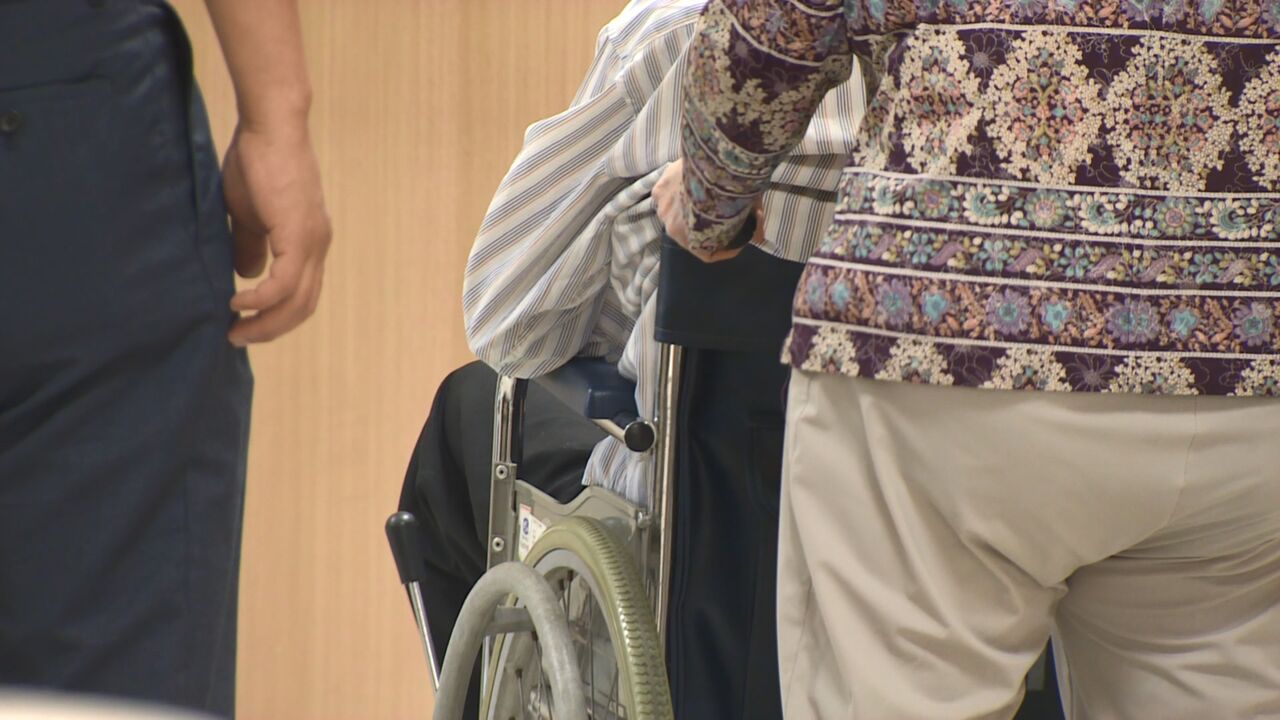
▲ An elderly person in a wheelchair
Two-person households across South Korea are projected to exceed 30% of all households next year for the first time, data showed.
Two-person households will outnumber not only three-person households but also the combined total of three- and four-person households, the latter of which has traditionally been considered the standard family structure.
With a significant portion of two-person households estimated to consist of elderly couples, experts point out that policy attention is needed to prevent them from falling into blind spots in care services.
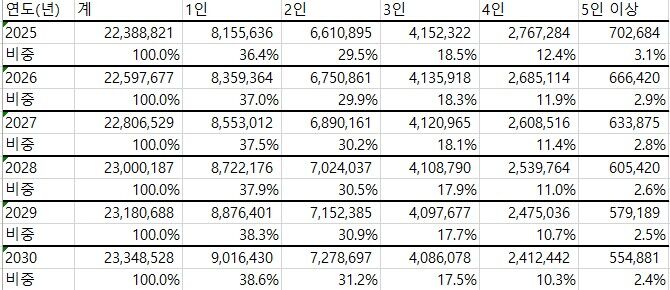
According to the future household projections released by the Korea Data Agency today (the 6th), total households next year are expected to reach 22.807 million, marking a 0.9% increase from this year.
The growth is led by single-person households, which will rise 2.3% to 8.553 million, and two-person households, which will increase 2.1% to 6.89 million.
Conversely, three-person households are estimated to decrease by 0.4% to 4.121 million, and four-person households are projected to drop by 2.9% to 2.609 million.
Households with five or more members will remain limited to 634,000.
While single-person households will account for the highest proportion at 37.5%, up 0.5 percentage points (p), two-person households will reach 30.2%, up 0.3 percentage points from this year's 29.9%.
This marks the first time that the proportion of two-person households will surpass 30% since the compilation of future household projections began in 2000.
The proportions of three- and four-person households will shrink by 0.2 percentage points and 0.5 percentage points to 18.1% and 11.4%, respectively.
The share of five-person households will decrease by 0.1 percentage points to 2.8%.
Next year will also mark the first time that the proportion of two-person households surpasses the combined total of three- and four-person households (29.5%).
The trend of declining three- and four-person households alongside increasing one- and two-person households is projected to continue through 2043.
By then, the proportions of single-person and two-person households are expected to expand to 40.9% and 34.2%, respectively.
In contrast, three- and four-person households will shrink to 15.6% and 7.7%.
Following this period, the impact of population decline will lead to a gradual reduction in single- and two-person households as well, resulting in an overall decrease in total household numbers.
By 2052, the final year of the projections, the proportion of single-person households is forecast to reach 41.3%, with two-person households reaching 35.5%.
Three-person households will account for 15.2%, and four-person households will make up 6.7%.
Restricting the analysis to two-person households, the share of household heads aged 65 or older will reach 44.3% next year, expanding by 1.3 percentage points from this year.
A significant portion of these are believed to be elderly couples.
As nuclear families become the norm and advancements in medical services improve the health conditions of older adults, more elderly couples are spending their later years living together.
However, experts warn that as they grow older, they risk falling into the trap of "senile-to-senile care," where a relatively healthier elderly person has to care for a more frail spouse, necessitating active policy intervention.
(Photo provided by Yonhap News TV, Yonhap News)
※ Please note: This article was translated by AI and may contain errors.


 Video News
 Video News
 Video News
 Video News
 Video News