
 KOR
KORThat day, the reporting team conducted a survey among the parents to ask how much money they spend each month on their children's rehabilitation and therapy. Thankfully, many answered with great care. On the train heading back to Seoul, as I looked through the questionnaires, I noticed that one mother had written a long note in the blank space on the back of the survey form. It began: "Having spent over 100 million won on therapy before entering elementary school...(this is common around me)."

She was the mother of an eight-year-old child with autism spectrum disorder. Her writing explained that although she had spent over 100 million won on therapy before elementary school, many heartbreaking setbacks occurred in the child's development as support dwindled and therapy was interrupted after starting school. She shared that her child began taking psychiatric medication after entering school, writing, "Regardless of the severity of a child's disability, functioning level, or ability, continuous therapy and education must be provided to everyone without interruption."
Because she did not leave a name or contact number, it was difficult to ask more about her exact circumstances and the full meaning of her words. However, I understood it as an appeal that despite pouring huge sums of money and effort into their child with autism from an early age, parents and families could not sustain such support entirely on their own, and the current public education system and school environments were failing to fill the gap. The long letter filling an entire A4 page concluded with the words: "It is sad and bleak."
While preparing this broadcast, I tried not to focus solely on the outward distress of families with autistic children. Even without tears or intense displays of emotion, I believed that the calm "facts" of everyday life shared by parents already fully conveyed the heavy burden these families bear. Yet during the reporting process, emotions welled up at times, and there were moments during interviews when tears made it hard to continue asking questions. Reading that final sentence on the train—"It is sad and bleak"—was one of those moments.
Survey of 517 Parents of Children with Developmental Disabilities Shows 'Gap Between Reality and Policy'
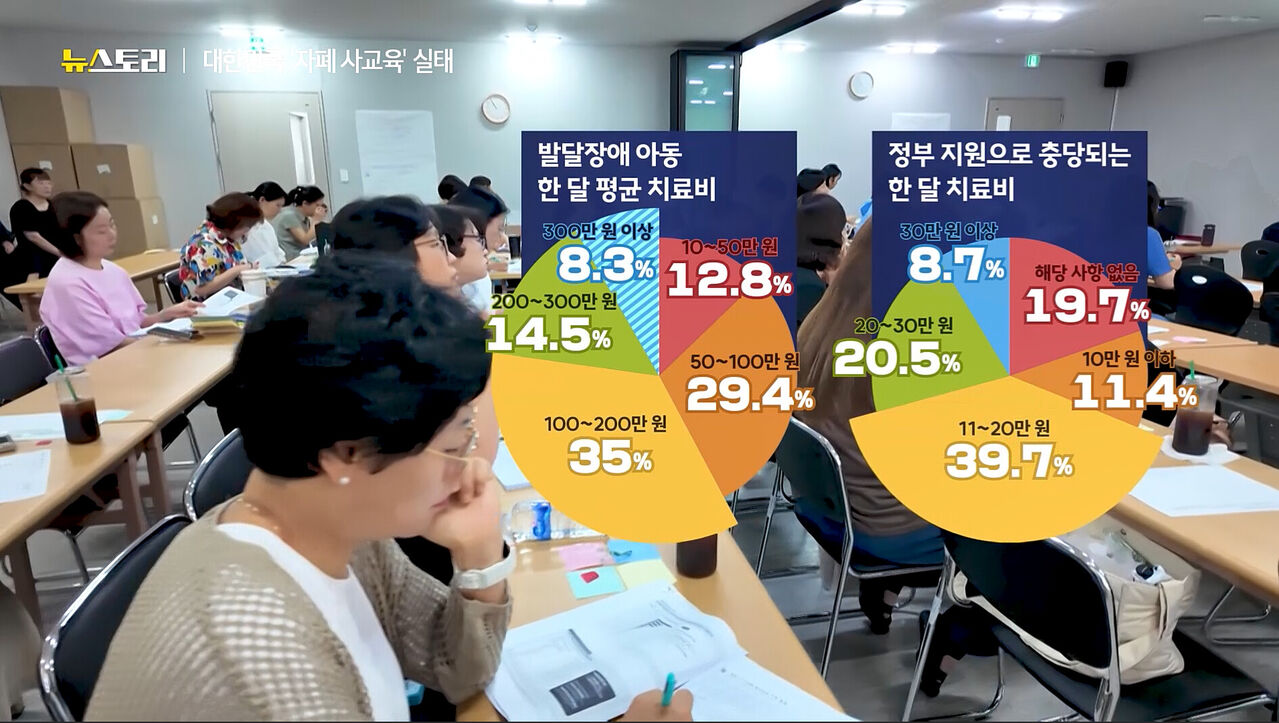
Respondents were undergoing an average of 3.9 therapies at the time of the survey. Families spending roughly 100,000 to 500,000 won per month received an average of 2.29 therapies, while those spending 3 million won or more received 5.37 therapies. Looking at households with high expenses, applied behavior analysis (ABA) was frequently included. Starting from the spending bracket of 2 million won or more, the proportion of families undergoing ABA jumped sharply to over 40%.
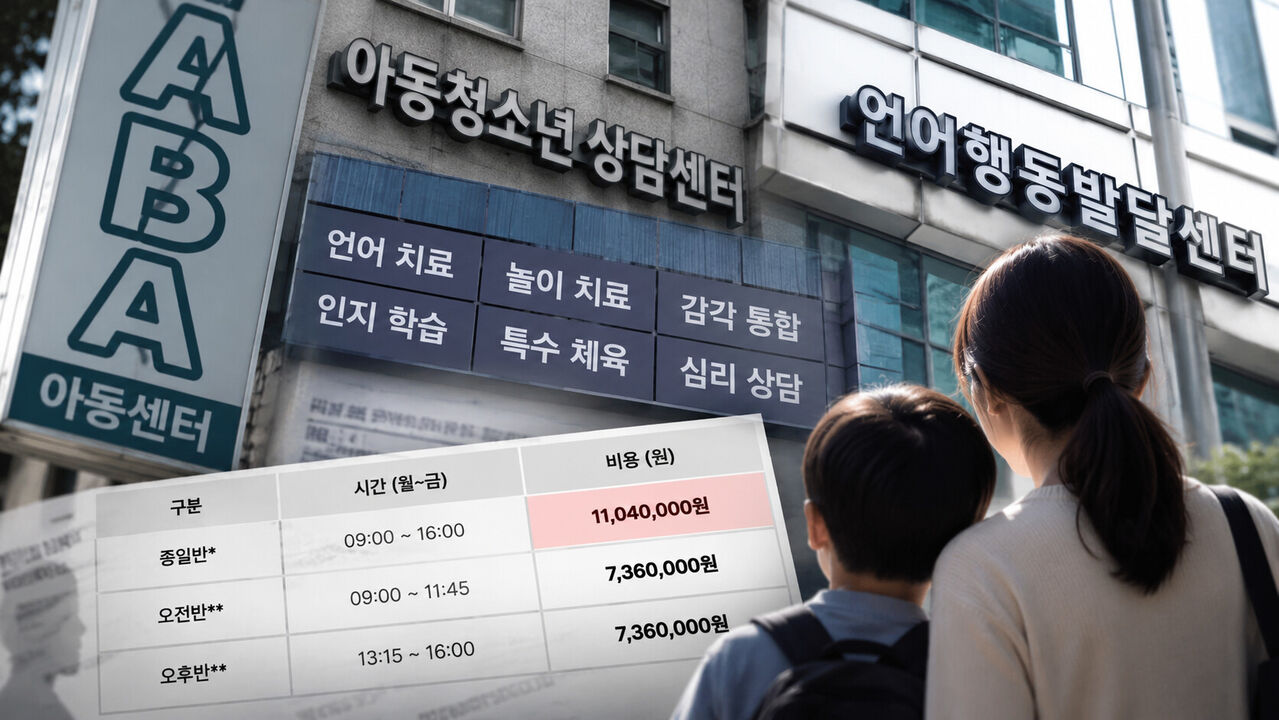
ABA is the primary evidence-based therapy recommended for autism spectrum disorder, but in South Korea, it remains one of the most expensive non-covered treatments. Because sessions are often conducted one-on-one or involve multiple specialists working with a single child, costs are high, and the proportion of ABA sessions ineligible for government Developmental Rehabilitation Service Vouchers is relatively higher than other therapies.
The Developmental Rehabilitation Service Voucher is a type of 'therapy subsidy' provided under the Act on Welfare Support for Children with Disabilities to help improve mental and sensory functioning as well as behavioral development in growing children with disabilities under the age of 18 while easing financial burdens. However, support amounts are categorized by household income rather than the severity of the child's disability. Eligibility is limited to households with an income of 180% or less of the standard median income, and the subsidy ranges from 180,000 to 260,000 won per month across different income tiers. With the exception of Basic Living Security recipients, families in other tiers must pay an out-of-pocket copay of 20,000 to 80,000 won per month. With high demand and limited funding, eligible applicants often cannot receive support immediately, and there is also a vast discrepancy between actual therapy costs at private centers and the voucher amounts provided.

Why Parents Cannot Let Go of Therapy Even as Household Finances Collapse
Cheon Keun-ah, a professor of child psychiatry at Severance Hospital, stated, "The 'golden window' does not mean shuttling your child endlessly between therapy centers. It means direct parental involvement. Among my patients, there was a child who attended centers starting at 18 months old, and by age five when I first met the child, they appeared dazed and unresponsive," adding, "Rather than focusing strictly on the number of sessions and hours—such as speech therapy three times a week or behavioral therapy for 12 hours—parents need to look closely at what target goals the therapists have, whether they truly understand the child's actual deficits, and whether they are tailoring therapy accordingly."
The household undergoing 'ten therapies' mentioned earlier was a single-income family spending an average of about 3 million won per month on their child's therapy. The parent noted that "household finances have suffered severely" as a result. The child was currently receiving speech therapy, cognitive therapy, occupational therapy, sensory integration therapy, play therapy, art therapy, music therapy, adapted physical education, ABA, and transcranial magnetic stimulation (TMS). Considering therapy centers usually schedule sessions at least twice a week, both child and parents appeared to have little time to rest amid a grueling daily schedule shuttling from center to center.
Yet why is this family unable to let go of therapy even when sensing a crisis in household finances? Although I could not ask this parent directly, answers from other survey respondents offered some clarity.
"The more severe the disability, the more impossible it is to let go of therapy due to regression, yet state support is absurdly small. In our home, both children are on the autism spectrum, and even after cutting down therapies as much as possible, our livelihood is compromised. Yet we can't stop, because we know that if they regress, they won't be able to live in society in the future. So we ought to go out and make more money, but caring for children with disabilities requires so much constant attention that dual-income work is almost impossible. Special education schools are far too few and entry barriers are high. Our children are non-verbal and severe, but because they attend general schools, after-school care is completely out of reach. Private therapy is unspeakably expensive, and vouchers are set far too low. I truly believe this is a terrible country in which to raise a disabled child." (Mother raising two children with severe autism)
Swayed by the Words: "Kids with Potential Improve Quickly—They Are Rough Diamonds"
During the reporting process, I visited a well-known behavioral therapy center in Gangnam for a consultation. Raising a child on the autism spectrum myself, I had frequently heard of this center's reputation, and because it was a type of class my child had never experienced, I was curious to see what they would say. While listening to my explanation of my child, the therapist said, "Kids with potential improve quickly. Those children are 'rough diamonds.'"
Hearing that my child has higher growth potential than others and could improve rapidly—is there any parent who wouldn't be swayed by such words? Even though I was visiting for reporting purposes, I was honestly shaken. I even felt momentarily elated. The therapist continued: "We have two 'early intervention classes' with four kids each, and one child in one of the classes is leaving next month. That leaves an open spot, and the kids who joined this class recently are all quite good. Your child would likely fit right in." An early intervention class differs from regular 40- to 50-minute sessions, running for three to four consecutive hours per day. At this center, attending such early intervention classes twice a week cost about 1.5 million won.
Such classes are, of course, not exclusively found at private centers. Community disability welfare centers established by local governments also offer therapy classes for developmentally disabled children, and programs are available at public hospitals such as Seoul Children's Hospital and Regional Specialized Hospitals' Centers for Behavioral Development. Therapy classes at community welfare centers or public hospitals are substantially cheaper. However, opportunities are scarce and waiting lists are long. "If you just wait for a spot at a welfare center, the early intervention window and the golden time will completely pass you by," was a self-deprecating comment heard from parents during reporting. Furthermore, outside the Seoul metropolitan area, both welfare centers and private therapy centers are scarce, prompting some autism families to rent studio apartments in Seoul during holidays or school vacations for so-called 'therapy study abroad.'
How Many Private Therapy Centers Are There, and What Is the Average Cost? Ministry Says "No Such Statistics"
Our reporting team attempted to conduct our own sampling survey to obtain average figures, but it proved difficult. One reason is that private therapy centers span diverse fields, and most are registered simply under broad categories like 'other personal service activities' or 'other educational support services.' Because they are not subject to government licensing or authorization, the scope is enormous, making data compilation challenging.
While the government's lack of statistics is understandable to a degree, in order to verify whether various support systems funded by substantial taxpayer money—such as the Developmental Rehabilitation Service Voucher—are truly delivering tangible benefits to those in need, an investigation into the scale and cost structure of these private therapy centers appears necessary.
※ You can watch the News Story broadcast video and read Part 1 of the Reporter's Notebook via the links below.
▶ [News Story] The Reality of 'Private Tutoring for Autism' in South Korea - A Country Where Therapy Has Become Shadow Education
▶ [Reporter's Notebook] On the Question: "What Is the Point of Treating Autistic Children?"
※ Please note: This article was translated by AI and may contain errors.





 Video News
 Video News