
 KOR
KOR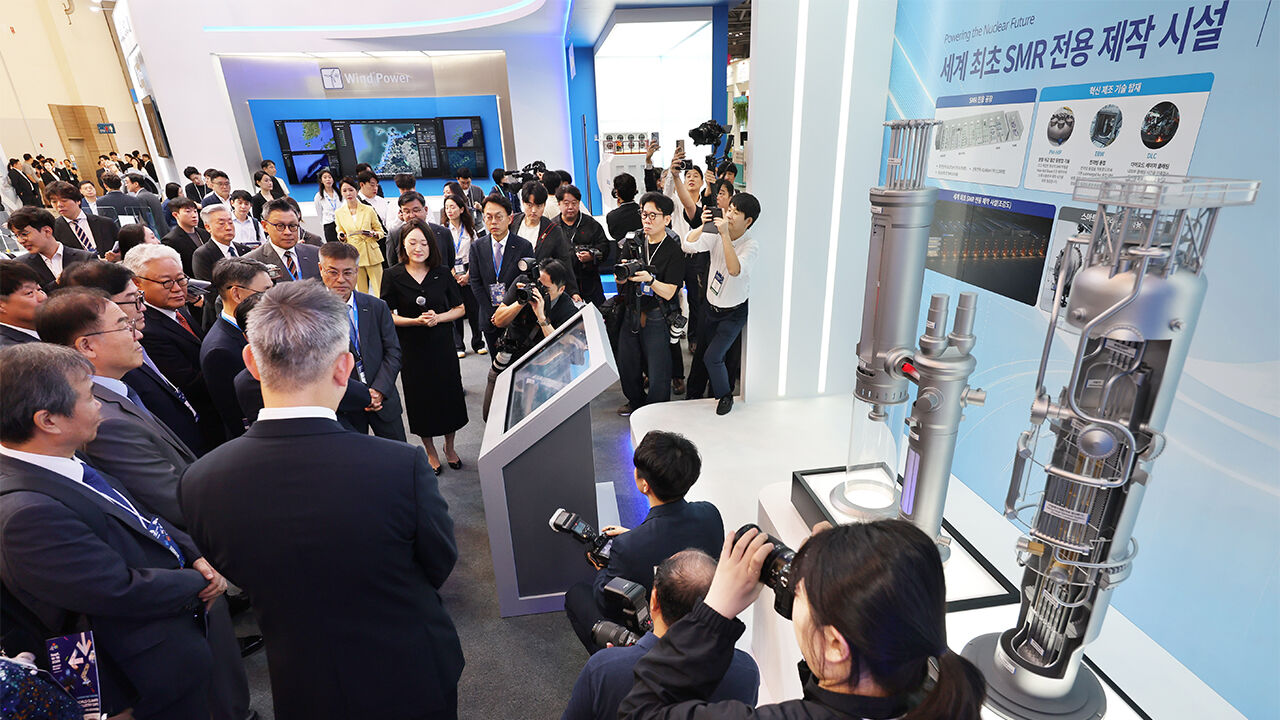
▲ SMR Model
The government has kicked off the commercialization of its "7 Seed" projects, which are being fostered as future growth engines.
For small modular reactors (SMRs), a public-private consultative body involving supply and demand companies will be launched this month to lay the groundwork for commercialization. Meanwhile, the quantum sector will step up support to connect research achievements with startups and business ventures.
The Ministry of Science and ICT (MSIT) announced that it held an "SMR Supply and Demand Company Meeting" at the conference room of the National Science and Technology Advisory Council in Gwanghwamun, Seoul, today (October 1).
SMRs are expected to be utilized for various purposes, including not only onshore power generation, but also supplying process heat for the steel and petrochemical industries, serving as marine propulsion power sources, and powering floating nuclear power plants.
The meeting was attended by government and research officials, as well as SMR demand companies such as POSCO E&C, Lotte Chemical, HD Hyundai Heavy Industries, Samsung Heavy Industries, and Hanwha Ocean, alongside SMR supply companies such as Doosan Enerbility, Hyundai Engineering & Construction, Samsung C&T, and Daewoo E&C.
The MSIT reviewed marine SMRs, industrial complex heat demand and supply timelines, and domestic site conditions with the companies.
They also discussed the direction of the SMR system development basic plan, which is scheduled to be established next year.
The ministry shared the results of the launch ceremony for the IAEA's "ATLAS" (Coordinated Research Project on Marine Nuclear Power) initiative held in the United States last August, emphasizing the importance of early participation in shaping international standards and systems necessary for the commercialization of marine nuclear energy.
It also stated that last month's IAEA General Conference confirmed a shift in the focus of the nuclear sector from safety to growth.
In addition, plans for the IAEA Ministerial Conference on Nuclear Power to be held in Songdo, Incheon, from October 27 to 29 were shared, and active participation was requested.

▲ People examining a quantum computer
The MSIT and companies agreed to form a joint public-private consultative body and hold a kickoff meeting within this month.
This afternoon, the MSIT held a meeting at Seoul National University to discuss connecting quantum technology research achievements to startups and business commercialization.
The ministry explained the direction of support policies for quantum companies, and during a panel discussion, experts from academia, industry, and research institutes discussed support measures.
Goo Hyuk-chae, First Vice Minister of Science and ICT, visited the ion-trap quantum computing laboratory at Seoul National University to observe the operation process of a quantum computer combining domestic chips, control devices, and software.
Vice Minister Goo stated, "The 7 Seed projects are core policies preparing for next-generation industries that will lead South Korea 10 to 20 years from now," adding, "It is crucial to lead these efforts to tangible outcomes such as startup creation and commercialization."
(Photo: Yonhap News)
※ Please note: This article was translated by AI and may contain errors.


 Video News
 Video News
 Video News
 Video News
 Video News