
 KOR
KOR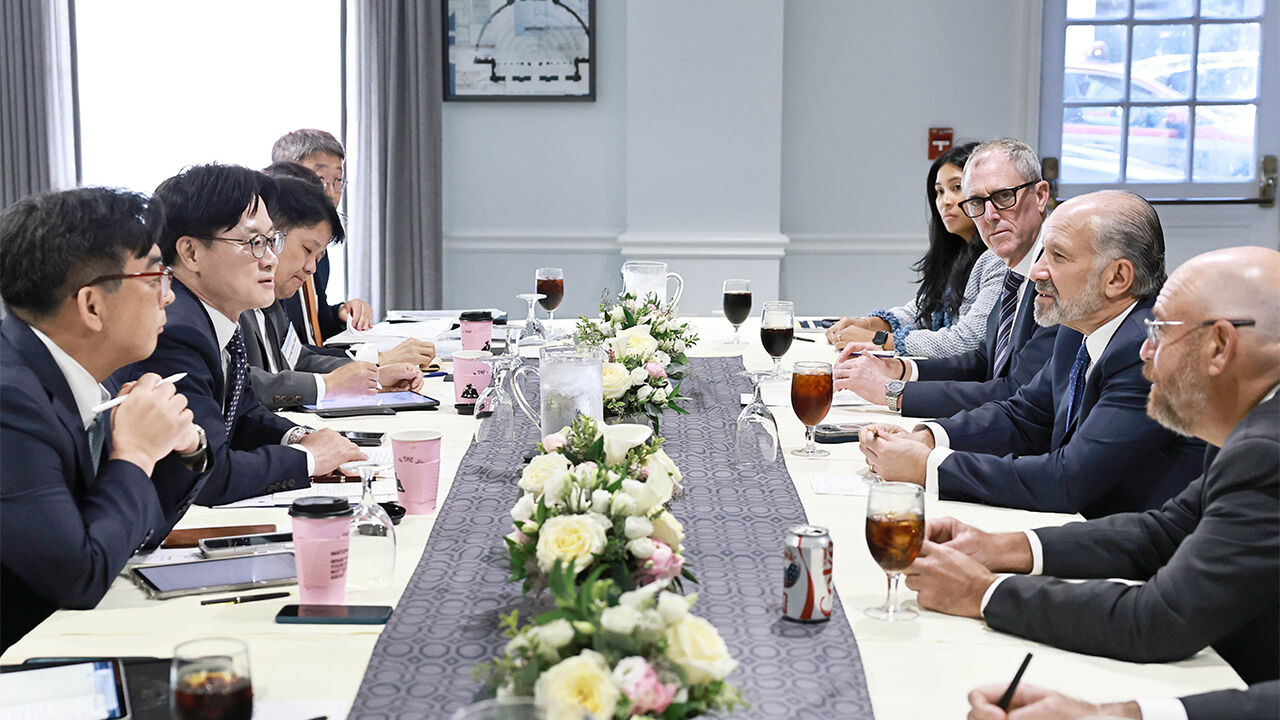
▲ Minister of Trade, Industry and Energy Kim Jeong-kwan meets with the U.S. Secretary of Commerce
Following long and intense negotiations between the South Korean and U.S. governments, the US investment projects have been narrowed down to the energy sector.
According to the South Korea-U.S. strategic investment project promotion plan announced by the governments of both countries today (October 1), the Texas combined-cycle gas turbine power plant project has been confirmed as the official No. 1 US investment project.
As follow-up projects, the construction of eight large-scale nuclear power plants in the U.S. and the pursuit of the Alaska LNG project will be discussed.
The first project, named Project Star, is a project to invest $22.3 billion to construct and operate a 6.472-gigawatt combined-cycle gas turbine power plant for AI data centers in the Encinal area of Texas.
The South Korean government will fund 100% of the investment, remitting funds to the U.S. side over a period of seven years.
The power plant is structured to directly supply power to nearby data centers, with the goal of starting commercial operation for the first phase in 2029 and achieving full facility operation by 2032.
The project will proceed in a total of three phases, starting with the construction of a 1.952 GW gas turbine power plant to check demand and economic viability, followed by the expansion of highly efficient combined-cycle power generation facilities totaling 4.520 GW.
This project is led by Related Companies, a global real estate development firm, and NextEra Energy, the top U.S. power utility operator. Infrastructure such as land, natural gas, and water is provided by Lewis Energy Group, a Texas natural gas supplier.
The government views the commercial rationality of the project as sufficient and expects to recover $43 billion to $45 billion over the next 20 years.
The government plans to generate profits through a tolling-style power purchase agreement (PPA), where consumers bear the variable costs associated with power generation while the power plant receives a fixed fee based on capacity.
Minister of Trade, Industry and Energy Kim Jeong-kwan stated, "We expect the internal rate of return to be in the mid-15% range," adding, "Fluctuations in gas prices are offset between the electric utility and the gas company. We have ensured a stable cash flow by receiving fixed prices provided by the data center."
He also emphasized that competitive South Korean companies will be able to expand their participation across the board, ranging from power generation equipment, engineering, and construction, to long-term operation and maintenance.
Minister Kim explained that due to a surge in local electricity demand, the project implementation schedule, originally slated for 2030, was moved up and the power plant capacity was increased from 6.2 to 6.3 GW.
In this process, project costs also increased somewhat.
However, the counterpart to sign the long-term PPA has not yet been determined.
When asked whether he received a guarantee from the U.S. that it would ensure a PPA is signed with Big Tech or anyone else at an advantageous time, Minister Kim replied, "Yes. The U.S. plans to actively arrange it."
Regarding the nuclear power project, named Project Power, the two sides agreed on the South Korea-U.S. Nuclear Framework, which involves constructing eight large-scale nuclear reactors in the U.S. utilizing $120 billion from the South Korea-U.S. strategic investment fund and outlining directions for inter-firm cooperation.
The framework will be signed by the governments of both countries, Westinghouse, Korea Electric Power Corporation (KEPCO), and Korea Hydro & Nuclear Power (KHNP), and will push for the construction of six Westinghouse-model AP1000 units and two Korean-style APR1400 nuclear units.
The construction method involves building two AP1000 units first, followed by one APR1400 and one AP1000 unit each, and then adding two more AP1000 units.
Although the APR1400 is currently unable to enter the U.S. market under a settlement agreement signed by companies from both countries last year, it was decided to amend the settlement agreement to permit the construction of two units through US investment.
Both countries will invest up to $30 billion per two nuclear reactors, and even if this is exceeded, there will be no additional costs from the South Korea-U.S. strategic investment fund.
Even if contingency funds are not used, they will be included in the US investment amount.
Both countries also discussed a plan to disburse up to $10 billion first by the end of the year to secure long-lead items that take a long time to order and manufacture.
However, as the framework discusses cooperation at a broad level, the final implementation of individual nuclear power projects will be decided after going through elaboration, commercial rationality reviews, and National Assembly reporting procedures.
As the commercial viability of the Alaska LNG project, Project North, has not yet been guaranteed, the two countries reached an agreement at the level of initiating project reviews.
If the project is pursued, the U.S. has promised to create favorable participation conditions for South Korean companies, including tariff reduction benefits for related equipment such as steel.
In addition, it decided to guarantee long-term LNG supply contracts under economically viable conditions and grant South Korea priority access to the LNG produced from the project.
The investment scale is also expected to be scaled down from the $67 billion previously proposed by the U.S. to between $50 billion and $60 billion.
U.S. Secretary of Commerce Howard Lutnick stated on this day that South Korea will invest more than $50 billion in the Alaska LNG project.
The government's stance is that the project will be pursued only when commercial rationality is confirmed, and under no circumstances will the total strategic investment amount exceed $200 billion.
Minister Kim stated, "When (the U.S.) proposed the project scale back to us, it was discussed that it would be reduced to fit that (the $200 billion cap)."
(Photo: Provided by the Ministry of Trade, Industry and Energy, Yonhap News)
※ Please note: This article was translated by AI and may contain errors.



 Video News
 Video News

 Video News