
 KOR
KOR
▲ Bank of Korea
Household mortgage rates rose for the fourth consecutive month last month, reaching their highest level since the Legoland crisis.
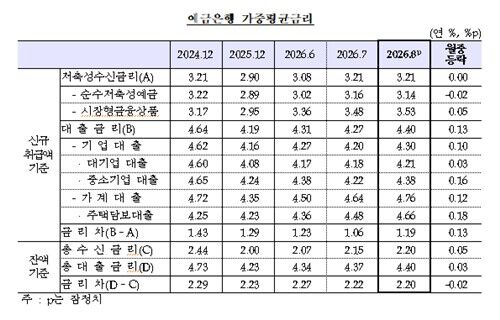
According to the weighted average interest rates statistics released by the Bank of Korea (BOK) today (September 30), the weighted average interest rate on home mortgage loans by deposit-taking banks in August (based on newly handled loans) stood at 4.66 percent per annum, up 0.18 percentage points from the previous month.
Maintaining an upward trend since May (4.42 percent), the rate reached its highest level in 3 years and 9 months since November 2022 (4.74 percent).
The monthly increase last month was the largest in 9 months since November of last year (0.19 percentage points).
Kim Sung-joon, head of the BOK Financial Statistics Team, explained, "Short-term benchmark rates and Bogeumjari loan rates rose, while the proportion of floating-rate loans, which have relatively lower interest rate levels, contracted."
The proportion of fixed-rate mortgages among all home mortgage loans rose 3.4 percentage points from the previous month to 35.3 percent, reversing direction for the first time in 10 months.
The proportion of fixed-rate loans among total household loans also increased by 2.5 percentage points from 21.0 percent to 23.5 percent.
Fixed-rate and floating-rate mortgage rates rose by 0.12 percentage points and 0.18 percentage points to 4.88 percent and 4.53 percent, respectively.
Kim explained, "As the increase in floating-rate loans widened, the rate gap narrowed, and in the past, such cases tended to see an increase in the proportion of fixed-rate loans."
General unsecured loan rates jumped 0.36 percentage points from the previous month to 6.33 percent.
This is the highest level in 2 years and 7 months since January 2024, when it was 6.38 percent.
The BOK explained that the rise was driven by increases in short-term bank debenture benchmark rates, alongside an increasing proportion of loans to mid-to-low credit borrowers.
Jeonse (lump-sum housing deposit) loan rates rose 0.16 percentage points to 4.35 percent.
With both mortgage rates and general unsecured loan rates rising, the overall household loan interest rate also increased by 0.12 percentage points from the previous month to 4.76 percent.
The overall household loan interest rate was the highest since November 2024 (4.79 percent).
Kim projected that loan rates are highly likely to rise in September as well.
He stated, "Market interest rates rose by about 0.20 percentage points up to September 22, and if this trend continues, loan rates are likely to rise as well," adding, "However, the magnitude of the increase will be influenced by banks' loan strategies and other factors."
Corporate loan rates rose 0.10 percentage points to 4.30 percent.
Both large corporate loan rates (rising from 4.18 to 4.21 percent) and small and medium-sized enterprise (SME) loan rates (rising from 4.22 to 4.38 percent) increased.
Kim said, "For SMEs, a base effect acted as rates had fallen the previous month due to special factors such as low-interest policy-driven loans from certain banks."
Across both households and corporations, the total banking sector loan interest rate was tallied at 4.40 percent, up 0.13 percentage points.
The monthly savings deposit interest rate (based on newly handled amounts) stood at 3.21 percent per annum, remaining unchanged from the previous month.
Rates on pure savings deposits, such as time deposits (3.14 percent), fell 0.02 percentage points from the previous month, marking a downward turn for the first time in 5 months since April (2.87 percent).
Rates on market-based financial products, such as bank debentures and certificates of deposit (CDs) (3.53 percent), rose 0.05 percentage points to 3.53 percent.
Kim explained, "There was a fluctuation because a large scale of low-interest time deposit funds flowed into a specific bank last month."
The difference between deposit and lending rates based on newly handled amounts at banks—namely the loan-deposit spread (1.19 percentage points)—increased by 0.13 percentage points.
This is the first time the loan-deposit spread has widened in 7 months since February (1.43 percentage points).
The loan-deposit spread based on outstanding balances (2.22 percentage points) narrowed by 0.02 percentage points.
Deposit rates at non-bank financial institutions (based on 1-year time deposits and trust products) all rose, with the exception of mutual savings banks (3.88 percent, down 0.33 percentage points).
Rates at credit cooperatives (3.62 percent), mutual finance (3.39 percent), and Saemaul Geumgo (3.57 percent) rose by 0.06 percentage points, 0.14 percentage points, and 0.09 percentage points, respectively.
Lending rates also fell by 0.28 percentage points at mutual savings banks (10.23 percent), while rising by 0.12 percentage points, 0.32 percentage points, and 0.02 percentage points at credit cooperatives (5.28 percent), mutual finance (4.93 percent), and Saemaul Geumgo (5.17 percent), respectively.
(Photo provided by Bank of Korea, Yonhap News)
※ Please note: This article was translated by AI and may contain errors.


 Video News
 Video News
 Video News
 Video News
 Video News