
 KOR
KOR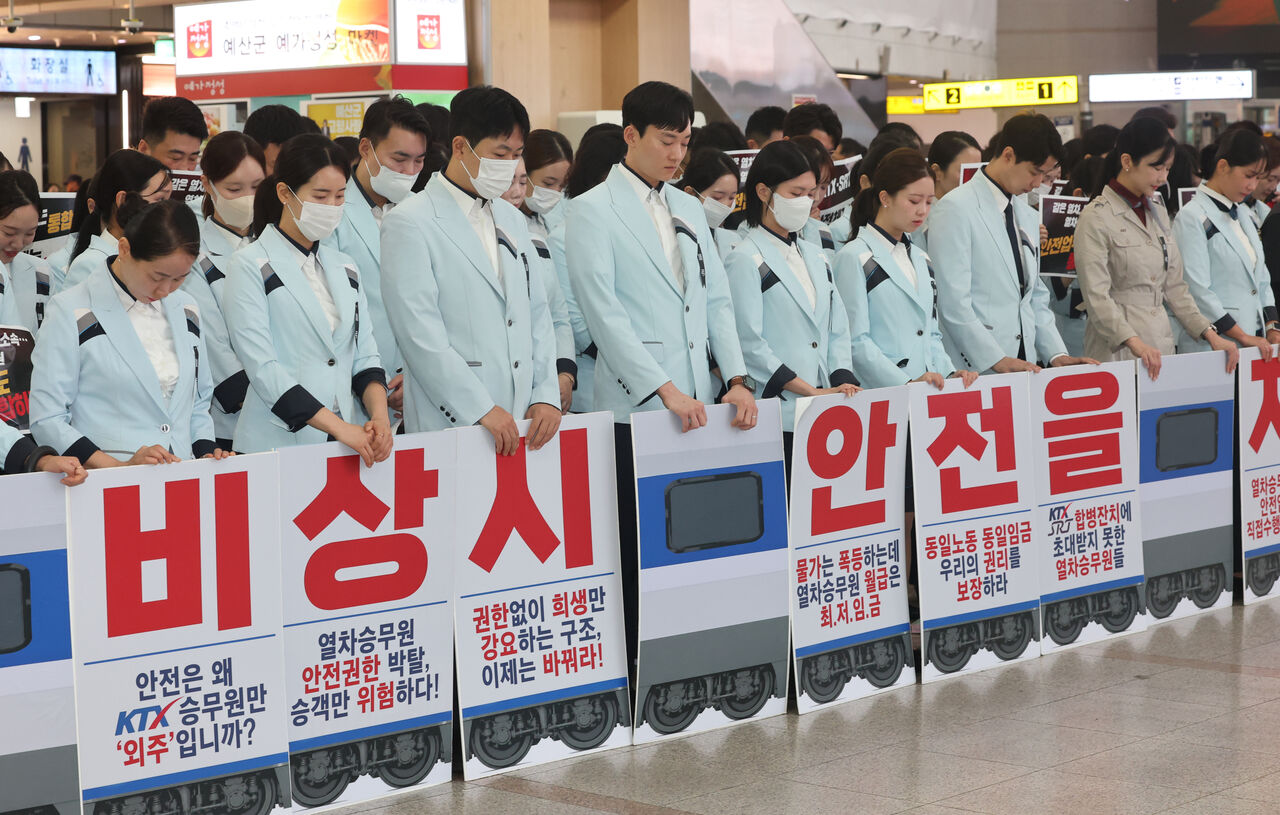
▲ Railway train crew members observe a moment of silence for an employee who died during a shunting operation at Uiwang Station
To prevent a repeat of the Uiwang Station accident, measures will be taken during shunting operations—which involve connecting and disconnecting railway cars—to minimize workers riding on the outside of freight cars and being exposed to danger zones on tracks, while utilizing technologies such as rear cameras and wireless controls to allow workers to check and guide train movements from safe locations.
The Ministry of Land, Infrastructure and Transport announced on September 29 that it is pushing forward with the "Railway Shunting Operation Safety Reinforcement Measures" containing these key provisions.
This action follows a series of accidents over the past decade related to shunting operations, which resulted in three deaths and seven injuries, including an incident on August 29 when an employee of Korea Railroad Corporation (KOROL) was crushed to death by a train while conducting freight car shunting operations at Uiwang Station on the Gyeongbu Line.
Shunting operations are carried out an average of about 1,370 times per day (771 freight, 599 passenger) across 115 stations nationwide, with 41.4% of all operations involving workers riding on vehicles.
The Ministry concluded that past accidents occurred because workers rode on the outside of freight cars during vehicle backing maneuvers where it is difficult for engineers to secure visibility, or worked under conditions of insufficient communication with engineers and local control. Consequently, the Ministry decided to improve existing work methods in which workers directly checked rear conditions and routes near vehicles and tracks.

In unavoidable cases such as long-distance movement, procedures will be strengthened so that workers board the inside of the locomotive, or vehicles are moved only after the engineer and worker confirm each other's completion of boarding and alighting.
In addition, workers' walking routes, switch operation points, and vehicle connection and disconnection points will be clearly marked, and safety fences and lines will be installed.
Furthermore, the Ministry plans to automate 174 switch points across 19 stations by December 2027 to reduce tasks where workers directly handle switches within the tracks.
Along with this, detachable rear cameras will be installed on vehicles so that rear paths and obstacles can be checked in real time from safe positions.
The rear cameras are scheduled to begin pilot operations at Obong Station in November before being expanded.

Taking into account shunting volumes and operational difficulty, wireless control shunting systems will be sequentially introduced to 10 locations across 8 out of 16 freight stations equipped with dedicated shunting locomotives by July 2027. A wireless shunting system is also scheduled to be introduced to Uiwang Station, where last month's accident occurred, by the first half of 2028.
Additionally, artificial intelligence (AI)-based CCTVs will be increasingly introduced along tracks starting in the first half of 2027 to build a risk prediction system, alongside the introduction of wearable vests and hands-free wireless microphones to assist communication.
In other efforts, management responsibilities for station masters and other managers will be strengthened, and the implementation of these measures will be intensively inspected through Ministry of Land, Infrastructure and Transport railway safety inspectors.
Kim Tae-byung, Director General for Railway Policy at the Ministry of Land, Infrastructure and Transport, stated, "These measures focus on changing the work method where workers had to go directly to dangerous spots to check things themselves," adding, "We will actively spread best practices whose effectiveness has been proven in the field to other workplaces, and continuously inspect and supplement whether the measures actually work during actual work processes, leading to safety improvements that can be felt on the ground."
(Photo provided by Ministry of Land, Infrastructure and Transport, Yonhap News)
※ Please note: This article was translated by AI and may contain errors.




 Video News
 Video News
 Video News