
 KOR
KOR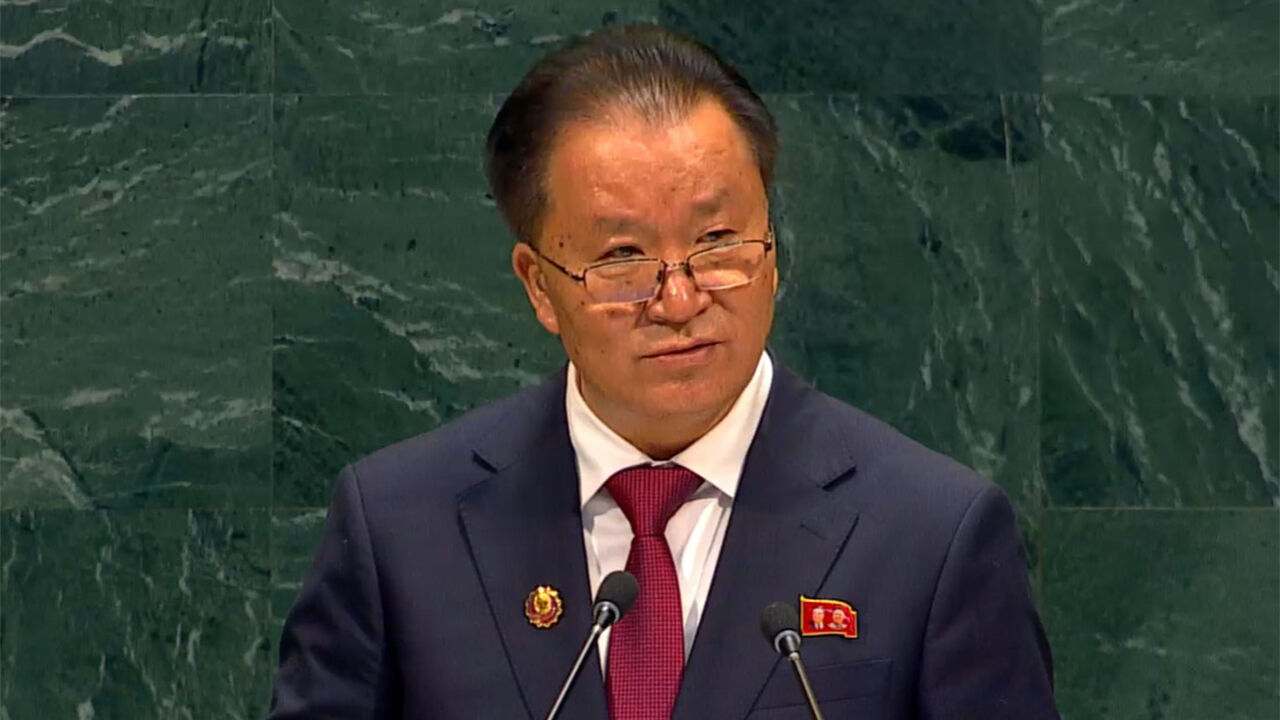
▲ Kim Son-gyong, North Korea's Vice Minister of Foreign Affairs
Kim Son-gyong, North Korea's vice minister of foreign affairs, reaffirmed on September 28 (local time) that the country's status as a nuclear weapons state is "irreversible under any circumstances and by any means," according to her UN General Assembly speech.
Speaking during the general debate of the 81st session of the UN General Assembly at UN Headquarters in New York, Vice Minister Kim stated that the nuclear deterrent possessed by the Democratic People's Republic of Korea is an "absolute force and an irresistible power to defend its sovereignty, safety, and peace from external aggression and threats."
She added, "The reason why physical conflicts are avoided and security is maintained in the Korean Peninsula region is because we possess a powerful war deterrent and are thoroughly managing the hostile forces' intent to use armed force."
The remarks serve to repeatedly rationalize the justification for possessing nuclear weapons.
While Kim did not directly mention North Korea-U.S. dialogue during her speech, she appeared to re-emphasize the Kim Jong-un regime's stance that denuclearization can never be a subject of discussion in the first place.
"We will remain more faithful to our mission as a nuclear weapons state by strictly controlling and managing all sorts of threats imposed from the outside through overwhelming might, thereby firmly safeguarding our national sovereignty and fundamental interests and guaranteeing peace and security in the region and the world," Kim said.
Kim also strongly protested against joint military exercises led by the U.S. military.
Mentioning the South Korea-U.S. joint exercise "Ulchi Freedom Shield," she criticized the U.S. for developing military cooperation with South Korea and Japan into a more aggressive military alliance—including nuclear weapon components—targeting North Korea.
"(The U.S.) is conspiring with its allies to revise and update nuclear war scripts while continuously cultivating and mastering their execution capabilities," she said.
She particularly sharpened her criticism against South Korea's push to acquire nuclear-powered submarines.
"The current military trend, in which the U.S. approves and actively promotes Seoul's ambition to acquire nuclear submarines while deploying various equipment such as state-of-the-art missiles and drones to the Korean Peninsula and surrounding areas, makes the already unstable regional security situation even more vulnerable," she criticized.
Regarding recent military trends such as Japan's test-firing of long-range cruise missiles, she claimed, "A primary war criminal state that inflicted indescribable pain and disaster on humanity in the last century is taking advantage of the chaotic international situation to unpresedentedly accelerate its re-militarization—including revising its pacifist constitution, reorganizing military organizations, and building up armed forces—thereby bringing the drums of war to the entire region."
She added, "Japan's ambition to engage in the full-scale development and possession of long-range offensive weapons runs completely counter to the meaning of a defeated nation."
Meanwhile, attention focused on whether North Korea would release related messages as U.S. President Donald Trump has openly expressed his willingness to talk with North Korean leader Kim Jong-un, but no specific remarks were made that day.
Earlier, President Trump also did not include any messages regarding the resumption of North Korea-U.S. dialogue in his UN General Assembly address.
Kim also emphasized the need for UN reform.
"Reforms should not be centered around a specific country, but rather the wills and interests of everyone must be represented equally," she said. "The era when a single country unilaterally imposed its will on the world and dominated international politics has come to an end forever."
She also repeatedly demonstrated confidence in the "self-reliance" stance despite internal and external threat factors.
"Although numerous challenges and difficulties lie ahead due to the anti-humanitarian maneuvers of forces that do not welcome our development or even our survival, no matter how the situation changes, we will surely achieve everything we aim for with our own strength," Kim said. "This is a confidence shared by all our people."
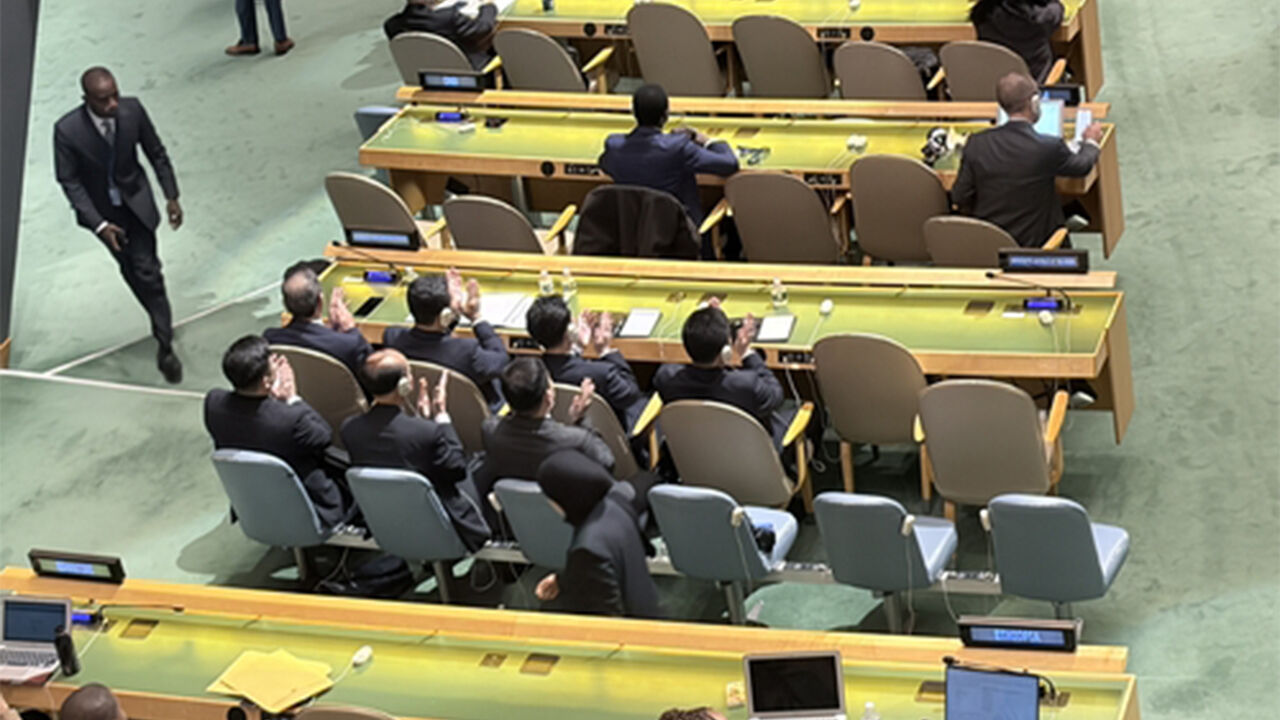
At this time, officials from the North Korean permanent mission, including Permanent Representative to the UN Kim Song, applauded in the venue, while there was no response from delegations of other countries.
A small number of officials from the South Korean, U.S., and Japanese delegations remained in their seats while Vice Minister Kim was speaking.
This is the second consecutive year, following last year, that Vice Minister Kim has delivered a UN speech.
Following the breakdown of the Hanoi North Korea-U.S. summit in 2019, North Korea did not dispatch high-level delegations to the UN General Assembly until 2024.
In the meantime, Ambassador Kim Song delivered the UN General Assembly keynote speech, but with Vice Minister Kim's attendance last year, North Korea resumed sending high-level delegations for the first time in seven years.
After the general debate concluded that day, a battle of words broke out among North Korea, China, and Japan over Japanese Prime Minister Sanae Takaichi's demand to delete the "enemy state clauses" from the UN Charter.
The enemy state clauses were provisions that allowed victorious nations of World War II to take military action without permission from the Security Council or a declaration of war to prevent defeated nations like Germany and Japan from staging a military resurgence.
Exercising its right of reply, the Japanese side stated, "Japan's defense capability is at the minimum level necessary for national security, and it also adheres to the three non-nuclear principles," refuting the claim that Japan is pursuing military superpower status once again.
In response, the North Korean side also took the floor to refer to Japan once again as a "war criminal state," claiming that it is "accelerating its transition into a war nation."
China also stated through its right of reply that "Japan's new militarism is spreading at a worrisome pace" and that it "firmly opposes the deletion of the enemy state clauses."
(Photo: UN Web TV capture, Yonhap News)
※ Please note: This article was translated by AI and may contain errors.




 Video News
 Video News
 Video News