
 KOR
KOR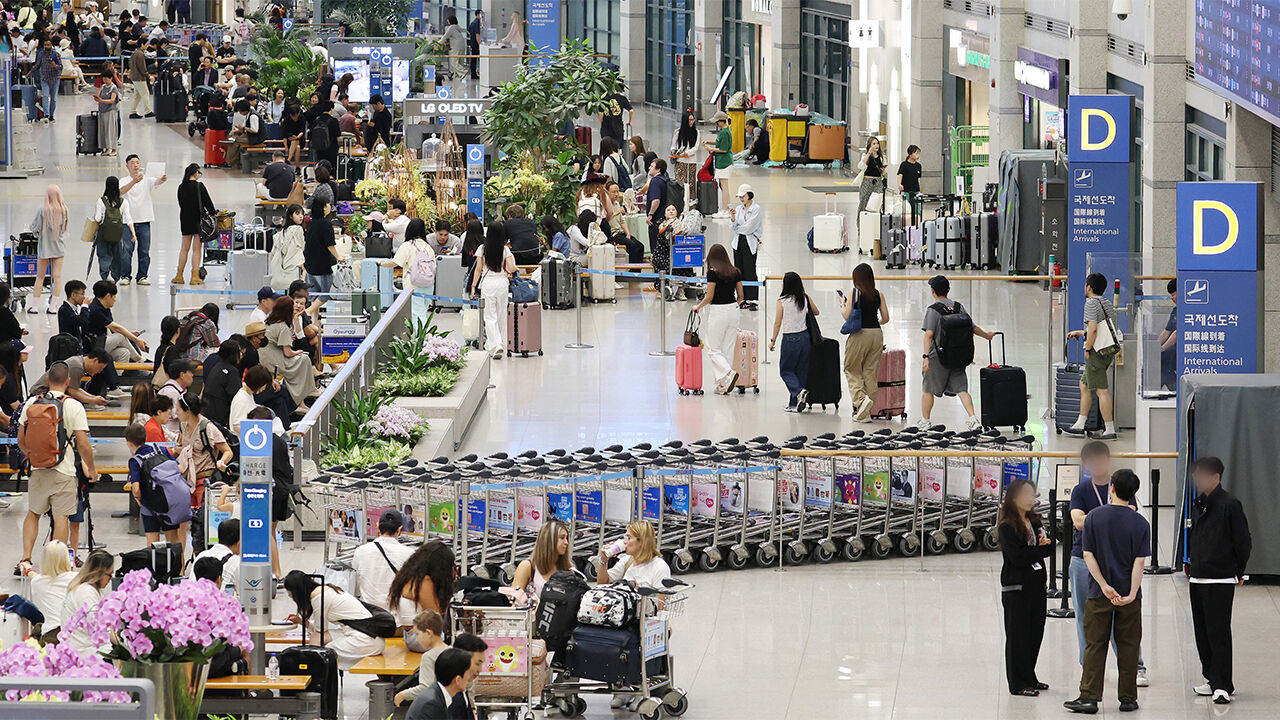
▲ Incheon International Airport
Despite travel sentiment being dampened by high oil prices this year, international air passenger traffic has increased by about 10% compared to last year.
This growth is attributed to a significant increase in travelers on Japan and China routes driven by the weak Japanese yen and visa-free policies, as well as an increase in transfer demand transiting through Incheon Airport due to the impact of the Middle East war.
According to statistics from the Ministry of Land, Infrastructure and Transport's Aviation Portal Information System on September 26, international passengers from January to August this year reached 68,435,000, a 9.8% increase from 62,315,000 during the same period last year.
The number of international flights increased by 6.6% to 384,700.
By region, passenger traffic on Japan routes rose 20.3% to 21,310,000, while China routes saw a 23.0% increase to 13,615,000.
The combined passenger increase on the Japan and China routes stood at 6,141,000, which is comparable to the overall international passenger increase of 6,120,000.
Passengers on these two routes accounted for 51.0% of the total.
The weak yen supported travel demand for Japan, while the visa-free entry policy influenced travel to China.
In particular, while flight operations on China routes increased by 7.9%, passenger numbers surged by 23.0%, showing a recovery in demand that far exceeded the increase in supply.
The aviation industry believes that as the Chinese government discouraged visits to Japan amid deteriorating China-Japan relations, more Chinese tourists chose to visit South Korea instead of Japan.
In contrast, the decline in passenger traffic on Southeast Asian routes was pronounced.
Vietnam routes, ranking third after Japan and China, dropped 5.1% from the same period last year to 6,626,000 passengers.
Routes to the Philippines and Thailand fell by 13.7% to 2,501,000 and 13.0% to 2,343,000, respectively.
An industry official stated, "As the burden of fuel surcharges grew following soaring international crude oil prices, travel demand shifted from Southeast Asia, which requires a 4-to-6-hour flight, to Japan and China, which are 1 to 3 hours away. Airlines also reallocated their supply centering on Japan and China routes, which offer high load factors and profitability."
In fact, flight operations from January to August this year decreased by 6.6% for Vietnam, 9.3% for Thailand, and 17.5% for the Philippines.
However, despite rising fuel surcharges, long-haul routes to the Americas and Europe showed growth.
Passenger traffic on Americas routes increased by 8.2% to 4,961,000, and Europe routes grew by 9.3% to 3,478,000.
While fixed demand such as business and studying abroad remained steady, these routes absorbed long-haul transfer demand. Following the Middle East war, some traffic heading to Europe from regions like Southeast Asia and Australia via the Middle East shifted to routes transiting through Incheon Airport, according to analysis.
The recovery of direct US-China flights remaining sluggish due to the conflict between the US and China also appears to have influenced the increase in demand traveling from China to the Americas via Incheon.
This trend was clearly reflected in transfer passenger statistics.
International transfer passengers from January to August this year reached 5,982,000, a 20.1% increase from 4,980,000 during the same period last year.
This is more than double the growth rate of total international passengers.
By region, the growth rate of transfer passengers was highest for Europe at 53.0%, followed by Japan at 42.6%, China at 35.8%, and the Americas at 12.8%.
Transfer passengers for the Americas were the highest at 2,020,000.
Certain airlines benefited from the increase in transfers and inbound demand to Korea.
Korean Air's passenger business revenue in the second quarter, when the impact of the Middle East war began in earnest, rose by 451.4 billion won from the same period last year to 2.8479 trillion won.
The company explained that while outbound passenger demand from Korea contracted somewhat due to rising oil prices, transfer demand from the Middle East and inbound travel demand to Korea increased.
In response to growing demand, Korean Air increased flights on North American routes such as Los Angeles (LA), Atlanta, and Vancouver, while also expanding supply on major Japanese routes including Tokyo and Osaka.
Eastar Jet and Jeju Air recently announced plans to launch new routes to China, including Xiamen, Hangzhou, and Guilin.
(Photo: Yonhap News)
※ Please note: This article was translated by AI and may contain errors.


 Video News
 Video News
 Video News
 Video News
 Video News