
 KOR
KOR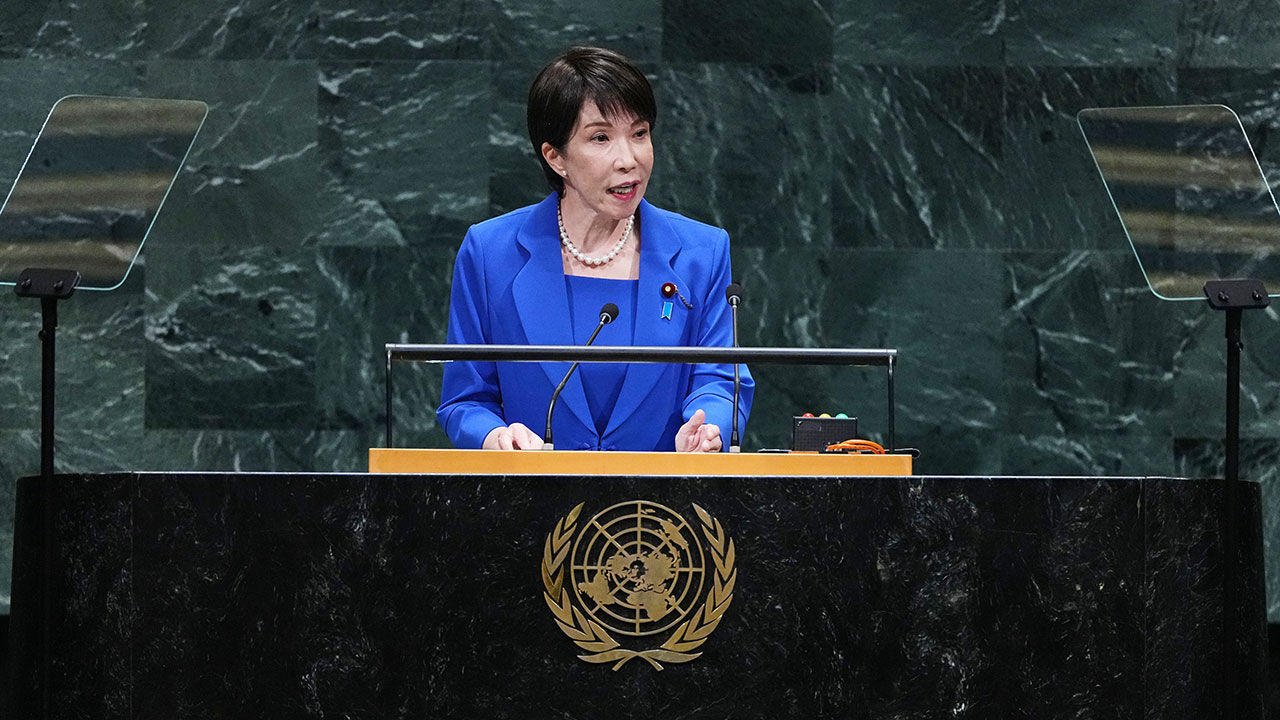
▲ Japanese Prime Minister Sanae Takaichi delivers a speech at the UN General Assembly.
Japanese Prime Minister Sanae Takaichi demanded the prompt removal of the "enemy state clauses," which stipulate military action rights for the founding members of the UN against World War II defeated nations, during her UN General Assembly speech in New York on the 22nd (local time).
According to the Nihon Keizai Shimbun (Nikkei) and other sources, Prime Minister Takaichi, delivering her first UN General Assembly speech since taking office, argued for the deletion of the enemy state clauses in the UN Charter.
The enemy state clauses were regulations that allowed victorious nations of World War II to take military action without authorization from the UN Security Council or a declaration of war to prevent Germany, Japan, and other defeated countries from repeating military provocations.
Following Prime Minister Takaichi's remarks in November of last year hinting at "intervention in a contingency involving Taiwan," China cited these clauses to argue for the legitimacy of military responses against Japan.
In response, Japan has maintained that these clauses have already become obsolete through UN General Assembly resolutions.
Along with the removal of the enemy state clauses, Prime Minister Takaichi also called for UN Security Council reform.
Mentioning the invasion of Ukraine by Russia, a permanent member of the Security Council, she stated that the number of both permanent members—consisting of the five nations of the United States, the United Kingdom, France, Russia, and China—and non-permanent members should be expanded.
Prime Minister Takaichi's demands for the deletion of the enemy state clauses and the restructuring of the Security Council are interpreted as an intention to keep China's growing influence in check amid a confrontational stance with Beijing and to strengthen Japan's international standing aimed at expanding its defense capabilities.
In this context, Prime Minister Takaichi noted, "Japan has consistently contributed to peace and prosperity in the international community as a peaceful nation based on the principle of exclusively defense-oriented policy (exercising defense capabilities only when attacked by another country)."
She also argued that as the only country to have suffered atomic bombings, she considers it her nation's mission to lead efforts toward a "world without nuclear weapons," and that efforts must be made to maintain and strengthen the Treaty on the Non-Proliferation of Nuclear Weapons (NPT) regime, in which both nuclear-armed and non-nuclear states participate.
(Photo: AP, Yonhap News)
※ Please note: This article was translated by AI and may contain errors.


 Video News
 Video News
 Video News
 Video News
 Video News