
 KOR
KOR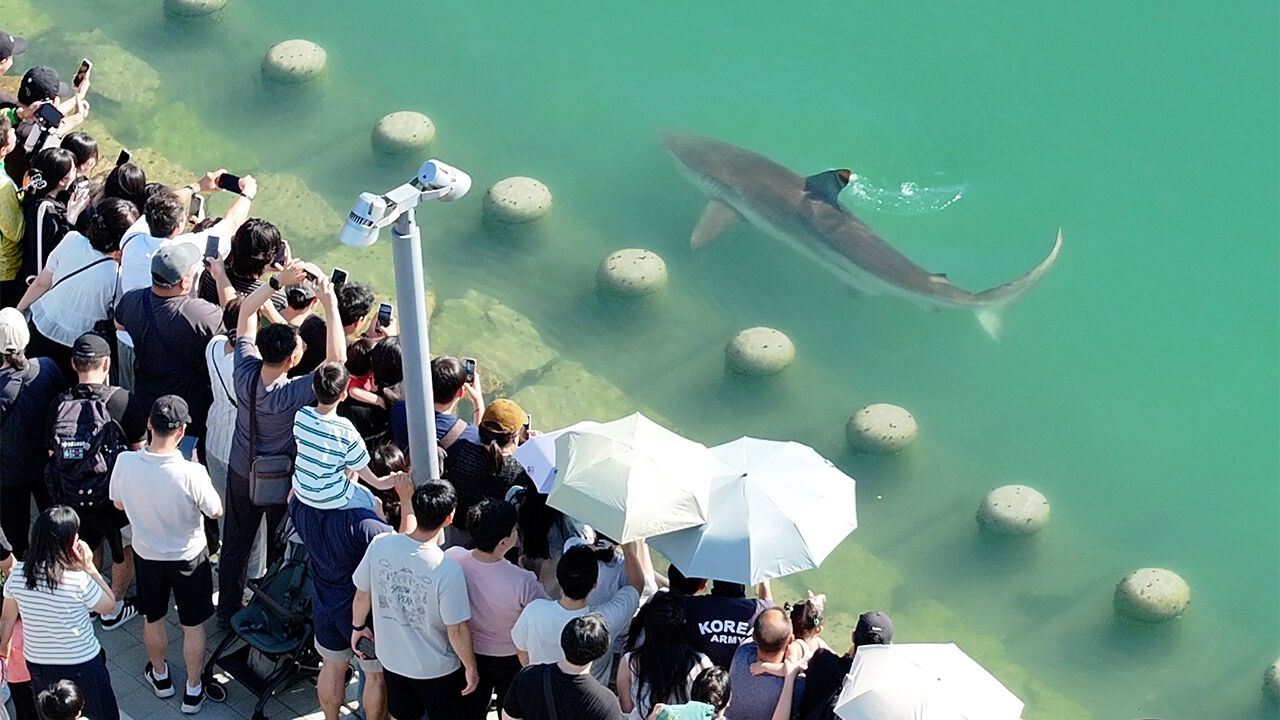
▲ Citizens take pictures of a shark that appeared in the waterway of the waterfront park at Busan Port North Port in Dong-gu, Busan. (Photo: Yonhap News)
Did it follow its prey and lose its way? Or is there a reason it refuses to leave?
Public interest is surging as a shark has been spotted for four consecutive days in the waterway of the waterfront park at Busan Port North Port.
Over the past weekend alone, 19,000 people visited the park, which is four to five times the usual number, and unverified accounts claiming that "even a baby shark was seen" have spread across social media.
The biggest mystery is why the shark continues to circle the same waterway instead of heading out to the open sea.
Choi Yoon, professor emeritus in the Department of Marine Biology at Kunsan National University, interpreted the situation by saying, "It came in chasing prey and failed to find the exit."
He explained that the shark, which had been hunting amberjack or mackerel in the open ocean, followed scattered prey into the artificial waterway and has since been unable to find its way out.
Ji Hwan-sung, a researcher at the National Institute of Fisheries Science, also stated, "Since the waterway itself is a straight line, it could get out by moving a bit further in either direction, but both ends are slightly curved, which seems to make it difficult for the shark to find the exit. Even when we conducted a driving operation at the site for about six hours, it was drawing semicircles or swimming in circles."
Kim Jin-goo, a professor in the Department of Marine Bio-Resource Science at Pukyong National University, cautiously speculates that there might be a reason for the shark to stay.
He noted that sharks have sufficient ability to navigate the open ocean by sensing water currents and scents.
"There are various possibilities, such as a continuous food supply, impending birth, or staying in shallow water due to an injury," Professor Kim explained. "Since this is an unusual situation, we need to directly examine the individual and check its health status to know the exact reason."
The shark was initially estimated by the National Institute of Fisheries Science to be a sandbar shark, but the possibility that it is a dusky shark has also been raised.
Professor Choi drew attention to the fact that the shark in the footage appears to exceed 3 meters in length when compared with nearby structures.
"Adult sandbar sharks grow up to 3 meters, while dusky sharks grow up to 4 meters, and this specimen appeared to be around 3.5 meters long," Professor Choi said. "It cannot be distinguished with the naked eye, and we have to catch it and check its teeth."
Professor Kim similarly stated that it is difficult to distinguish between a sandbar shark and a dusky shark with the naked eye, adding that genetic analysis and other methods are necessary for accurate identification.
On social media, rumors circulated that a small shark about 1 meter long was seen next to the large shark.
However, it has not been confirmed whether it was an actual shark or an offspring born to this shark.
Still, Professor Choi noted that the North Port waterfront park does not seem like a suitable location for giving birth.
He implied that sharks give birth in places rich in shellfish where their pups can feed and grow, making it unlikely that this artificial waterway was intentionally chosen.
However, Professor Choi did not entirely rule out the possibility that a pregnant individual might have accidentally entered the waterway and given birth.
Researcher Ji also lowered the possibility, stating, "Sharks give birth to about 7 to 20 pups at once, but that cannot be said of what is currently identifiable."
Regarding whether rescue efforts are necessary, Professor Choi opined that human intervention should be considered if signs appear of the shark slowing down or losing energy.
He explained that there is no need to view the shark as facing immediate starvation just because it has been lingering for four days.
According to him, once a shark consumes a large meal, it can survive for about a week without eating.
What he pays attention to is not the number of days spent there, but how it swims.
He stated that they should observe whether it continues to swim actively as it does now, and consider measures to guide it out if signs of slowed movement or fatigue emerge.
"Sharks can jump 2 to 3 meters above the water, so forcing an operation can be dangerous," Professor Choi advised. "We should carefully watch its current swimming speed, and if its movements become sluggish over a day or two and we determine there is a risk of mortality, we must intervene."
Researcher Ji said, "We expected it to find its way out on its own, but since things have come to this, we need to guide it out," adding, "While a park waterway with a depth of 3 meters is not an environment where a shark cannot survive, it is not suitable for a long-term stay."
Professor Choi explained that while it is rare for sandbar or dusky sharks to approach and attack humans first, they can become dangerous if provoked.
"Globally, there are two cases where dusky sharks attacked humans, one resulting in minor injuries and the other being fatal," Professor Choi stated. "However, I understand that it is extremely rare for them to approach and attack humans on their own unless provoked first."
(Photo: Yonhap News)
※ Please note: This article was translated by AI and may contain errors.



 Video News
 Video News
 Video News
 Video News