
 KOR
KOR
The initial investigation was flawed, and from that point on, Kim became a "fighting victim." Attending every criminal hearing of her assailant, she gathered information piece by piece as if picking up scraps. However, because she was not a "party to the trial," even gaining access to the case records was not easy. After the criminal conviction of the perpetrator was finalized, Kim filed a state compensation lawsuit to hold the authorities accountable for the botched investigation. In the process, she requested permission from the court and the prosecution to inspect and copy the DNA appraisal report for her jeans—a key piece of evidence pointing to sexual assault—asking that the victim also be allowed to review the case records. However, the document Kim received was almost entirely blacked out, as shown in the photo.
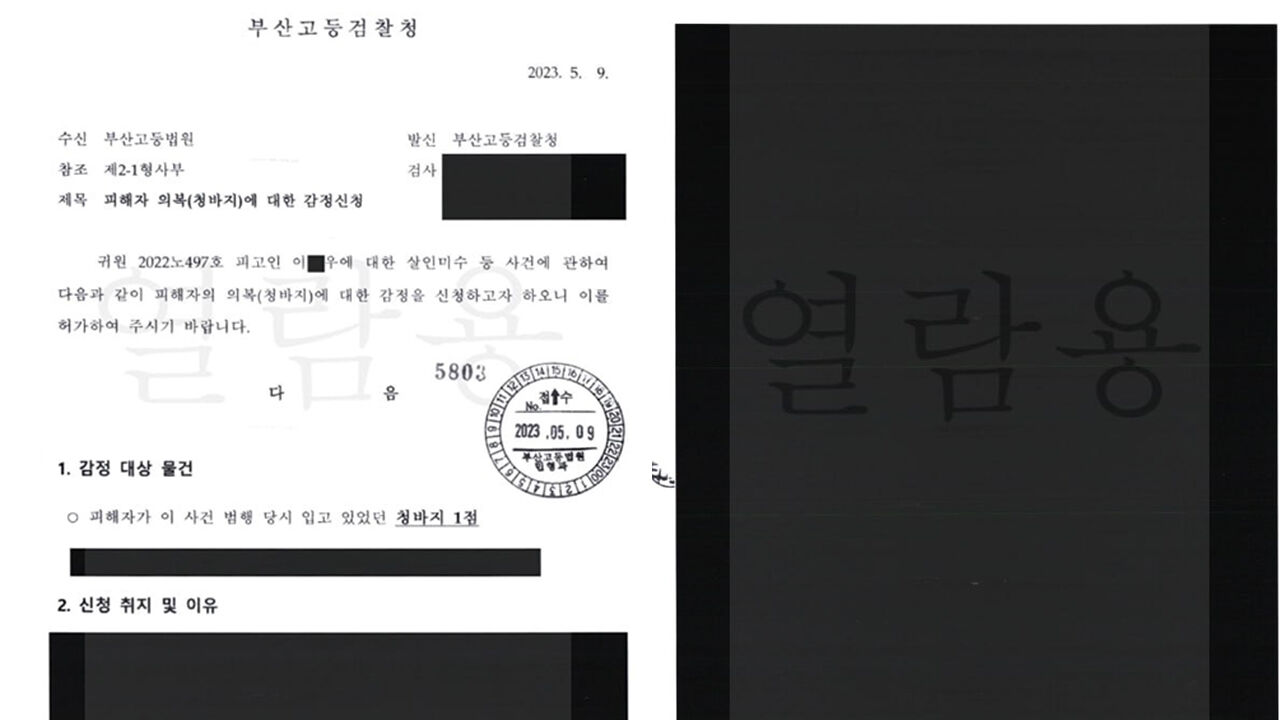
The prosecution, which was storing the investigation records, cited "privacy protection" and "concerns over leaking investigative secrets" as reasons for withholding the appraisal report. However, for Kim, a party to the incident, this was hard to accept. It meant she herself was barred from seeing the results of the investigative agency's DNA testing on her own clothing. Given that she, as the victim, had no reason whatsoever to leak investigative secrets to the outside world, the prosecution's decision to withhold the document was difficult to comprehend.
Only after Kim visited the prosecutor's office in person was she able to obtain the original appraisal report. She was told that the disclosure was granted in accordance with the "Guidelines for the Processing of Inspection and Copying of Case Records." Yet, despite applying the same guidelines, the criteria determining why disclosure is granted in some cases and denied in others remain unclear. This is an ordeal experienced not just by Kim, but by many crime victims in reality.
"At first, we applied for evidence access to the entire criminal trial record of the perpetrator. Yet the prosecution only sent a very small portion, such as the petitions submitted by Kim Jin-ju or documents that had already been disclosed during the trial. They did not provide any secrets related to the investigation at all. Since it was essential evidence for the state compensation lawsuit, we repeatedly requested the DNA appraisal report, and that was the response we received. Aside from the documents Kim went to the prosecutor's office to obtain in person, most of the investigation records were ultimately never provided.
It is not easy for victims to access investigation-related records while a criminal proceeding is ongoing. In this case, we requested the records from the prosecution while preparing for the state compensation lawsuit after the criminal trial was completely finished. But the reality is, if the prosecution decides not to hand over records, it is very hard to overturn that decision." — Attorney Han Joo-hyun, legal counsel for Busan roundhouse kick victim Kim Jin-ju
Victims Are Not "Parties to the Trial"... Access to Key Records Remains Difficult
This is because the formal parties to a criminal trial are solely the prosecution, the defendant, and the court.
"To anyone looking at it, it feels so strongly like 'the state treats us like baggage.' Victims have poor access to evidence. We can't even ask the right questions because we don't know anything. But in the end, what do investigative agencies think of [victims]? They just think victims are appealing like this because they're having a hard time. In the end, we become people who have no 'logic.' We can't ask proper questions from the start. All we can ultimately say in our petitions is just 'I'm suffering.'" — Kim Jin-ju, victim of the Busan roundhouse kick incident
South Korea's criminal justice procedure has long focused on protecting the rights of the defendant against the state's formidable penal power. In contrast, crime victims, despite being the parties directly affected by the crime, have not been recognized as formal parties to criminal litigation, leaving them without an adequate role in the proceedings. This is why calls are mounting to reexamine whether it is truly justifiable to restrict victims' opportunities to participate in the investigation and trial process.
"The criminal procedure is a process where the state punishes the defendant. While the state bans individuals from 'private retribution,' it monopolizes punitive authority and assists in remedying victims' rights. In reality, however, victims' rights are far too weak. As the judicial system has been built around the human rights of defendants, even the evidence that victims must obtain to seek relief is subject entirely to the discretion of the courts and the prosecution regarding whether to 'give it or not,' leading to substantial difficulties." — Attorney Oh Ji-won, Law Firm Law & Healing
Both Notice and Inspection Left to Discretion: "Clear Standards Must Be Established First"
Victims Sidelined from Key Records: "The State Is Telling Us Not to Know"
Even words of comfort suggesting it was time to return to everyday life felt like a second wound to crime victims. Kim Jin-ju, too, had to give up her livelihood and follow every hearing.
Because no one had "properly" informed Kim Jin-ju.
"You either have to attend every single hearing or search your case number every minute and second of every day. That's why we can't return to daily life. Because we don't have access. If the victim's side received notifications about things like whether the perpetrator submitted a letter of remorse, that would be one thing, but because we can't know at all, the system forces us to search all day long. And then they ask us how we can't just return to daily life? In the end, victims give up too. The state is basically telling us, 'Don't know about this.'"
During the interview, Kim Jin-ju used the word "tilted." No one—neither lawyers nor journalists—is immune to becoming a victim of crime, yet the investigation and trial process that crime victims face sounded less like the scales of justice and more like a tilted seesaw that is heavily stacked against victims.
"We [the victims] are not the main cast, but extras. We are treated as lacking credibility, and whenever we request something, we are always rejected. They say we aren't parties to the case. Victims can't get information anywhere they turn. In such a situation, how can a victim speak 'rationally'? I don't think anyone truly understands how devastating it feels to be rejected everywhere."
Speaking Out Outside the Courtroom: "The Victim Is Also Playing the Media"
Kim Jin-ju's fight against the state has reached a conclusion. On February 13, the Seoul Central District Court acknowledged the investigative agency's flawed investigation and ordered the state to pay 15 million won in damages. It came 3 years and 8 months after the incident occurred. The Ministry of Justice gave up an appeal and apologized to the victim. This was made possible because Kim refused to give up and continued speaking out outside the courtroom for 3 years and 8 months.
The perpetrator in the Busan roundhouse kick incident is currently on another trial for retaliatory intimidation against the victim. On September 9, about a week after a phone interview with Kim Jin-ju, the presiding judge of the 2nd Criminal Division of the Busan High Court questioned during witness examination whether the victim had also engaged in considerable media play throughout the trial. The judge added that the case felt as though it was becoming politicized.
Victims began speaking out outside the courtroom because there was no place for them to speak inside it. Even though supplementary investigations prompted by the victim's appeals led to the assailant's charges being upgraded, and the court also held the state liable for the botched investigation, the bench still expressed a negative nuance regarding the victim's refusal to "stay silent." This vividly reflects the grim reality that crime victims face in South Korean society.
※ Please note: This article was translated by AI and may contain errors.


 Video News
 Video News


