
 KOR
KOR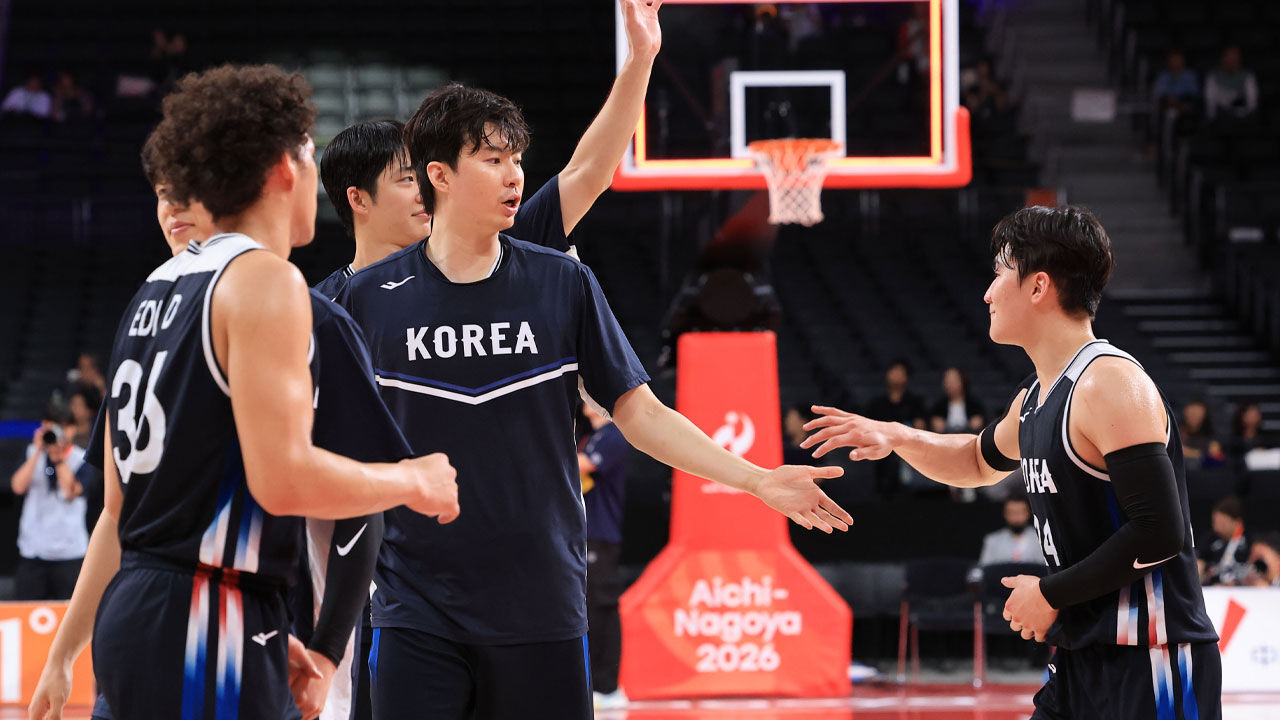
▲ South Korean players celebrate their victory against Jordan in the quarterfinals of the men's basketball tournament at the 2026 Aichi-Nagoya Asian Games held at the Aichi International Arena in Nagoya, Japan, on September 16. (Photo: Yonhap News)
The surging South Korean men's basketball national team is set to face its formidable nemesis, Iran, in the final hurdle toward reclaiming the Asian title for the first time in 12 years.
Led by head coach Nikolajs Mazurs (Latvia), the national team will square off against Iran tomorrow (September 18) at the Aichi International Arena in Nagoya, Japan, with a ticket to the Asian Games final on the line.
Iran is ranked 28th in the International Basketball Federation (FIBA) world rankings, placing them ahead of South Korea, which sits at 57th, in objective indicators.
According to records from the Korea Basketball Association, South Korea holds a 13-10 advantage in the all-time head-to-head matchup record between the two countries' senior national teams.
Notably, South Korea holds fond memories of defeating Iran 79-77 in the final of the 2014 Incheon Asian Games 12 years ago to claim the gold medal.
That also marks the most recent Asian Games gold medal captured by South Korean men's basketball.
However, the glory stopped there.
Since that victory in the Incheon final, South Korea has struggled against Iran, suffering six consecutive losses.
In particular, Iran has blocked South Korea's path at every major junction in recent Asian Games.
South Korea lost 68-80 in the semifinals of the 2018 Jakarta-Palembang Games and stumbled 82-89 in the 5th-to-8th-place classification match at the previous Hangzhou Games, swallowing the bitter pill of its lowest-ever finish at 7th place.
However, the Iranian squad participating in this tournament lacks the heavy presence of its past "full-strength" eras.
Key pillars who played crucial roles in the FIBA World Cup qualifiers and other tournaments, such as Behnam Yakhchali, Mohammad Amini, and Sina Vahedi, are largely absent.
Indeed, Iran suffered a 53-59 upset loss to Qatar in its opening match of the group stage.
Afterward, they edged Chinese Taipei 72-69 in a nail-biting thriller, defeated Jordan 81-68 to finish the group stage at 2-1 and top Group B, and then brushed past Bahrain 79-74 to reach the quarterfinals.
This upcoming semifinal showdown boils down to a clash between explosive firepower and a solid defensive organization.
Having swept all four matches from the group stage to the quarterfinals, South Korea boasts a ferocious offense.
Following matches with 102 points against Indonesia and 100 points against Japan, they poured in 114 points in the quarterfinal against Jordan, surpassing the 100-point mark in three consecutive games.
They have averaged 99.5 points across their previous four games with a field goal percentage nearing 50%.
Conversely, Iran averages 71.3 points per game with a 38% field goal percentage. While their firepower is lower, they excel at suffocating opponents through tight defense and dominance on the boards.
They have clamped down so tightly in the paint during this tournament that they have allowed opponents an average of only 5.5 offensive rebounds per game (compared to South Korea's 11.8).
Their perimeter defense has also been tenacious, holding opponents to a 27% 3-point shooting percentage (South Korea is at 32%).
The momentum of the South Korean national team ahead of the showdown is at its peak.
Forward Choi Jun-yong (KCC), who missed the group stage due to overseas league schedules, and Yeo Jun-seok (Seattle University), who had been sidelined by injury, joined the team starting from the quarterfinal match, finally completing the final puzzle piece of their roster.
The players' shooting touches have also heated up.
Lee Hyun-jung poured in 28 points, including six 3-pointers, along with 9 rebounds and 5 assists in just 20 minutes of play against Jordan, while Lee Jung-hyun also delivered a stellar performance with 12 points and 6 assists, sinking three perimeter shots.
For South Korea to break its agonizing losing streak against Iran, neutralizing veteran Arsalan Kazemi is expected to be crucial.
Kazemi played the role of a "floor general" to perfection in the quarterfinal against Bahrain, rattling the opponent's defense and creating scoring opportunities for his teammates with 11 rebounds and 10 assists.
If South Korea defeats Iran in the semifinals, they will face the winner of the semifinal match between Japan and China for the gold medal.
(Photo: Yonhap News)
※ Please note: This article was translated by AI and may contain errors.


 Video News
 Video News

 Video News
 Video News