
 KOR
KOR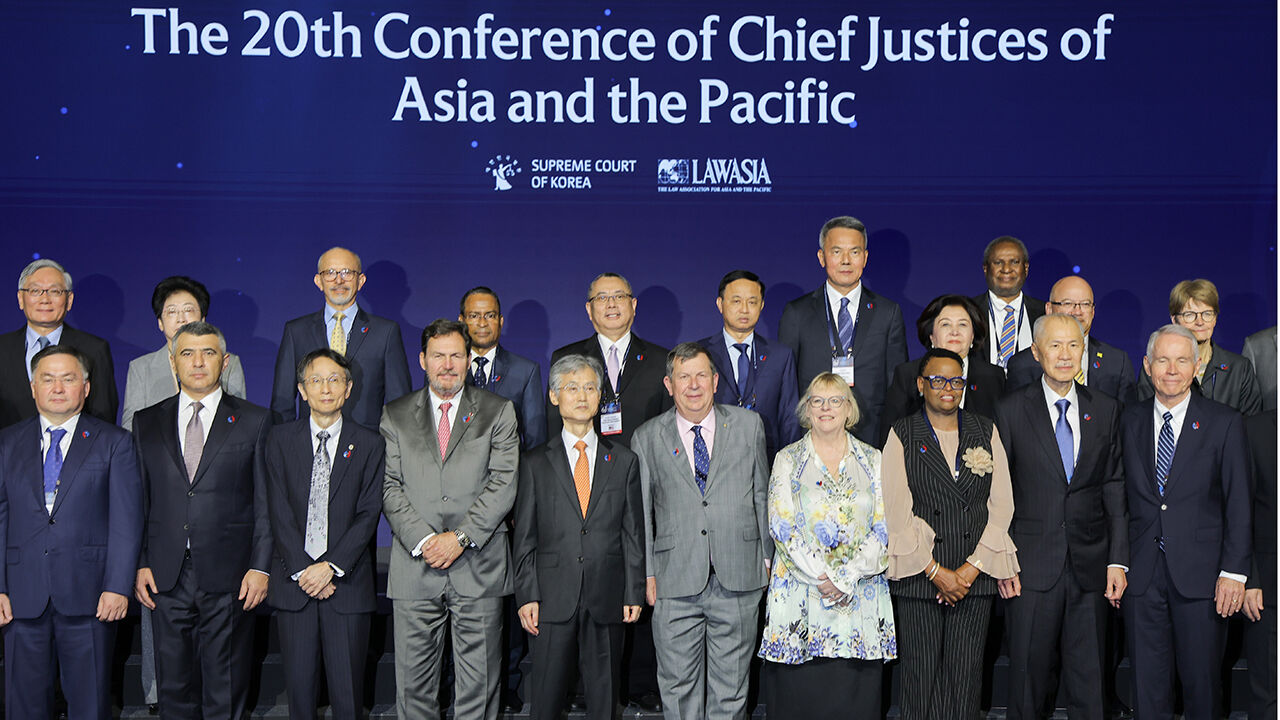
▲ Chief Justice Cho Hee-dae and other attendees pose for a commemorative photo at the opening ceremony of the 20th Conference of Chief Justices of Asia and the Pacific held at the Grand Hyatt Seoul hotel on the 17th.
Chief Justice Cho Hee-dae, who remains in a tense standoff with the presidential office over the re-nomination of a Supreme Court justice candidate, stated that "cooperation between the judiciary, the legislature, and the executive branch must be carried out while guaranteeing the independence of the judiciary."
During his opening address at the 20th Conference of Chief Justices of Asia and the Pacific held at the Grand Hyatt Seoul in Yongsan-gu, Seoul, this morning (the 17th), Chief Justice Cho said, "No matter what challenges we face, the independence of the judicial power must be firmly defended," adding, "This is to enable the judiciary to safeguard democracy and the rule of law and to fulfill its inherent role."
Chief Justice Cho explained, "In many countries, complex political and social disputes are heading to the courts, and the public has increasingly high expectations for the judiciary," emphasizing that "in such situations, the courts must firmly uphold the law and principles."
He added, "All judges must have the courage to adjudicate solely according to law and principle without fear, no matter what difficulties they encounter," and "Chief justices bear a special responsibility to support judges so that they can fulfill these duties."
Chief Justice Cho noted, "As you know well through experience and as chief justices from various countries have emphasized, mutual respect and cooperation between the judiciary, the legislature, and the executive branch are necessary for judicial functions to be performed effectively."
He further stressed, "Such cooperation helps resolve the complex conflicts of modern society.
However, that cooperation must be achieved while respecting the inherent responsibilities of each institution and guaranteeing the independence of the judiciary."
Chief Justice Cho stated, "Maintaining a balance between judicial independence and the cooperation of the three branches while earning public trust is a difficult task," expressing his hope that "by sharing our experiences and insights, we can jointly seek constructive ways to faithfully carry out this responsibility."
The judiciary has maintained a tense relationship with the presidential office over the issue of nominating a Supreme Court justice candidate.
On August 18 of last month, Chief Justice Cho nominated Son Bong-ki, presiding judge of the Daegu District Court, who was one of four candidates recommended by the Supreme Court Justice Recommendation Committee as a successor to former Supreme Court Justice Noh Tae-ak. Ten days later, the presidential office demanded a re-nomination, calling it "a unilateral written nomination without substantive consultation."
While the presidential office's stance hinted at re-nominating someone from the remaining three previously recommended candidates, weight is being placed inside the court on newly forming the Supreme Court Justice Recommendation Committee, citing the Court Organization Act, to restart the candidate recommendation process from the beginning.
The Conference of Chief Justices of Asia and the Pacific is an international meeting where chief justices from Asia-Pacific nations gather every two years to exchange diverse experiences and policies regarding judicial systems and pending issues. This year's event was held on a record scale, attended by chief justices and supreme court justices from approximately 40 countries, including nations outside the traditional Asia-Pacific region.
This marks the third time South Korea has hosted the conference, following 1999 and 2011.
Introducing King Sejong's Hunminjeongeum, Chief Justice Cho also shared, "If only 'I' existed in the world, only 'rice' would be needed and 'law' would be unnecessary, but because 'you,' meaning other people, exist, 'law' is needed."
Furthermore, while introducing the theme of the second session discussing the use of artificial intelligence (AI) in the legal profession, Chief Justice Cho said, "While AI can enhance access to justice and improve the efficiency of judicial procedures, significant questions are also being raised regarding reliability, accountability, and the integrity of judicial judgment," adding, "We face the task of fully utilizing the potential of AI while preserving the fundamental values of judicial justice."
In addition, emphasizing the importance of bonds, Chief Justice Cho introduced a self-written poem from his teens that begins with the phrase, "The joyful sound of a bell strikes my heart."
(Photo: Yonhap News)
※ Please note: This article was translated by AI and may contain errors.



 Video News
 Video News

 Video News